| Record Information |
|---|
| Version | 1.0 |
|---|
| Creation Date | 2016-09-30 22:27:52 UTC |
|---|
| Update Date | 2020-06-04 20:51:39 UTC |
|---|
| BMDB ID | BMDB0000289 |
|---|
| Secondary Accession Numbers | |
|---|
| Metabolite Identification |
|---|
| Common Name | Uric acid |
|---|
| Description | Uric acid, also known as urate or acid, uric, belongs to the class of organic compounds known as xanthines. These are purine derivatives with a ketone group conjugated at carbons 2 and 6 of the purine moiety. Uric acid exists as a solid, possibly soluble (in water), and an extremely weak basic (essentially neutral) compound (based on its pKa) molecule. Uric acid exists in all living species, ranging from bacteria to humans. Uric acid is a potentially toxic compound. Uric acid has been found to be associated with several diseases known as fanconi syndrome, impaired glucose tolerance, and d-lactic acidosis; also uric acid has been linked to several inborn metabolic disorders including atic deficiency and lesch-nyhan syndrome. |
|---|
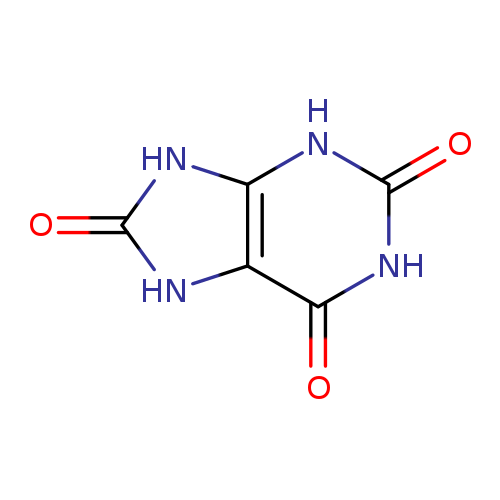
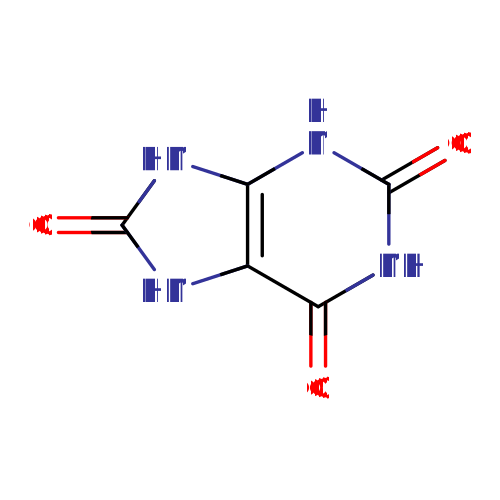
| Structure | |
|---|
| Synonyms | | Value | Source |
|---|
| 2,6,8-Trioxopurine | ChEBI | | 2,6,8-Trioxypurine | ChEBI | | Purine-2,6,8(1H,3H,9H)-trione | ChEBI | | Urate | ChEBI | | 1H-Purine-2,6,8-triol | HMDB | | 2,6,8-Trihydroxypurine | HMDB | | Lithate | HMDB | | Lithic acid | HMDB | | Acid urate, ammonium | HMDB | | Ammonium acid urate | HMDB | | Monohydrate, sodium urate | HMDB | | Urate, ammonium acid | HMDB | | Urate, monosodium | HMDB | | Acid, uric | HMDB | | Monosodium urate monohydrate | HMDB | | Sodium acid urate | HMDB | | Sodium urate | HMDB | | Trioxopurine | HMDB | | Urate, sodium acid | HMDB | | Monohydrate, monosodium urate | HMDB | | Monosodium urate | HMDB | | Potassium urate | HMDB | | Sodium acid urate monohydrate | HMDB | | Urate monohydrate, sodium | HMDB | | Acid urate, sodium | HMDB | | Sodium urate monohydrate | HMDB | | Urate monohydrate, monosodium | HMDB | | Urate, potassium | HMDB | | Urate, sodium | HMDB |
|
|---|
| Chemical Formula | C5H4N4O3 |
|---|
| Average Molecular Weight | 168.1103 |
|---|
| Monoisotopic Molecular Weight | 168.028340014 |
|---|
| IUPAC Name | 2,3,6,7,8,9-hexahydro-1H-purine-2,6,8-trione |
|---|
| Traditional Name | uric acid |
|---|
| CAS Registry Number | 69-93-2 |
|---|
| SMILES | O=C1NC2=C(N1)C(=O)NC(=O)N2 |
|---|
| InChI Identifier | InChI=1S/C5H4N4O3/c10-3-1-2(7-4(11)6-1)8-5(12)9-3/h(H4,6,7,8,9,10,11,12) |
|---|
| InChI Key | LEHOTFFKMJEONL-UHFFFAOYSA-N |
|---|
| Chemical Taxonomy |
|---|
| Description | belongs to the class of organic compounds known as xanthines. These are purine derivatives with a ketone group conjugated at carbons 2 and 6 of the purine moiety. |
|---|
| Kingdom | Organic compounds |
|---|
| Super Class | Organoheterocyclic compounds |
|---|
| Class | Imidazopyrimidines |
|---|
| Sub Class | Purines and purine derivatives |
|---|
| Direct Parent | Xanthines |
|---|
| Alternative Parents | |
|---|
| Substituents | - Xanthine
- 6-oxopurine
- Purinone
- Alkaloid or derivatives
- Pyrimidone
- Pyrimidine
- Azole
- Imidazole
- Heteroaromatic compound
- Vinylogous amide
- Lactam
- Urea
- Azacycle
- Hydrocarbon derivative
- Organic oxide
- Organooxygen compound
- Organonitrogen compound
- Organic nitrogen compound
- Organopnictogen compound
- Organic oxygen compound
- Aromatic heteropolycyclic compound
|
|---|
| Molecular Framework | Aromatic heteropolycyclic compounds |
|---|
| External Descriptors | |
|---|
| Ontology |
|---|
| Status | Detected and Quantified |
|---|
| Origin | |
|---|
| Biofunction | Not Available |
|---|
| Application | Not Available |
|---|
| Cellular locations | |
|---|
| Physical Properties |
|---|
| State | Solid |
|---|
| Experimental Properties | | Property | Value | Reference |
|---|
| Melting Point | > 300 °C | Not Available | | Boiling Point | Not Available | Not Available | | Water Solubility | 0.06 mg/mL | Not Available | | LogP | -2.17 | NAHUM,A & HORVATH,C (1980) |
|
|---|
| Predicted Properties | |
|---|
| Spectra |
|---|
| Spectra | |
|---|
| General References | - Tiemeyer W, Stohrer M, Giesecke D: Metabolites of nucleic acids in bovine milk. J Dairy Sci. 1984 Apr;67(4):723-8. doi: 10.3168/jds.S0022-0302(84)81361-2. [PubMed:6539345 ]
- Giesecke D, Ehrentreich L, Stangassinger M, Ahrens F: Mammary and renal excretion of purine metabolites in relation to energy intake and milk yield in dairy cows. J Dairy Sci. 1994 Aug;77(8):2376-81. doi: 10.3168/jds.S0022-0302(94)77180-0. [PubMed:7962859 ]
- Indyk HE, Woollard DC: Determination of orotic acid, uric acid, and creatinine in milk by liquid chromatography. J AOAC Int. 2004 Jan-Feb;87(1):116-22. [PubMed:15084094 ]
- I.M.P.L.V.O Ferreira, A.M.P Gomes, M.A Ferreira (1998). Carbohydrate Polymers 37 (1998) 225-229. Carbohydrate Polymers.
- Kurt J. Boudonck, Matthew W. Mitchell, Jacob Wulff and John A. Ryals (2009). Kurt J. Boudonck, Matthew W. Mitchell, Jacob Wulff and John A. Ryals. Characterization of the biochemical variability of bovine milk using metabolomics. Metabolomics (2009) 5:375?386. Metabolomics.
|
|---|