| Record Information |
|---|
| Version | 1.0 |
|---|
| Creation Date | 2016-09-30 22:30:59 UTC |
|---|
| Update Date | 2020-06-04 19:37:14 UTC |
|---|
| BMDB ID | BMDB0000452 |
|---|
| Secondary Accession Numbers | |
|---|
| Metabolite Identification |
|---|
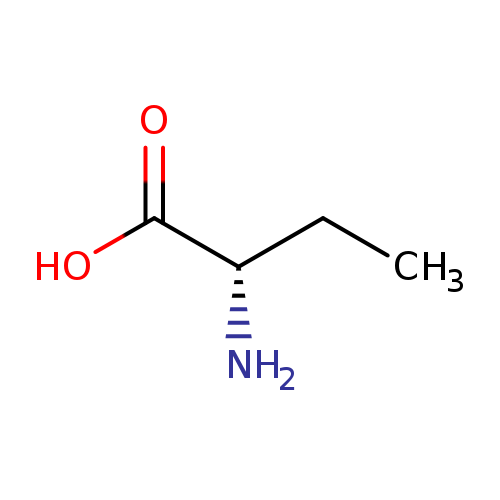
| Common Name | L-Alpha-aminobutyric acid |
|---|
| Description | 2-Aminobutyrate, also known as L-butyrine or L-homoalanine, belongs to the class of organic compounds known as l-alpha-amino acids. These are alpha amino acids which have the L-configuration of the alpha-carbon atom. 2-Aminobutyrate exists as a solid, very hydrophobic, practically insoluble (in water), and relatively neutral molecule. 2-Aminobutyrate exists in all eukaryotes, ranging from yeast to humans. |
|---|
| Structure | |
|---|
| Synonyms | | Value | Source |
|---|
| (-)-2-Aminobutyric acid | ChEBI | | (2S)-2-Aminobutyric acid | ChEBI | | (S)-2-Aminobutanoate | ChEBI | | (S)-2-Aminobutanoic acid | ChEBI | | (S)-2-Aminobutyric acid | ChEBI | | L-(+)-2-Aminobutyric acid | ChEBI | | L-2-Aminobuttersaeure | ChEBI | | L-2-Aminobutyric acid | ChEBI | | L-alpha-Amino-N-butyric acid | ChEBI | | L-Butyrine | ChEBI | | S-Butyrine | ChEBI | | (-)-2-Aminobutyrate | Generator | | (2S)-2-Aminobutyrate | Generator | | (S)-2-Aminobutyrate | Generator | | L-(+)-2-Aminobutyrate | Generator | | L-2-Aminobutyrate | Generator | | L-a-Amino-N-butyrate | Generator | | L-a-Amino-N-butyric acid | Generator | | L-alpha-Amino-N-butyrate | Generator | | L-Α-amino-N-butyrate | Generator | | L-Α-amino-N-butyric acid | Generator | | L-a-Aminobutyrate | Generator | | L-a-Aminobutyric acid | Generator | | L-alpha-Aminobutyrate | Generator | | L-Α-aminobutyrate | Generator | | L-Α-aminobutyric acid | Generator | | (+)-2-Aminobutanoate | HMDB | | (+)-2-Aminobutanoic acid | HMDB | | (+)-2-Aminobutyric acid | HMDB | | (+)-alpha-Aminobutyric acid | HMDB | | (2S)-2-Aminobutanoate | HMDB | | (2S)-2-Aminobutanoic acid | HMDB, MeSH | | (S)-(+)-alpha-Aminobutyric acid | HMDB | | (S)-2-amino-Butanoate | HMDB | | (S)-2-amino-Butanoic acid | HMDB | | 2-Aminobutanoate | HMDB | | 2-Aminobutanoic acid | HMDB, MeSH | | 2-Aminobutyrate | HMDB | | 2S-amino-Butanoate | HMDB, Generator | | 2S-amino-Butanoic acid | HMDB | | alpha-Aminobutyric acid | HMDB, MeSH | | L-2-amino-N-Butyric acid | HMDB | | L-Ethylglycine | HMDB | | Butyrine, (R)-isomer | MeSH, HMDB | | 2-Aminobutyric acid | MeSH, HMDB, Generator | | alpha-Aminobutyric acid, (+-)-isomer | MeSH, HMDB | | Butyrine | MeSH, HMDB | | Butyrine, (S)-isomer | MeSH, HMDB | | L-Homoalanine | MeSH, HMDB | | alpha-Aminobutyric acid, (S)-isomer | MeSH, HMDB | | Homoalanine | MeSH, HMDB | | alpha-Aminobutyric acid, (R)-isomer | MeSH, HMDB | | Butyrine, (+-)-isomer | MeSH, HMDB | | L-2-Aminobutanoate | Generator, HMDB |
|
|---|
| Chemical Formula | C4H9NO2 |
|---|
| Average Molecular Weight | 103.1198 |
|---|
| Monoisotopic Molecular Weight | 103.063328537 |
|---|
| IUPAC Name | (2S)-2-aminobutanoic acid |
|---|
| Traditional Name | (-)-2-aminobutyric acid |
|---|
| CAS Registry Number | 1492-24-6 |
|---|
| SMILES | CC[C@H](N)C(O)=O |
|---|
| InChI Identifier | InChI=1S/C4H9NO2/c1-2-3(5)4(6)7/h3H,2,5H2,1H3,(H,6,7)/t3-/m0/s1 |
|---|
| InChI Key | QWCKQJZIFLGMSD-VKHMYHEASA-N |
|---|
| Chemical Taxonomy |
|---|
| Description | belongs to the class of organic compounds known as l-alpha-amino acids. These are alpha amino acids which have the L-configuration of the alpha-carbon atom. |
|---|
| Kingdom | Organic compounds |
|---|
| Super Class | Organic acids and derivatives |
|---|
| Class | Carboxylic acids and derivatives |
|---|
| Sub Class | Amino acids, peptides, and analogues |
|---|
| Direct Parent | L-alpha-amino acids |
|---|
| Alternative Parents | |
|---|
| Substituents | - L-alpha-amino acid
- Fatty acid
- Amino acid
- Carboxylic acid
- Monocarboxylic acid or derivatives
- Amine
- Hydrocarbon derivative
- Organic oxide
- Organopnictogen compound
- Primary amine
- Organooxygen compound
- Organonitrogen compound
- Organic oxygen compound
- Primary aliphatic amine
- Organic nitrogen compound
- Carbonyl group
- Aliphatic acyclic compound
|
|---|
| Molecular Framework | Aliphatic acyclic compounds |
|---|
| External Descriptors | |
|---|
| Ontology |
|---|
| Status | Detected and Quantified |
|---|
| Origin | |
|---|
| Biofunction | Not Available |
|---|
| Application | Not Available |
|---|
| Cellular locations | |
|---|
| Physical Properties |
|---|
| State | Solid |
|---|
| Experimental Properties | | Property | Value | Reference |
|---|
| Melting Point | 291 °C | Not Available | | Boiling Point | Not Available | Not Available | | Water Solubility | Not Available | Not Available | | LogP | -3.17 | HANSCH,C ET AL. (1995) |
|
|---|
| Predicted Properties | |
|---|
| Spectra |
|---|
| Spectra | |
|---|
| Biological Properties |
|---|
| Cellular Locations | |
|---|
| Biospecimen Locations | - Blood
- Kidney
- Liver
- Milk
- Semen
|
|---|
| Pathways | |
|---|
| Normal Concentrations |
|---|
| |
| Blood | Detected but not Quantified | Not Quantified | Not Specified | Not Specified | Normal | | details | | Kidney | Expected but not Quantified | Not Quantified | Not Specified | Not Specified | Normal | | details | | Liver | Detected but not Quantified | Not Quantified | Not Specified | Not Specified | Normal | | details | | Milk | Detected and Quantified | 1 - 10 uM | Not Specified | Not Specified | Normal | | details | | Milk | Detected but not Quantified | Not Quantified | Not Specified | Not Specified | Normal | | details | | Semen | Detected but not Quantified | Not Quantified | Not Specified | Not Specified | Normal | | details |
|
|---|
| Abnormal Concentrations |
|---|
| |
| Blood | Detected but not Quantified | Not Quantified | Not Specified | Not Specified | Sub/clinical ketosis | | details | | Blood | Detected but not Quantified | Not Quantified | Not Specified | Not Specified | All Mycobacterium avium subsp. paratuberculosis-infected | | details | | Blood | Detected but not Quantified | Not Quantified | Not Specified | Not Specified | High dose Mycobacterium avium subsp. paratuberculosis-infected | | details | | Blood | Detected but not Quantified | Not Quantified | Not Specified | Not Specified | Low dose Mycobacterium avium subsp. paratuberculosis-infected | | details |
|
|---|
| External Links |
|---|
| HMDB ID | HMDB0000452 |
|---|
| DrugBank ID | Not Available |
|---|
| Phenol Explorer Compound ID | Not Available |
|---|
| FooDB ID | FDB012537 |
|---|
| KNApSAcK ID | Not Available |
|---|
| Chemspider ID | 72524 |
|---|
| KEGG Compound ID | C02356 |
|---|
| BioCyc ID | CPD0-1942 |
|---|
| BiGG ID | Not Available |
|---|
| Wikipedia Link | Alpha-Aminobutyric acid |
|---|
| METLIN ID | 12 |
|---|
| PubChem Compound | 80283 |
|---|
| PDB ID | Not Available |
|---|
| ChEBI ID | 35619 |
|---|
| References |
|---|
| Synthesis Reference | Fotheringham, I. G.; Grinter, N.; Pantaleone, D. P.; Senkpeil, R. F.; Taylor, P. P. Engineering of a novel biochemical pathway for the biosynthesis of l-2-aminobutyric acid in Escherichia coli K12. Bioorganic & Medicinal Chemistry (1999), 7(10), 2209-2213. |
|---|
| Material Safety Data Sheet (MSDS) | Not Available |
|---|
| General References | - Klein MS, Almstetter MF, Schlamberger G, Nurnberger N, Dettmer K, Oefner PJ, Meyer HH, Wiedemann S, Gronwald W: Nuclear magnetic resonance and mass spectrometry-based milk metabolomics in dairy cows during early and late lactation. J Dairy Sci. 2010 Apr;93(4):1539-50. doi: 10.3168/jds.2009-2563. [PubMed:20338431 ]
- Melzer N, Wittenburg D, Hartwig S, Jakubowski S, Kesting U, Willmitzer L, Lisec J, Reinsch N, Repsilber D: Investigating associations between milk metabolite profiles and milk traits of Holstein cows. J Dairy Sci. 2013 Mar;96(3):1521-34. doi: 10.3168/jds.2012-5743. [PubMed:23438684 ]
- Mung D, Li L: Applying quantitative metabolomics based on chemical isotope labeling LC-MS for detecting potential milk adulterant in human milk. Anal Chim Acta. 2018 Feb 25;1001:78-85. doi: 10.1016/j.aca.2017.11.019. Epub 2017 Nov 14. [PubMed:29291809 ]
|
|---|