| Record Information |
|---|
| Version | 1.0 |
|---|
| Creation Date | 2016-09-30 22:32:45 UTC |
|---|
| Update Date | 2020-04-22 15:04:10 UTC |
|---|
| BMDB ID | BMDB0000557 |
|---|
| Secondary Accession Numbers | |
|---|
| Metabolite Identification |
|---|
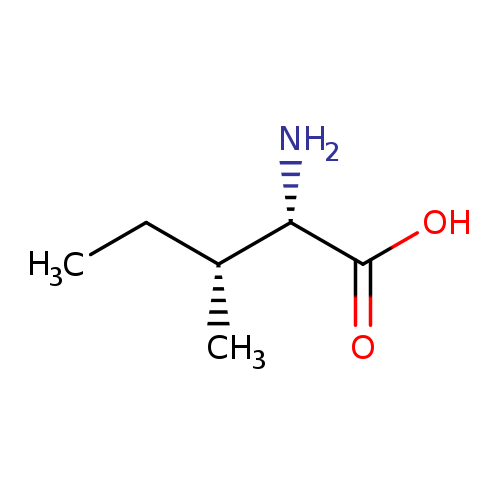
| Common Name | L-Alloisoleucine |
|---|
| Description | L-Alloisoleucine, also known as threo-L-isoleucine or alle, belongs to the class of organic compounds known as isoleucine and derivatives. Isoleucine and derivatives are compounds containing isoleucine or a derivative thereof resulting from reaction of isoleucine at the amino group or the carboxy group, or from the replacement of any hydrogen of glycine by a heteroatom. L-Alloisoleucine exists as a solid, possibly soluble (in water), and a very strong basic compound (based on its pKa) molecule. L-Alloisoleucine has been found to be associated with several diseases known as eosinophilic esophagitis, short/branched chain acyl-coa dehydrogenase deficiency, and colorectal cancer; also l-alloisoleucine has been linked to the inborn metabolic disorders including maple syrup urine disease. |
|---|
| Structure | |
|---|
| Synonyms | | Value | Source |
|---|
| (2S,3R)-2-Amino-3-methylpentanoic acid | ChEBI | | Alle | ChEBI | | Allo-L-isoleucine | ChEBI | | L(+)-Alloisoleucine | ChEBI | | Threo-3-methyl-L-norvaline | ChEBI | | Threo-L-isoleucine | ChEBI | | (2S,3R)-2-Amino-3-methylpentanoate | Generator | | Alloisoleucine | HMDB | | Isoleucine | HMDB | | Isoleucine, L isomer | HMDB | | Isoleucine, L-isomer | HMDB | | L-Isoleucine | HMDB | | L-Isomer isoleucine | HMDB | | (3R)-LS-Isoleucine | HMDB | | 2-Amino-3-methyl-[S-(r*,s*)]-pentanoate | HMDB | | 2-Amino-3-methyl-[S-(r*,s*)]-pentanoic acid | HMDB | | Allo-isoleucine | HMDB | | L-Allo-isoleucine | HMDB | | [S-(R*,s*)]-2-amino-3-methylpentanoate | HMDB | | [S-(R*,s*)]-2-amino-3-methylpentanoic acid | HMDB |
|
|---|
| Chemical Formula | C6H13NO2 |
|---|
| Average Molecular Weight | 131.1729 |
|---|
| Monoisotopic Molecular Weight | 131.094628665 |
|---|
| IUPAC Name | (2S,3R)-2-amino-3-methylpentanoic acid |
|---|
| Traditional Name | allo-isoleucine |
|---|
| CAS Registry Number | 1509-34-8 |
|---|
| SMILES | CC[C@@H](C)[C@H](N)C(O)=O |
|---|
| InChI Identifier | InChI=1S/C6H13NO2/c1-3-4(2)5(7)6(8)9/h4-5H,3,7H2,1-2H3,(H,8,9)/t4-,5+/m1/s1 |
|---|
| InChI Key | AGPKZVBTJJNPAG-UHNVWZDZSA-N |
|---|
| Chemical Taxonomy |
|---|
| Description | belongs to the class of organic compounds known as isoleucine and derivatives. Isoleucine and derivatives are compounds containing isoleucine or a derivative thereof resulting from reaction of isoleucine at the amino group or the carboxy group, or from the replacement of any hydrogen of glycine by a heteroatom. |
|---|
| Kingdom | Organic compounds |
|---|
| Super Class | Organic acids and derivatives |
|---|
| Class | Carboxylic acids and derivatives |
|---|
| Sub Class | Amino acids, peptides, and analogues |
|---|
| Direct Parent | Isoleucine and derivatives |
|---|
| Alternative Parents | |
|---|
| Substituents | - Isoleucine or derivatives
- Alpha-amino acid
- L-alpha-amino acid
- Branched fatty acid
- Methyl-branched fatty acid
- Fatty acid
- Fatty acyl
- Amino acid
- Monocarboxylic acid or derivatives
- Carboxylic acid
- Organic oxide
- Organopnictogen compound
- Primary amine
- Organooxygen compound
- Organonitrogen compound
- Primary aliphatic amine
- Carbonyl group
- Organic oxygen compound
- Amine
- Organic nitrogen compound
- Hydrocarbon derivative
- Aliphatic acyclic compound
|
|---|
| Molecular Framework | Aliphatic acyclic compounds |
|---|
| External Descriptors | |
|---|
| Ontology |
|---|
| Status | Detected but not Quantified |
|---|
| Origin | |
|---|
| Biofunction | Not Available |
|---|
| Application | Not Available |
|---|
| Cellular locations | |
|---|
| Physical Properties |
|---|
| State | Solid |
|---|
| Experimental Properties | | Property | Value | Reference |
|---|
| Melting Point | 60 - 64 °C | Not Available | | Boiling Point | Not Available | Not Available | | Water Solubility | 34.4 mg/mL at 25 °C | Not Available | | LogP | -1.7 | HANSCH,C ET AL. (1995) |
|
|---|
| Predicted Properties | |
|---|
| Spectra |
|---|
| Spectra | |
|---|