| Record Information |
|---|
| Version | 1.0 |
|---|
| Creation Date | 2016-09-30 22:33:52 UTC |
|---|
| Update Date | 2020-05-11 20:55:06 UTC |
|---|
| BMDB ID | BMDB0000630 |
|---|
| Secondary Accession Numbers | |
|---|
| Metabolite Identification |
|---|
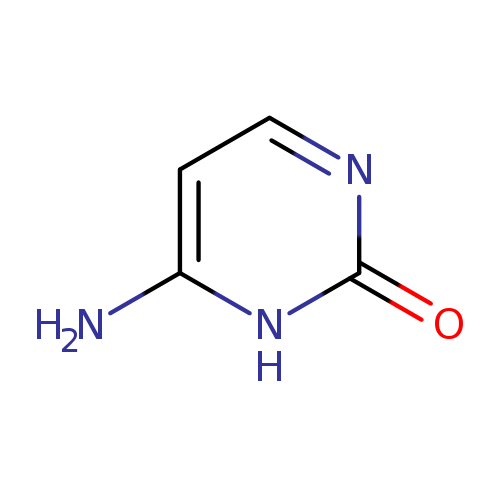
| Common Name | Cytosine |
|---|
| Description | Cytosine, also known as C, belongs to the class of organic compounds known as pyrimidones. Pyrimidones are compounds that contain a pyrimidine ring, which bears a ketone. Pyrimidine is a 6-membered ring consisting of four carbon atoms and two nitrogen centers at the 1- and 3- ring positions. Cytosine exists as a solid, possibly soluble (in water), and a strong basic compound (based on its pKa) molecule. Cytosine exists in all living species, ranging from bacteria to humans. |
|---|
| Structure | |
|---|
| Synonyms | | Value | Source |
|---|
| 4-Amino-2(1H)-pyrimidinone | ChEBI | | 4-Amino-2-hydroxypyrimidine | ChEBI | | C | ChEBI | | Cyt | ChEBI | | Cytosin | ChEBI | | Zytosin | ChEBI | | 4-Amino-2-oxo-1,2-dihydropyrimidine | HMDB | | 4-Aminouracil | HMDB | | Cytosinimine | HMDB |
|
|---|
| Chemical Formula | C4H5N3O |
|---|
| Average Molecular Weight | 111.102 |
|---|
| Monoisotopic Molecular Weight | 111.043261797 |
|---|
| IUPAC Name | 6-amino-1,2-dihydropyrimidin-2-one |
|---|
| Traditional Name | 2(1H)-pyrimidinone, 6-amino- |
|---|
| CAS Registry Number | 71-30-7 |
|---|
| SMILES | NC1=CC=NC(=O)N1 |
|---|
| InChI Identifier | InChI=1S/C4H5N3O/c5-3-1-2-6-4(8)7-3/h1-2H,(H3,5,6,7,8) |
|---|
| InChI Key | OPTASPLRGRRNAP-UHFFFAOYSA-N |
|---|
| Chemical Taxonomy |
|---|
| Description | belongs to the class of organic compounds known as pyrimidones. Pyrimidones are compounds that contain a pyrimidine ring, which bears a ketone. Pyrimidine is a 6-membered ring consisting of four carbon atoms and two nitrogen centers at the 1- and 3- ring positions. |
|---|
| Kingdom | Organic compounds |
|---|
| Super Class | Organoheterocyclic compounds |
|---|
| Class | Diazines |
|---|
| Sub Class | Pyrimidines and pyrimidine derivatives |
|---|
| Direct Parent | Pyrimidones |
|---|
| Alternative Parents | |
|---|
| Substituents | - Pyrimidone
- Aminopyrimidine
- Hydropyrimidine
- Heteroaromatic compound
- Azacycle
- Organic nitrogen compound
- Organic oxygen compound
- Organopnictogen compound
- Organic oxide
- Hydrocarbon derivative
- Primary amine
- Organooxygen compound
- Organonitrogen compound
- Amine
- Aromatic heteromonocyclic compound
|
|---|
| Molecular Framework | Aromatic heteromonocyclic compounds |
|---|
| External Descriptors | |
|---|
| Ontology |
|---|
| Status | Detected but not Quantified |
|---|
| Origin | |
|---|
| Biofunction | Not Available |
|---|
| Application | Not Available |
|---|
| Cellular locations | Not Available |
|---|
| Physical Properties |
|---|
| State | Solid |
|---|
| Experimental Properties | | Property | Value | Reference |
|---|
| Melting Point | > 300 °C | Not Available | | Boiling Point | Not Available | Not Available | | Water Solubility | 8.0 mg/mL | Not Available | | LogP | -1.73 | HANSCH,C ET AL. (1995) |
|
|---|
| Predicted Properties | |
|---|
| Spectra |
|---|
| Spectra | |
|---|
| Biological Properties |
|---|
| Cellular Locations | Not Available |
|---|
| Biospecimen Locations | - Epidermis
- Fibroblasts
- Intestine
- Mammary Gland
- Milk
- Neuron
- Placenta
- Prostate Tissue
- Skeletal Muscle
- Spleen
- Testis
|
|---|
| Pathways | |
|---|
| Normal Concentrations |
|---|
| |
| Epidermis | Expected but not Quantified | Not Quantified | Not Specified | Not Specified | Normal | | details | | Fibroblasts | Expected but not Quantified | Not Quantified | Not Specified | Not Specified | Normal | | details | | Intestine | Expected but not Quantified | Not Quantified | Not Specified | Not Specified | Normal | | details | | Mammary Gland | Detected but not Quantified | Not Quantified | Not Specified | Not Specified | Normal | | details | | Mammary Gland | Detected but not Quantified | Not Quantified | Not Specified | Not Specified | Normal | | details | | Milk | Detected but not Quantified | Not Quantified | Not Specified | Not Specified | Normal | | details | | Neuron | Expected but not Quantified | Not Quantified | Not Specified | Not Specified | Normal | | details | | Placenta | Expected but not Quantified | Not Quantified | Not Specified | Not Specified | Normal | | details | | Prostate Tissue | Expected but not Quantified | Not Quantified | Not Specified | Not Specified | Normal | | details | | Skeletal Muscle | Expected but not Quantified | Not Quantified | Not Specified | Not Specified | Normal | | details | | Spleen | Expected but not Quantified | Not Quantified | Not Specified | Not Specified | Normal | | details | | Testis | Expected but not Quantified | Not Quantified | Not Specified | Not Specified | Normal | | details |
|
|---|
| Abnormal Concentrations |
|---|
| Not Available |
|---|
| External Links |
|---|
| HMDB ID | HMDB0000630 |
|---|
| DrugBank ID | Not Available |
|---|
| Phenol Explorer Compound ID | Not Available |
|---|
| FooDB ID | FDB022151 |
|---|
| KNApSAcK ID | C00001498 |
|---|
| Chemspider ID | 577 |
|---|
| KEGG Compound ID | C00380 |
|---|
| BioCyc ID | CYTOSINE |
|---|
| BiGG ID | 34812 |
|---|
| Wikipedia Link | Cytosine |
|---|
| METLIN ID | 283 |
|---|
| PubChem Compound | 597 |
|---|
| PDB ID | Not Available |
|---|
| ChEBI ID | 16040 |
|---|
| References |
|---|
| Synthesis Reference | Hitchings, George H.; Elion, Gertrude B.; Falco, Elvira A.; Russell, Peter B. New synthesis of cytosine and 5-methylcytosine. Journal of Biological Chemistry (1949), 177 357-60. |
|---|
| Material Safety Data Sheet (MSDS) | Not Available |
|---|
| General References | - Pan L, Yu J, Mi Z, Mo L, Jin H, Yao C, Ren D, Menghe B: A Metabolomics Approach Uncovers Differences between Traditional and Commercial Dairy Products in Buryatia (Russian Federation). Molecules. 2018 Mar 22;23(4). pii: molecules23040735. doi: 10.3390/molecules23040735. [PubMed:29565828 ]
|
|---|