| Record Information |
|---|
| Version | 1.0 |
|---|
| Creation Date | 2016-09-30 22:34:31 UTC |
|---|
| Update Date | 2020-05-11 20:47:45 UTC |
|---|
| BMDB ID | BMDB0000663 |
|---|
| Secondary Accession Numbers | |
|---|
| Metabolite Identification |
|---|
| Common Name | Glucaric acid |
|---|
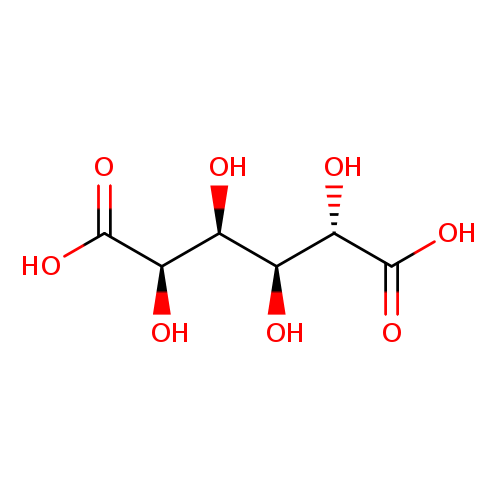
| Description | Glucaric acid, also known as glucarate or D-saccharic acid, belongs to the class of organic compounds known as glucuronic acid derivatives. Glucuronic acid derivatives are compounds containing a glucuronic acid moiety (or a derivative), which consists of a glucose moiety with the C6 carbon oxidized to a carboxylic acid. Glucaric acid is a very hydrophobic molecule, practically insoluble (in water), and relatively neutral. Glucaric acid exists in all living organisms, ranging from bacteria to humans. |
|---|
| Structure | |
|---|
| Synonyms | | Value | Source |
|---|
| D-(+)-Saccharic acid | ChEBI | | D-Glucosaccharic acid | ChEBI | | D-Saccharic acid | ChEBI | | L-Gularic acid | ChEBI | | Saccharic acid | ChEBI | | D-Glucaric acid | Kegg | | Glucarate | Kegg | | D-(+)-Saccharate | Generator | | D-Glucosaccharate | Generator | | D-Saccharate | Generator | | L-Gularate | Generator | | Saccharate | Generator | | D-Glucarate | Generator | | Acid, saccharic | MeSH | | Anhydrous calcium glucarate | MeSH | | Anhydrous calcium saccharate | MeSH | | Calcium glucarate | MeSH | | Calcium glucarate, anhydrous | MeSH | | Calcium saccharate | MeSH | | Calcium saccharate anhydrous | MeSH | | Calcium saccharate tetrahydrate | MeSH | | Calcium saccharate, anhydrous | MeSH | | D Glucaric acid | MeSH | | D Saccharic acid | MeSH | | Glucarate, anhydrous calcium | MeSH | | Glucarate, calcium | MeSH | | Glucosaccharic acid | MeSH | | L Gularic acid | MeSH | | Levo gularic acid | MeSH | | Levo-gularic acid | MeSH | | Saccharate tetrahydrate, calcium | MeSH | | Saccharate, anhydrous calcium | MeSH | | Saccharate, calcium | MeSH | | Tetrahydrate, calcium saccharate | MeSH | | Tetrahydroxyadipic acid | MeSH | | (2R,3S,4S,5S)-2,3,4,5-Tetrahydroxyhexanedioate | HMDB | | (2R,3S,4S,5S)-2,3,4,5-Tetrahydroxyhexanedioic acid | HMDB | | D-Tetrahydroxyadipate | HMDB | | D-Tetrahydroxyadipic acid | HMDB | | DL-Glucaric acid | HMDB | | GKR | HMDB |
|
|---|
| Chemical Formula | C6H10O8 |
|---|
| Average Molecular Weight | 210.1388 |
|---|
| Monoisotopic Molecular Weight | 210.037567296 |
|---|
| IUPAC Name | (2R,3S,4S,5S)-2,3,4,5-tetrahydroxyhexanedioic acid |
|---|
| Traditional Name | saccharic acid |
|---|
| CAS Registry Number | 25525-21-7 |
|---|
| SMILES | O[C@@H]([C@H](O)[C@@H](O)C(O)=O)[C@H](O)C(O)=O |
|---|
| InChI Identifier | InChI=1S/C6H10O8/c7-1(3(9)5(11)12)2(8)4(10)6(13)14/h1-4,7-10H,(H,11,12)(H,13,14)/t1-,2-,3-,4+/m0/s1 |
|---|
| InChI Key | DSLZVSRJTYRBFB-LLEIAEIESA-N |
|---|
| Chemical Taxonomy |
|---|
| Description | belongs to the class of organic compounds known as glucuronic acid derivatives. Glucuronic acid derivatives are compounds containing a glucuronic acid moiety (or a derivative), which consists of a glucose moiety with the C6 carbon oxidized to a carboxylic acid. |
|---|
| Kingdom | Organic compounds |
|---|
| Super Class | Organic oxygen compounds |
|---|
| Class | Organooxygen compounds |
|---|
| Sub Class | Carbohydrates and carbohydrate conjugates |
|---|
| Direct Parent | Glucuronic acid derivatives |
|---|
| Alternative Parents | |
|---|
| Substituents | - Glucuronic acid or derivatives
- Medium-chain hydroxy acid
- Medium-chain fatty acid
- Beta-hydroxy acid
- Hydroxy fatty acid
- Monosaccharide
- Hydroxy acid
- Dicarboxylic acid or derivatives
- Alpha-hydroxy acid
- Fatty acyl
- Fatty acid
- Secondary alcohol
- Polyol
- Carboxylic acid
- Carboxylic acid derivative
- Hydrocarbon derivative
- Organic oxide
- Carbonyl group
- Alcohol
- Aliphatic acyclic compound
|
|---|
| Molecular Framework | Aliphatic acyclic compounds |
|---|
| External Descriptors | |
|---|
| Ontology |
|---|
| Status | Detected but not Quantified |
|---|
| Origin | |
|---|
| Biofunction | Not Available |
|---|
| Application | Not Available |
|---|
| Cellular locations | |
|---|
| Physical Properties |
|---|
| State | Solid |
|---|
| Experimental Properties | | Property | Value | Reference |
|---|
| Melting Point | Not Available | Not Available | | Boiling Point | Not Available | Not Available | | Water Solubility | 912 mg/mL | Not Available | | LogP | Not Available | Not Available |
|
|---|
| Predicted Properties | |
|---|
| Spectra |
|---|
| Spectra | |
|---|
| Synthesis Reference | Bamba, K.; Kokoh, K. B.; Servat, K.; Leger, J.-M. Electrocatalytic oxidation of monosaccharides on platinum electrodes modified by thallium adatoms in carbonate buffered medium. Journal of Applied Electrochemistry (2006), 36(2), 233-238. |
|---|
| General References | - Pan L, Yu J, Mi Z, Mo L, Jin H, Yao C, Ren D, Menghe B: A Metabolomics Approach Uncovers Differences between Traditional and Commercial Dairy Products in Buryatia (Russian Federation). Molecules. 2018 Mar 22;23(4). pii: molecules23040735. doi: 10.3390/molecules23040735. [PubMed:29565828 ]
|
|---|