| Record Information |
|---|
| Version | 1.0 |
|---|
| Creation Date | 2016-09-30 22:35:27 UTC |
|---|
| Update Date | 2020-05-21 16:29:03 UTC |
|---|
| BMDB ID | BMDB0000719 |
|---|
| Secondary Accession Numbers | |
|---|
| Metabolite Identification |
|---|
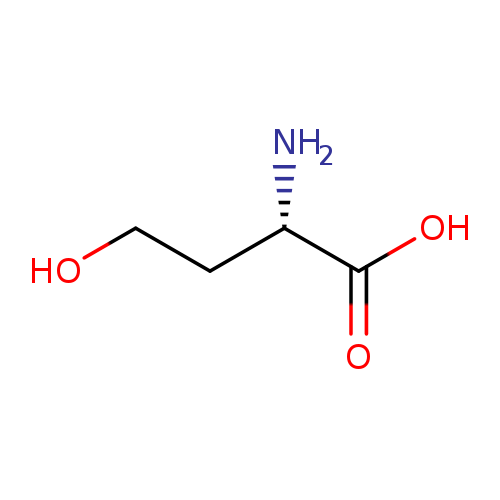
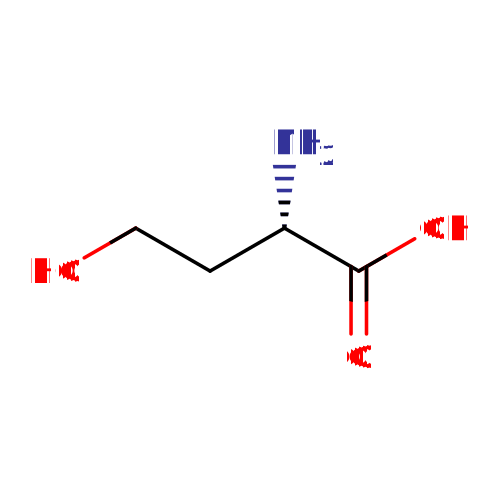
| Common Name | L-Homoserine |
|---|
| Description | L-Homoserine belongs to the class of organic compounds known as l-alpha-amino acids. These are alpha amino acids which have the L-configuration of the alpha-carbon atom. L-Homoserine exists in all living species, ranging from bacteria to plants to humans. Based on a literature review a small amount of articles have been published on L-Homoserine. |
|---|
| Structure | |
|---|
| Synonyms | | Value | Source |
|---|
| (2S)-2-Amino-4-hydroxybutanoic acid | ChEBI | | 2-Amino-4-hydroxybutanoic acid | ChEBI | | 2-Amino-4-hydroxybutyric acid | ChEBI | | Homoserine | ChEBI | | (2S)-2-Amino-4-hydroxybutanoate | Generator | | 2-Amino-4-hydroxybutanoate | Generator | | 2-Amino-4-hydroxybutyrate | Generator | | (S)-2-Amino-4-hydroxy-butanoate | HMDB | | (S)-2-Amino-4-hydroxy-butanoic acid | HMDB | | (S)-2-Amino-4-hydroxybutanoate | HMDB | | (S)-2-Amino-4-hydroxybutanoic acid | HMDB | | (S)-Homoserine | HMDB | | 2-Amino-4-hydroxy-butyrate | HMDB | | 2-Amino-4-hydroxy-butyric acid | HMDB | | 2-Amino-4-hydroxy-L-butyrate | HMDB | | 2-Amino-4-hydroxy-L-butyric acid | HMDB | | Homoserine L-isomer | HMDB | | L Isomer OF homoserine | HMDB | | L-Isomer OF homoserine | HMDB |
|
|---|
| Chemical Formula | C4H9NO3 |
|---|
| Average Molecular Weight | 119.1192 |
|---|
| Monoisotopic Molecular Weight | 119.058243159 |
|---|
| IUPAC Name | (2S)-2-amino-4-hydroxybutanoic acid |
|---|
| Traditional Name | L-homoserine |
|---|
| CAS Registry Number | 672-15-1 |
|---|
| SMILES | N[C@@H](CCO)C(O)=O |
|---|
| InChI Identifier | InChI=1S/C4H9NO3/c5-3(1-2-6)4(7)8/h3,6H,1-2,5H2,(H,7,8)/t3-/m0/s1 |
|---|
| InChI Key | UKAUYVFTDYCKQA-VKHMYHEASA-N |
|---|
| Chemical Taxonomy |
|---|
| Description | belongs to the class of organic compounds known as l-alpha-amino acids. These are alpha amino acids which have the L-configuration of the alpha-carbon atom. |
|---|
| Kingdom | Organic compounds |
|---|
| Super Class | Organic acids and derivatives |
|---|
| Class | Carboxylic acids and derivatives |
|---|
| Sub Class | Amino acids, peptides, and analogues |
|---|
| Direct Parent | L-alpha-amino acids |
|---|
| Alternative Parents | |
|---|
| Substituents | - L-alpha-amino acid
- Short-chain hydroxy acid
- Fatty acid
- 1,3-aminoalcohol
- Amino acid
- Carboxylic acid
- Monocarboxylic acid or derivatives
- Organic nitrogen compound
- Hydrocarbon derivative
- Organic oxide
- Primary amine
- Primary alcohol
- Organooxygen compound
- Organonitrogen compound
- Organopnictogen compound
- Primary aliphatic amine
- Organic oxygen compound
- Carbonyl group
- Amine
- Alcohol
- Aliphatic acyclic compound
|
|---|
| Molecular Framework | Aliphatic acyclic compounds |
|---|
| External Descriptors | |
|---|
| Ontology |
|---|
| Status | Detected but not Quantified |
|---|
| Origin | |
|---|
| Biofunction | Not Available |
|---|
| Application | Not Available |
|---|
| Cellular locations | Not Available |
|---|
| Physical Properties |
|---|
| State | Solid |
|---|
| Experimental Properties | | Property | Value | Reference |
|---|
| Melting Point | 203 °C | Not Available | | Boiling Point | Not Available | Not Available | | Water Solubility | 1000.0 mg/mL | Not Available | | LogP | Not Available | Not Available |
|
|---|
| Predicted Properties | |
|---|
| Spectra |
|---|
| Spectra | |
|---|
| Biological Properties |
|---|
| Cellular Locations | Not Available |
|---|
| Biospecimen Locations | - Liver
- Mammary Gland
- Milk
- Prostate Tissue
|
|---|
| Pathways | |
|---|
| Normal Concentrations |
|---|
| |
| Liver | Detected but not Quantified | Not Quantified | Not Specified | Not Specified | Normal | | details | | Liver | Detected but not Quantified | Not Quantified | Not Specified | Not Specified | Normal | | details | | Mammary Gland | Detected but not Quantified | Not Quantified | Not Specified | Not Specified | Normal | | details | | Mammary Gland | Detected but not Quantified | Not Quantified | Not Specified | Not Specified | Normal | | details | | Milk | Detected but not Quantified | Not Quantified | Not Specified | Not Specified | Normal | | details | | Milk | Detected but not Quantified | Not Quantified | Not Specified | Not Specified | Normal | | details | | Milk | Detected but not Quantified | Not Quantified | Not Specified | Not Specified | Normal | | details | | Prostate Tissue | Expected but not Quantified | Not Quantified | Not Specified | Not Specified | Normal | | details |
|
|---|
| Abnormal Concentrations |
|---|
| Not Available |
|---|
| External Links |
|---|
| HMDB ID | HMDB0000719 |
|---|
| DrugBank ID | DB04193 |
|---|
| Phenol Explorer Compound ID | Not Available |
|---|
| FooDB ID | FDB006683 |
|---|
| KNApSAcK ID | C00001366 |
|---|
| Chemspider ID | 12126 |
|---|
| KEGG Compound ID | C00263 |
|---|
| BioCyc ID | HOMO-SER |
|---|
| BiGG ID | 34437 |
|---|
| Wikipedia Link | Homoserine |
|---|
| METLIN ID | 5687 |
|---|
| PubChem Compound | 12647 |
|---|
| PDB ID | Not Available |
|---|
| ChEBI ID | 15699 |
|---|
| References |
|---|
| Synthesis Reference | Kokusenya, Yoshio; Matsuoka, Manabu. Synthesis of amino acids by electrochemical reduction. I. Synthesis of L-homoserine by electrochemical reduction of L-asparagine. Denki Kagaku oyobi Kogyo Butsuri Kagaku (1987), 55(2), 174-5. |
|---|
| Material Safety Data Sheet (MSDS) | Not Available |
|---|
| General References | - Mung D, Li L: Development of Chemical Isotope Labeling LC-MS for Milk Metabolomics: Comprehensive and Quantitative Profiling of the Amine/Phenol Submetabolome. Anal Chem. 2017 Apr 18;89(8):4435-4443. doi: 10.1021/acs.analchem.6b03737. Epub 2017 Mar 28. [PubMed:28306241 ]
- Pan L, Yu J, Mi Z, Mo L, Jin H, Yao C, Ren D, Menghe B: A Metabolomics Approach Uncovers Differences between Traditional and Commercial Dairy Products in Buryatia (Russian Federation). Molecules. 2018 Mar 22;23(4). pii: molecules23040735. doi: 10.3390/molecules23040735. [PubMed:29565828 ]
- Mung D, Li L: Applying quantitative metabolomics based on chemical isotope labeling LC-MS for detecting potential milk adulterant in human milk. Anal Chim Acta. 2018 Feb 25;1001:78-85. doi: 10.1016/j.aca.2017.11.019. Epub 2017 Nov 14. [PubMed:29291809 ]
|
|---|