| Record Information |
|---|
| Version | 1.0 |
|---|
| Creation Date | 2016-09-30 22:36:15 UTC |
|---|
| Update Date | 2020-05-11 20:37:54 UTC |
|---|
| BMDB ID | BMDB0000765 |
|---|
| Secondary Accession Numbers | |
|---|
| Metabolite Identification |
|---|
| Common Name | Mannitol |
|---|
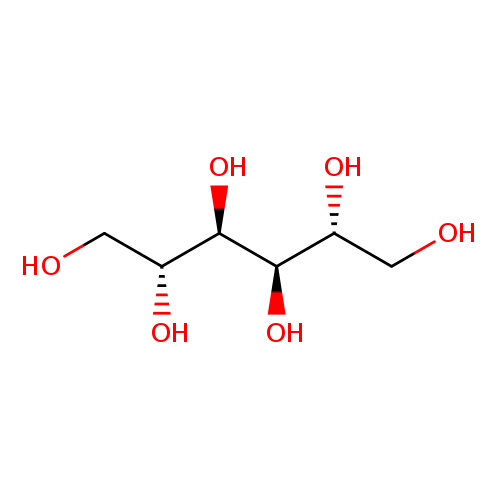
| Description | D-Mannitol, also known as mannite or osmitrol, belongs to the class of organic compounds known as sugar alcohols. These are hydrogenated forms of carbohydrate in which the carbonyl group (aldehyde or ketone, reducing sugar) has been reduced to a primary or secondary hydroxyl group. D-Mannitol is a drug which is used for the promotion of diuresis before irreversible renal failure becomes established, the reduction of intracranial pressure, the treatment of cerebral edema, and the promotion of urinary excretion of toxic substances. D-Mannitol exists as a solid, possibly soluble (in water), and an extremely weak basic (essentially neutral) compound (based on its pKa) molecule. D-Mannitol exists in all living species, ranging from bacteria to humans. D-Mannitol has been found to be associated with several diseases known as eosinophilic esophagitis, aids, and alzheimer's disease; also d-mannitol has been linked to several inborn metabolic disorders including ribose-5-phosphate isomerase deficiency and cytochrome c oxidase deficiency. |
|---|
| Structure | |
|---|
| Synonyms | | Value | Source |
|---|
| (2R,3R,4R,5R)-Hexane-1,2,3,4,5,6-hexaol | ChEBI | | (2R,3R,4R,5R)-Hexane-1,2,3,4,5,6-hexol | ChEBI | | D-(-)-Mannitol | ChEBI | | Dulcite | ChEBI | | e 421 | ChEBI | | e-421 | ChEBI | | e421 | ChEBI | | Manna sugar | ChEBI | | Mannite | ChEBI | | Osmitrol | ChEBI | | D-Mannitol | Kegg | | Tobrex | Kegg | | Bronchitol | Kegg | | 1,2,3,4,5,6-Hexanehexol | HMDB | | Cordycepate | HMDB | | Cordycepic acid | HMDB | | Diosmol | HMDB | | Hexahydroxyhexane | HMDB | | Hexanhexol | HMDB | | Invenex | HMDB | | Isotol | HMDB | | Manicol | HMDB | | Maniton S | HMDB | | Maniton-S | HMDB | | Mannazucker | HMDB | | Mannidex | HMDB | | Mannigen | HMDB | | Mannistol | HMDB | | Mannit | HMDB | | Mannit p | HMDB | | Mannogem 2080 | HMDB | | Marine crystal | HMDB | | Mushroom sugar | HMDB | | Osmofundin | HMDB | | Osmosal | HMDB | | Resectisol | HMDB | | SDM No. 35 | HMDB | | (L)-Mannitol | HMDB | | Mannitol | ChEBI |
|
|---|
| Chemical Formula | C6H14O6 |
|---|
| Average Molecular Weight | 182.1718 |
|---|
| Monoisotopic Molecular Weight | 182.07903818 |
|---|
| IUPAC Name | (2R,3R,4R,5R)-hexane-1,2,3,4,5,6-hexol |
|---|
| Traditional Name | mannitol |
|---|
| CAS Registry Number | 69-65-8 |
|---|
| SMILES | OC[C@@H](O)[C@@H](O)[C@H](O)[C@H](O)CO |
|---|
| InChI Identifier | InChI=1S/C6H14O6/c7-1-3(9)5(11)6(12)4(10)2-8/h3-12H,1-2H2/t3-,4-,5-,6-/m1/s1 |
|---|
| InChI Key | FBPFZTCFMRRESA-KVTDHHQDSA-N |
|---|
| Chemical Taxonomy |
|---|
| Description | belongs to the class of organic compounds known as sugar alcohols. These are hydrogenated forms of carbohydrate in which the carbonyl group (aldehyde or ketone, reducing sugar) has been reduced to a primary or secondary hydroxyl group. |
|---|
| Kingdom | Organic compounds |
|---|
| Super Class | Organic oxygen compounds |
|---|
| Class | Organooxygen compounds |
|---|
| Sub Class | Carbohydrates and carbohydrate conjugates |
|---|
| Direct Parent | Sugar alcohols |
|---|
| Alternative Parents | |
|---|
| Substituents | - Sugar alcohol
- Monosaccharide
- Secondary alcohol
- Polyol
- Hydrocarbon derivative
- Primary alcohol
- Alcohol
- Aliphatic acyclic compound
|
|---|
| Molecular Framework | Aliphatic acyclic compounds |
|---|
| External Descriptors | |
|---|
| Ontology |
|---|
| Status | Detected but not Quantified |
|---|
| Origin | |
|---|
| Biofunction | Not Available |
|---|
| Application | Not Available |
|---|
| Cellular locations | |
|---|
| Physical Properties |
|---|
| State | Solid |
|---|
| Experimental Properties | | Property | Value | Reference |
|---|
| Melting Point | 166 °C | Not Available | | Boiling Point | Not Available | Not Available | | Water Solubility | 216 mg/mL at 25 °C | YALKOWSKY,SH & DANNENFELSER,RM (1992) | | LogP | -3.1 | HANSCH,C ET AL. (1995) |
|
|---|
| Predicted Properties | |
|---|
| Spectra |
|---|
| Spectra | |
|---|