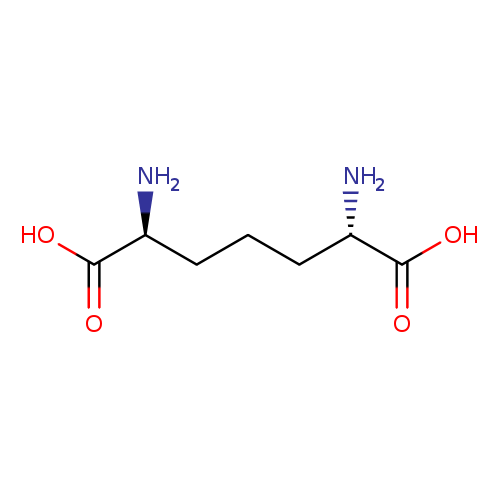
Record Information
Version1.0
Creation Date2016-09-30 22:44:52 UTC
Update Date2020-05-05 18:40:10 UTC
BMDB IDBMDB0001370
Secondary Accession Numbers
  • BMDB01370
Metabolite Identification
Common NameDiaminopimelic acid
DescriptionDiaminopimelic acid, also known as LL-2,6-diaminopimelate or acid, diaminopimelic, belongs to the class of organic compounds known as l-alpha-amino acids. These are alpha amino acids which have the L-configuration of the alpha-carbon atom. Diaminopimelic acid exists as a solid, very hydrophobic, practically insoluble (in water), and relatively neutral molecule. Diaminopimelic acid exists in all living species, ranging from bacteria to humans.
Structure
Thumb
Synonyms
ValueSource
(S,S)-2,6-Diaminopimelic acidChEBI
(S-(R*,r*))-2,6-diaminoheptanedioic acidChEBI
L,L-2,6-Diaminopimelic acidChEBI
LL-2,6-DiaminoheptanedioateChEBI
LL-2,6-DiaminopimelateChEBI
LL-2,6-Diaminopimelic acidKegg
(S,S)-2,6-DiaminopimelateGenerator
(S-(R*,r*))-2,6-diaminoheptanedioateGenerator
L,L-2,6-DiaminopimelateGenerator
LL-2,6-Diaminoheptanedioic acidGenerator
DiaminopimelateGenerator
( (R*,s*)-2,6-diamino-heptanedioateHMDB
( (R*,s*)-2,6-diamino-heptanedioic acidHMDB
(2R,6S)-2,6-diamino-HeptanedioateHMDB
(2R,6S)-2,6-diamino-Heptanedioic acidHMDB
(R*,s*)-2,6-diamino-heptanedioateHMDB
(R*,s*)-2,6-diamino-heptanedioic acidHMDB
2,6-diamino-HeptanedioateHMDB
2,6-diamino-Heptanedioic acidHMDB
2,6-DiaminoheptanedioateHMDB
2,6-Diaminoheptanedioic acidHMDB
2,6-DiaminopimelateHMDB
2,6-Diaminopimelic acidHMDB, MeSH
a,A'-diaminopimelateHMDB
a,A'-diaminopimelic acidHMDB
a,e-DiaminopimelateHMDB
a,e-Diaminopimelic acidHMDB
D,L-DiaminopimelateHMDB
D,L-meso-DiaminoheptanedioateHMDB
D,L-meso-Diaminoheptanedioic acidHMDB
DAPAHMDB
DL-2,6-DiaminoheptanedioateHMDB
DL-2,6-Diaminoheptanedioic acidHMDB
DL-2,6-DiaminopimelateHMDB
DL-2,6-Diaminopimelic acidHMDB
L,L-2,6-DiaminoheptanedioateHMDB
L,L-2,6-Diaminoheptanedioic acidHMDB
L,L-DiaminopimelateHMDB
meso-1-alpha,epsilon-DiaminopimelateHMDB
meso-2,6-diamino-HeptanedioateHMDB
meso-2,6-diamino-Heptanedioic acidHMDB
meso-2,6-DiaminoheptanedioateHMDB
meso-2,6-Diaminoheptanedioic acidHMDB
meso-alpha,Alpha'-diaminopimelateHMDB
meso-alpha,Alpha'-diaminopimelic acidHMDB
meso-alpha,epsilon-DiaminopimelateHMDB
meso-alpha,epsilon-Diaminopimelic acidHMDB
meso-DiaminoheptanedioateHMDB
meso-Diaminoheptanedioic acidHMDB
meso-DiaminopimelateHMDB
Acid, diaminopimelicMeSH, HMDB
2,6 Diaminopimelic acidMeSH, HMDB
Acid, 2,6-diaminopimelicMeSH, HMDB
Diamino-pimelateGenerator, HMDB
Diaminopimelic acidMeSH
Chemical FormulaC7H14N2O4
Average Molecular Weight190.1971
Monoisotopic Molecular Weight190.095356946
IUPAC Name(2S,6S)-2,6-diaminoheptanedioic acid
Traditional Namediamino-pimelic acid
CAS Registry Number583-93-7
SMILES
N[C@@H](CCC[C@H](N)C(O)=O)C(O)=O
InChI Identifier
InChI=1S/C7H14N2O4/c8-4(6(10)11)2-1-3-5(9)7(12)13/h4-5H,1-3,8-9H2,(H,10,11)(H,12,13)/t4-,5-/m0/s1
InChI KeyGMKMEZVLHJARHF-WHFBIAKZSA-N
Chemical Taxonomy
Description belongs to the class of organic compounds known as l-alpha-amino acids. These are alpha amino acids which have the L-configuration of the alpha-carbon atom.
KingdomOrganic compounds
Super ClassOrganic acids and derivatives
ClassCarboxylic acids and derivatives
Sub ClassAmino acids, peptides, and analogues
Direct ParentL-alpha-amino acids
Alternative Parents
Substituents
  • L-alpha-amino acid
  • Medium-chain fatty acid
  • Amino fatty acid
  • Dicarboxylic acid or derivatives
  • Fatty acid
  • Fatty acyl
  • Amino acid
  • Carboxylic acid
  • Organopnictogen compound
  • Organic nitrogen compound
  • Amine
  • Organic oxygen compound
  • Primary amine
  • Organooxygen compound
  • Organonitrogen compound
  • Primary aliphatic amine
  • Carbonyl group
  • Hydrocarbon derivative
  • Organic oxide
  • Aliphatic acyclic compound
Molecular FrameworkAliphatic acyclic compounds
External Descriptors
Ontology
StatusDetected but not Quantified
Origin
  • Exogenous
BiofunctionNot Available
ApplicationNot Available
Cellular locations
  • Cytoplasm
Physical Properties
StateSolid
Experimental Properties
PropertyValueReference
Melting Point300 °CNot Available
Boiling PointNot AvailableNot Available
Water SolubilityNot AvailableNot Available
LogPNot AvailableNot Available
Predicted Properties
PropertyValueSource
logP-4.1ALOGPS
logP-5.5ChemAxon
logS-1.1ALOGPS
pKa (Strongest Acidic)1.85ChemAxon
pKa (Strongest Basic)9.83ChemAxon
Physiological Charge0ChemAxon
Hydrogen Acceptor Count6ChemAxon
Hydrogen Donor Count4ChemAxon
Polar Surface Area126.64 ŲChemAxon
Rotatable Bond Count6ChemAxon
Refractivity43.64 m³·mol⁻¹ChemAxon
Polarizability18.93 ųChemAxon
Number of Rings0ChemAxon
BioavailabilityYesChemAxon
Rule of FiveYesChemAxon
Ghose FilterYesChemAxon
Veber's RuleYesChemAxon
MDDR-like RuleYesChemAxon
Spectra
Spectra
Biological Properties
Cellular Locations
  • Cytoplasm
Biospecimen Locations
  • Mammary Gland
  • Milk
Pathways
Normal Concentrations
BiospecimenStatusValueAgeSexConditionReferenceDetails
Mammary GlandDetected but not QuantifiedNot QuantifiedNot SpecifiedNot Specified
Normal
details
Mammary GlandDetected but not QuantifiedNot QuantifiedNot SpecifiedNot Specified
Normal
details
MilkDetected but not QuantifiedNot QuantifiedNot SpecifiedNot Specified
Normal
details
MilkDetected but not QuantifiedNot QuantifiedNot SpecifiedNot Specified
Normal
details
Abnormal Concentrations
Not Available
HMDB IDHMDB0001370
DrugBank IDDB03590
Phenol Explorer Compound IDNot Available
FooDB IDFDB022583
KNApSAcK IDC00007596
Chemspider ID388416
KEGG Compound IDC00666
BioCyc IDLL-DIAMINOPIMELATE
BiGG IDNot Available
Wikipedia LinkDiaminopimelic acid
METLIN ID352
PubChem Compound439283
PDB IDNot Available
ChEBI ID16026
References
Synthesis ReferenceGao, Yong. Synthesis of diaminopimelic acid (DAP) and analogues: mechanistic studies on DAP aminotransferase, epimerase and dehydrogenase. (1998), 166 pp.
Material Safety Data Sheet (MSDS)Not Available
General References
  1. Mung D, Li L: Development of Chemical Isotope Labeling LC-MS for Milk Metabolomics: Comprehensive and Quantitative Profiling of the Amine/Phenol Submetabolome. Anal Chem. 2017 Apr 18;89(8):4435-4443. doi: 10.1021/acs.analchem.6b03737. Epub 2017 Mar 28. [PubMed:28306241 ]
  2. Mung D, Li L: Applying quantitative metabolomics based on chemical isotope labeling LC-MS for detecting potential milk adulterant in human milk. Anal Chim Acta. 2018 Feb 25;1001:78-85. doi: 10.1016/j.aca.2017.11.019. Epub 2017 Nov 14. [PubMed:29291809 ]