| Record Information |
|---|
| Version | 1.0 |
|---|
| Creation Date | 2016-09-30 22:45:52 UTC |
|---|
| Update Date | 2020-06-04 19:13:37 UTC |
|---|
| BMDB ID | BMDB0001431 |
|---|
| Secondary Accession Numbers | |
|---|
| Metabolite Identification |
|---|
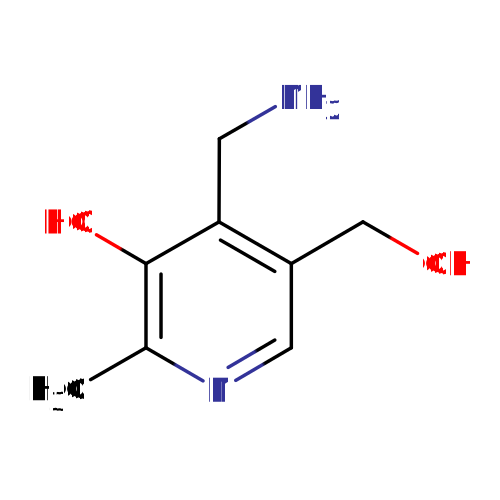
| Common Name | Pyridoxamine |
|---|
| Description | Pyridoxamine, also known as PM, belongs to the class of organic compounds known as pyridoxamine 5'-phosphates. These are heterocyclic aromatic compounds containing a pyridoxamine that carries a phosphate group at the 5'-position. Pyridoxamine is possibly soluble (in water) and a very strong basic compound (based on its pKa). Pyridoxamine exists in all living species, ranging from bacteria to humans. Pyridoxamine participates in a number of enzymatic reactions, within cattle. In particular, Pyridoxamine can be converted into pyridoxal; which is catalyzed by the enzyme pyridoxine-5'-phosphate oxidase. In addition, Pyridoxamine can be converted into pyridoxamine 5'-phosphate through its interaction with the enzyme pyridoxal kinase. In cattle, pyridoxamine is involved in the metabolic pathway called the vitamin B6 metabolism pathway. |
|---|
| Structure | |
|---|
| Synonyms | | Value | Source |
|---|
| 4-(AMINOMETHYL)-5-(hydroxymethyl)-2-methylpyridin-3-ol | ChEBI | | PM | ChEBI | | 2-Methyl-4-aminomethyl-5-hydroxymethyl-3-pyridinol | HMDB | | 4-(Aminomethyl)-5-(hydroxymethyl)-2-methyl-3-pyridinol | HMDB | | 4-(Aminomethyl)-5-hydroxy-6-methyl-3-pyridinemethanol | HMDB | | Pyridoxylamine | HMDB |
|
|---|
| Chemical Formula | C8H12N2O2 |
|---|
| Average Molecular Weight | 168.1931 |
|---|
| Monoisotopic Molecular Weight | 168.089877638 |
|---|
| IUPAC Name | 4-(aminomethyl)-5-(hydroxymethyl)-2-methylpyridin-3-ol |
|---|
| Traditional Name | pyridoxamine |
|---|
| CAS Registry Number | 85-87-0 |
|---|
| SMILES | CC1=C(O)C(CN)=C(CO)C=N1 |
|---|
| InChI Identifier | InChI=1S/C8H12N2O2/c1-5-8(12)7(2-9)6(4-11)3-10-5/h3,11-12H,2,4,9H2,1H3 |
|---|
| InChI Key | NHZMQXZHNVQTQA-UHFFFAOYSA-N |
|---|
| Chemical Taxonomy |
|---|
| Description | belongs to the class of organic compounds known as pyridoxamine 5'-phosphates. These are heterocyclic aromatic compounds containing a pyridoxamine that carries a phosphate group at the 5'-position. |
|---|
| Kingdom | Organic compounds |
|---|
| Super Class | Organoheterocyclic compounds |
|---|
| Class | Pyridines and derivatives |
|---|
| Sub Class | Pyridoxamines |
|---|
| Direct Parent | Pyridoxamine 5'-phosphates |
|---|
| Alternative Parents | |
|---|
| Substituents | - Pyridoxamine 5'-phosphate
- Aralkylamine
- Hydroxypyridine
- Methylpyridine
- Heteroaromatic compound
- Azacycle
- Amine
- Hydrocarbon derivative
- Alcohol
- Aromatic alcohol
- Primary amine
- Primary alcohol
- Organooxygen compound
- Organonitrogen compound
- Primary aliphatic amine
- Organic nitrogen compound
- Organopnictogen compound
- Organic oxygen compound
- Aromatic heteromonocyclic compound
|
|---|
| Molecular Framework | Aromatic heteromonocyclic compounds |
|---|
| External Descriptors | |
|---|
| Ontology |
|---|
| Status | Detected and Quantified |
|---|
| Origin | |
|---|
| Biofunction | Not Available |
|---|
| Application | Not Available |
|---|
| Cellular locations | Not Available |
|---|
| Physical Properties |
|---|
| State | Solid |
|---|
| Experimental Properties | | Property | Value | Reference |
|---|
| Melting Point | Not Available | Not Available | | Boiling Point | Not Available | Not Available | | Water Solubility | 815 mg/mL | Not Available | | LogP | Not Available | Not Available |
|
|---|
| Predicted Properties | |
|---|
| Spectra |
|---|
| Spectra | |
|---|
| Biological Properties |
|---|
| Cellular Locations | Not Available |
|---|
| Biospecimen Locations | - Milk
- Placenta
- Prostate Tissue
|
|---|
| Pathways | |
|---|
| Normal Concentrations |
|---|
| |
| Milk | Detected and Quantified | 0.099 +/- 0.038 uM | Not Specified | Not Specified | Normal | | details | | Milk | Detected but not Quantified | Not Quantified | Not Specified | Not Specified | Normal | | details | | Placenta | Expected but not Quantified | Not Quantified | Not Specified | Not Specified | Normal | | details | | Prostate Tissue | Expected but not Quantified | Not Quantified | Not Specified | Not Specified | Normal | | details |
|
|---|
| Abnormal Concentrations |
|---|
| Not Available |
|---|
| External Links |
|---|
| HMDB ID | HMDB0001431 |
|---|
| DrugBank ID | DB11673 |
|---|
| Phenol Explorer Compound ID | Not Available |
|---|
| FooDB ID | FDB021819 |
|---|
| KNApSAcK ID | C00007504 |
|---|
| Chemspider ID | 1023 |
|---|
| KEGG Compound ID | C00534 |
|---|
| BioCyc ID | PYRIDOXAMINE |
|---|
| BiGG ID | 35277 |
|---|
| Wikipedia Link | Pyridoxamine |
|---|
| METLIN ID | 238 |
|---|
| PubChem Compound | 1052 |
|---|
| PDB ID | Not Available |
|---|
| ChEBI ID | 16410 |
|---|
| References |
|---|
| Synthesis Reference | Not Available |
|---|
| Material Safety Data Sheet (MSDS) | Not Available |
|---|
| General References | - Coburn SP, Mahuren JD, Pauly TA, Ericson KL, Townsend DW: Alkaline phosphatase activity and pyridoxal phosphate concentrations in the milk of various species. J Nutr. 1992 Dec;122(12):2348-53. doi: 10.1093/jn/122.12.2348. [PubMed:1453218 ]
- Melzer N, Wittenburg D, Hartwig S, Jakubowski S, Kesting U, Willmitzer L, Lisec J, Reinsch N, Repsilber D: Investigating associations between milk metabolite profiles and milk traits of Holstein cows. J Dairy Sci. 2013 Mar;96(3):1521-34. doi: 10.3168/jds.2012-5743. [PubMed:23438684 ]
- Mung D, Li L: Development of Chemical Isotope Labeling LC-MS for Milk Metabolomics: Comprehensive and Quantitative Profiling of the Amine/Phenol Submetabolome. Anal Chem. 2017 Apr 18;89(8):4435-4443. doi: 10.1021/acs.analchem.6b03737. Epub 2017 Mar 28. [PubMed:28306241 ]
- Mung D, Li L: Applying quantitative metabolomics based on chemical isotope labeling LC-MS for detecting potential milk adulterant in human milk. Anal Chim Acta. 2018 Feb 25;1001:78-85. doi: 10.1016/j.aca.2017.11.019. Epub 2017 Nov 14. [PubMed:29291809 ]
|
|---|