| Record Information |
|---|
| Version | 1.0 |
|---|
| Creation Date | 2016-09-30 22:47:49 UTC |
|---|
| Update Date | 2020-04-22 15:08:45 UTC |
|---|
| BMDB ID | BMDB0001570 |
|---|
| Secondary Accession Numbers | |
|---|
| Metabolite Identification |
|---|
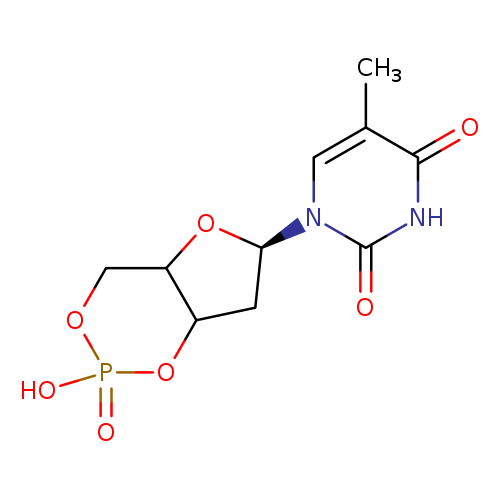
| Common Name | Thymidine 3',5'-cyclic monophosphate |
|---|
| Description | Thymidine 3',5'-cyclic monophosphate, also known as 3',5'-cyclic TMP or 3',5'-cyclic thymidine monophosphate, belongs to the class of organic compounds known as pyrimidones. Pyrimidones are compounds that contain a pyrimidine ring, which bears a ketone. Pyrimidine is a 6-membered ring consisting of four carbon atoms and two nitrogen centers at the 1- and 3- ring positions. Thymidine 3',5'-cyclic monophosphate is an extremely weak basic (essentially neutral) compound (based on its pKa). |
|---|
| Structure | |
|---|
| Synonyms | | Value | Source |
|---|
| Thymidine 3',5'-cyclic monophosphoric acid | Generator | | 3',5'-Cyclic thymidine monophosphate | HMDB | | 3',5'-Cyclic TMP | HMDB | | 4H-Furo[3,2-D]-1,3,2-dioxaphosphorin thymidine deriv. | HMDB | | CTMP | HMDB | | Cyclic 3',5'-dTMP | HMDB | | Cyclic 3',5'-thymidylate | HMDB | | Cyclic 3',5'-thymidylic acid | HMDB | | Cyclic TMP | HMDB | | Thymidine 3,5-cyclic monophosphate sodium salt | HMDB | | Thymidine cyclic 3',5'-phosphate | HMDB | | Thymidine cyclophosphate | HMDB | | Thymidine phosphate (cyclic) | HMDB | | 3',5'-Cyclic dTMP | HMDB | | Cyclic 3',5'-thymidine monophosphate | HMDB |
|
|---|
| Chemical Formula | C10H13N2O7P |
|---|
| Average Molecular Weight | 304.1932 |
|---|
| Monoisotopic Molecular Weight | 304.046037292 |
|---|
| IUPAC Name | 1-[(6R)-2-hydroxy-2-oxo-hexahydro-2lambda5-furo[3,2-d][1,3,2]dioxaphosphinin-6-yl]-5-methyl-1,2,3,4-tetrahydropyrimidine-2,4-dione |
|---|
| Traditional Name | 1-[(6R)-2-hydroxy-2-oxo-tetrahydro-4H-2lambda5-furo[3,2-d][1,3,2]dioxaphosphinin-6-yl]-5-methyl-3H-pyrimidine-2,4-dione |
|---|
| CAS Registry Number | 6453-60-7 |
|---|
| SMILES | CC1=CN([C@H]2CC3OP(O)(=O)OCC3O2)C(=O)NC1=O |
|---|
| InChI Identifier | InChI=1S/C10H13N2O7P/c1-5-3-12(10(14)11-9(5)13)8-2-6-7(18-8)4-17-20(15,16)19-6/h3,6-8H,2,4H2,1H3,(H,15,16)(H,11,13,14)/t6?,7?,8-/m1/s1 |
|---|
| InChI Key | QSJFDOVQWZVUQG-KAVNDROISA-N |
|---|
| Chemical Taxonomy |
|---|
| Description | belongs to the class of organic compounds known as pyrimidones. Pyrimidones are compounds that contain a pyrimidine ring, which bears a ketone. Pyrimidine is a 6-membered ring consisting of four carbon atoms and two nitrogen centers at the 1- and 3- ring positions. |
|---|
| Kingdom | Organic compounds |
|---|
| Super Class | Organoheterocyclic compounds |
|---|
| Class | Diazines |
|---|
| Sub Class | Pyrimidines and pyrimidine derivatives |
|---|
| Direct Parent | Pyrimidones |
|---|
| Alternative Parents | |
|---|
| Substituents | - Pyrimidone
- Hydropyrimidine
- Organic phosphoric acid derivative
- Tetrahydrofuran
- Heteroaromatic compound
- Vinylogous amide
- Lactam
- Urea
- Oxacycle
- Azacycle
- Organic nitrogen compound
- Hydrocarbon derivative
- Organic oxide
- Organooxygen compound
- Organonitrogen compound
- Organopnictogen compound
- Organic oxygen compound
- Aromatic heteropolycyclic compound
|
|---|
| Molecular Framework | Aromatic heteropolycyclic compounds |
|---|
| External Descriptors | Not Available |
|---|
| Ontology |
|---|
| Status | Expected but not Quantified |
|---|
| Origin | |
|---|
| Biofunction | Not Available |
|---|
| Application | Not Available |
|---|
| Cellular locations | Not Available |
|---|
| Physical Properties |
|---|
| State | Solid |
|---|
| Experimental Properties | | Property | Value | Reference |
|---|
| Melting Point | Not Available | Not Available | | Boiling Point | Not Available | Not Available | | Water Solubility | Not Available | Not Available | | LogP | Not Available | Not Available |
|
|---|
| Predicted Properties | |
|---|
| Spectra |
|---|
| Spectra | |
|---|