| Record Information |
|---|
| Version | 1.0 |
|---|
| Creation Date | 2016-09-30 22:50:19 UTC |
|---|
| Update Date | 2020-04-22 15:09:30 UTC |
|---|
| BMDB ID | BMDB0002040 |
|---|
| Secondary Accession Numbers | |
|---|
| Metabolite Identification |
|---|
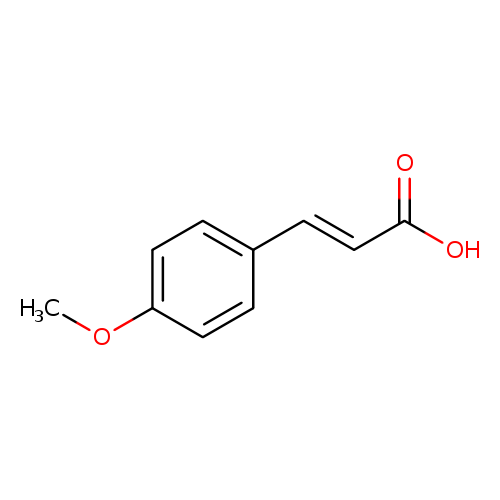
| Common Name | 4-Methoxycinnamic acid |
|---|
| Description | 4-Methoxycinnamic acid, also known as para-methoxycinnamate or O-methyl-p-coumarate, belongs to the class of organic compounds known as cinnamic acids. These are organic aromatic compounds containing a benzene and a carboxylic acid group forming 3-phenylprop-2-enoic acid. 4-Methoxycinnamic acid exists as a solid, possibly soluble (in water), and an extremely weak basic (essentially neutral) compound (based on its pKa) molecule. |
|---|
| Structure | |
|---|
| Synonyms | | Value | Source |
|---|
| 4-Methoxycinnamate | Generator | | 3-(4-Methoxyphenyl)acrylic acid | ChEMBL, HMDB | | Para-methoxycinnamic acid | ChEMBL, HMDB | | 3-(4-Methoxyphenyl)acrylate | Generator, HMDB | | Para-methoxycinnamate | Generator, HMDB | | (e)-3-(4-Methoxyphenyl)acrylate | HMDB | | (e)-3-(4-Methoxyphenyl)acrylic acid | HMDB | | 3-(4-Methoxy-phenyl)-acrylate | HMDB | | 3-(4-Methoxy-phenyl)-acrylic acid | HMDB | | 3-(4-Methoxyphenyl)-2-propenoate | HMDB | | 3-(4-Methoxyphenyl)-2-propenoic acid | HMDB | | 4-Methoxy cinnamate | HMDB | | 4-Methoxy cinnamic acid | HMDB | | O-Methyl-P-coumarate | HMDB | | O-Methyl-P-coumaric acid | HMDB | | P-Hydroxy methyl cinnamate | HMDB | | P-Methoxy ciannamate | HMDB | | P-Methoxy ciannamic acid | HMDB | | P-Methoxycinnamate | HMDB | | P-Methoxycinnamic acid | HMDB | | trans-4-Methoxycinnamate | HMDB | | trans-4-Methoxycinnamic acid | HMDB | | 4-Methoxycinnamate, aluminum salt | MeSH, HMDB | | 4-Methoxycinnamate, (e)-isomer | MeSH, HMDB | | 4-Methoxycinnamate, (Z)-isomer | MeSH, HMDB | | 4-Methoxycinnamate, zinc salt | MeSH, HMDB | | 4-Methoxycinnamate, zirconium salt | MeSH, HMDB | | e-P-Methoxycinnamic acid | MeSH, HMDB | | 4-Methoxycinnamate, calcium salt | MeSH, HMDB | | 4-Methoxycinnamate, magnesium salt | MeSH, HMDB | | 4-Methoxycinnamate, potassium salt | MeSH, HMDB | | 4-Methoxycinnamate, sodium salt | MeSH, HMDB | | (2E)-3-(4-Methoxyphenyl)prop-2-enoate | Generator, HMDB | | 4-Methoxycinnamic acid | MeSH | | (2E)-3-(4-Methoxyphenyl)-2-propenoic acid | HMDB | | (E)-3-(4-Methoxyphenyl)-2-propenoic acid | HMDB | | (E)-3-(4-Methoxyphenyl)acrylic acid | HMDB | | (E)-4-Methoxycinnamic acid | HMDB | | (E)-p-Methoxycinnamic acid | HMDB | | 3-(4-Methoxyphenyl)propenoic acid | HMDB | | 4'-Methoxycinnamic acid | HMDB | | 4-Methyoxycinnamic acid | HMDB | | 4’-Methoxycinnamic acid | HMDB | | O-Methyl-p-coumaric acid | HMDB | | p-Methoxycinnamic acid | HMDB | | trans-3-(4-Methoxyphenyl)-2-propenoic acid | HMDB | | trans-p-Methoxycinnamic acid | HMDB | | trans-p-Methoxycinnamate | Generator, HMDB |
|
|---|
| Chemical Formula | C10H10O3 |
|---|
| Average Molecular Weight | 178.1846 |
|---|
| Monoisotopic Molecular Weight | 178.062994186 |
|---|
| IUPAC Name | (2E)-3-(4-methoxyphenyl)prop-2-enoic acid |
|---|
| Traditional Name | p-methoxy-cinnamic acid |
|---|
| CAS Registry Number | 830-09-1 |
|---|
| SMILES | COC1=CC=C(\C=C\C(O)=O)C=C1 |
|---|
| InChI Identifier | InChI=1S/C10H10O3/c1-13-9-5-2-8(3-6-9)4-7-10(11)12/h2-7H,1H3,(H,11,12)/b7-4+ |
|---|
| InChI Key | AFDXODALSZRGIH-QPJJXVBHSA-N |
|---|
| Chemical Taxonomy |
|---|
| Description | belongs to the class of organic compounds known as cinnamic acids. These are organic aromatic compounds containing a benzene and a carboxylic acid group forming 3-phenylprop-2-enoic acid. |
|---|
| Kingdom | Organic compounds |
|---|
| Super Class | Phenylpropanoids and polyketides |
|---|
| Class | Cinnamic acids and derivatives |
|---|
| Sub Class | Cinnamic acids |
|---|
| Direct Parent | Cinnamic acids |
|---|
| Alternative Parents | |
|---|
| Substituents | - Cinnamic acid
- Phenoxy compound
- Anisole
- Methoxybenzene
- Styrene
- Phenol ether
- Alkyl aryl ether
- Monocyclic benzene moiety
- Benzenoid
- Carboxylic acid derivative
- Carboxylic acid
- Ether
- Monocarboxylic acid or derivatives
- Organic oxygen compound
- Carbonyl group
- Organic oxide
- Organooxygen compound
- Hydrocarbon derivative
- Aromatic homomonocyclic compound
|
|---|
| Molecular Framework | Aromatic homomonocyclic compounds |
|---|
| External Descriptors | Not Available |
|---|
| Ontology |
|---|
| Status | Detected but not Quantified |
|---|
| Origin | |
|---|
| Biofunction | Not Available |
|---|
| Application | Not Available |
|---|
| Cellular locations | |
|---|
| Physical Properties |
|---|
| State | Solid |
|---|
| Experimental Properties | | Property | Value | Reference |
|---|
| Melting Point | 173 - 175 °C | Not Available | | Boiling Point | Not Available | Not Available | | Water Solubility | 0.712 mg/mL at 25 °C | Not Available | | LogP | 2.68 | HANSCH,C ET AL. (1995) |
|
|---|
| Predicted Properties | |
|---|
| Spectra |
|---|
| Spectra | |
|---|
| Synthesis Reference | Puscaru, E.; Zotta, V.; Serper, Ana; Popescu, Margareta; Hociung, Jana; Gasmet, Ana; Spataru, Rodica. The N-methyl series of piperazine. II. Cinnamic acid derivatives. Farmacia (Bucharest, Romania) (1961), 9 345-50. |
|---|
| General References | - Qian L, Zhao A, Zhang Y, Chen T, Zeisel SH, Jia W, Cai W: Metabolomic Approaches to Explore Chemical Diversity of Human Breast-Milk, Formula Milk and Bovine Milk. Int J Mol Sci. 2016 Dec 17;17(12). pii: ijms17122128. doi: 10.3390/ijms17122128. [PubMed:27999311 ]
|
|---|