| Record Information |
|---|
| Version | 1.0 |
|---|
| Creation Date | 2016-09-30 23:02:17 UTC |
|---|
| Update Date | 2020-05-11 20:57:12 UTC |
|---|
| BMDB ID | BMDB0002961 |
|---|
| Secondary Accession Numbers | |
|---|
| Metabolite Identification |
|---|
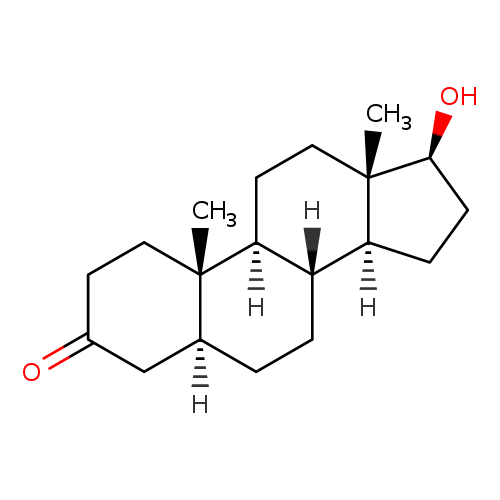
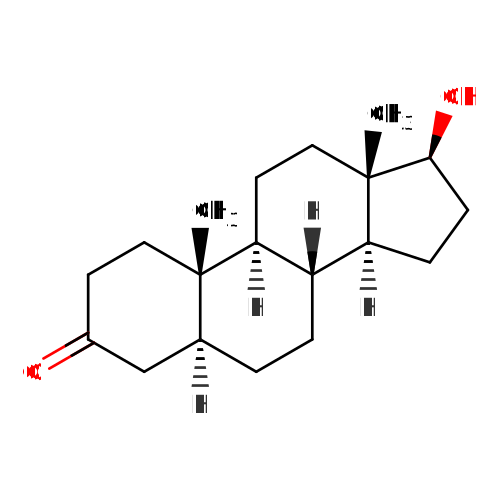
| Common Name | Dihydrotestosterone |
|---|
| Description | Dihydrotestosterone, also known as androstanolone or 5alpha-DHT, belongs to the class of organic compounds known as androgens and derivatives. These are 3-hydroxylated C19 steroid hormones. They are known to favor the development of masculine characteristics. They also show profound effects on scalp and body hair in humans. Thus, dihydrotestosterone is considered to be a steroid lipid molecule. Dihydrotestosterone is a very hydrophobic molecule, practically insoluble (in water), and relatively neutral. Dihydrotestosterone is a potentially toxic compound. |
|---|
| Structure | |
|---|
| Synonyms | | Value | Source |
|---|
| 17beta-Hydroxyandrostan-3-one | ChEBI | | 4,5alpha-Dihydrotestosterone | ChEBI | | 5alpha-DHT | ChEBI | | 5alpha-Dihydrotestosterone | ChEBI | | Androstanolona | ChEBI | | Androstanolone | ChEBI | | Androstanolonum | ChEBI | | DHT | ChEBI | | Dihydrotestosteron | ChEBI | | Stanolone | ChEBI | | 17beta-Hydroxy-5alpha-androstan-3-one | Kegg | | Andractim | Kegg | | 17b-Hydroxyandrostan-3-one | Generator | | 17Β-hydroxyandrostan-3-one | Generator | | 4,5a-Dihydrotestosterone | Generator | | 4,5Α-dihydrotestosterone | Generator | | 5a-DHT | Generator | | 5Α-DHT | Generator | | 5a-Dihydrotestosterone | Generator | | 5Α-dihydrotestosterone | Generator | | 17b-Hydroxy-5a-androstan-3-one | Generator | | 17Β-hydroxy-5α-androstan-3-one | Generator | | 17beta-Hydroxy-3-oxo-5alpha-androstanone | HMDB | | 17b-Hydroxy-3-oxo-5a-androstanone | HMDB | | 17Β-hydroxy-3-oxo-5α-androstanone | HMDB | | 17-Hydroxy-androstan-3-one | HMDB | | 17-Hydroxyandrostan-3-one | HMDB | | 17b-Hydroxy-3-androstanone | HMDB | | 4-Dihydrotestosterone | HMDB | | 5-a-Androstanolone | HMDB | | 5-alpha-Androstanolone | HMDB | | 5a-Androstan-17b-ol-3-one | HMDB | | 5a-Androstan-3-on-17b-ol | HMDB | | 5alpha-Androstan-17beta-ol-3-one | HMDB | | 5b-Androstan-3-on-17b-ol | HMDB | | Anaboleen | HMDB | | Anabolex | HMDB | | Androlone | HMDB | | Androstalone | HMDB | | Cristerona MB | HMDB | | Drolban | HMDB | | Neodrol | HMDB | | Proteina | HMDB | | Protona | HMDB | | Stanaprol | HMDB | | Stanorone | HMDB | | 17beta Hydroxy 5alpha androstan 3 one | HMDB | | 5 alpha Dihydrotestosterone | HMDB | | 5 beta Dihydrotestosterone | HMDB | | 5 beta-Dihydrotestosterone | HMDB | | Besins-iscovesco brand OF androstanolone | HMDB | | 5-alpha-DHT | HMDB | | Anaprotin | HMDB | | Berenguer infale brand OF androstanolone | HMDB | | Dihydroepitestosterone | HMDB | | 5 alpha DHT | HMDB | | 5 alpha-Dihydrotestosterone | HMDB | | Besins iscovesco brand OF androstanolone | HMDB | | Dihydrotestosterone, 5-alpha | HMDB | | 17 beta Hydroxy 5 beta androstan 3 one | HMDB | | 17 beta-Hydroxy-5 beta-androstan-3-one | HMDB | | 5-alpha Dihydrotestosterone | HMDB | | Cuxson brand OF androstanolone | HMDB | | Gelovit | HMDB | | beta-Hydroxy-5 beta-androstan-3-one, 17 | HMDB | | DIHYDROTESTOSTERONE | ChEBI |
|
|---|
| Chemical Formula | C19H30O2 |
|---|
| Average Molecular Weight | 290.4403 |
|---|
| Monoisotopic Molecular Weight | 290.224580204 |
|---|
| IUPAC Name | (1S,2S,7S,10R,11S,14S,15S)-14-hydroxy-2,15-dimethyltetracyclo[8.7.0.0^{2,7}.0^{11,15}]heptadecan-5-one |
|---|
| Traditional Name | (1S,2S,7S,10R,11S,14S,15S)-14-hydroxy-2,15-dimethyltetracyclo[8.7.0.0^{2,7}.0^{11,15}]heptadecan-5-one |
|---|
| CAS Registry Number | 521-18-6 |
|---|
| SMILES | [H][C@@]12CC[C@H](O)[C@@]1(C)CC[C@@]1([H])[C@@]2([H])CC[C@@]2([H])CC(=O)CC[C@]12C |
|---|
| InChI Identifier | InChI=1S/C19H30O2/c1-18-9-7-13(20)11-12(18)3-4-14-15-5-6-17(21)19(15,2)10-8-16(14)18/h12,14-17,21H,3-11H2,1-2H3/t12-,14-,15-,16-,17-,18-,19-/m0/s1 |
|---|
| InChI Key | NVKAWKQGWWIWPM-ABEVXSGRSA-N |
|---|
| Chemical Taxonomy |
|---|
| Description | belongs to the class of organic compounds known as androgens and derivatives. These are 3-hydroxylated C19 steroid hormones. They are known to favor the development of masculine characteristics. They also show profound effects on scalp and body hair in humans. |
|---|
| Kingdom | Organic compounds |
|---|
| Super Class | Lipids and lipid-like molecules |
|---|
| Class | Steroids and steroid derivatives |
|---|
| Sub Class | Androstane steroids |
|---|
| Direct Parent | Androgens and derivatives |
|---|
| Alternative Parents | |
|---|
| Substituents | - Androgen-skeleton
- 3-oxosteroid
- 3-oxo-5-alpha-steroid
- 17-hydroxysteroid
- Oxosteroid
- Hydroxysteroid
- Cyclic alcohol
- Cyclic ketone
- Secondary alcohol
- Ketone
- Organic oxygen compound
- Organooxygen compound
- Hydrocarbon derivative
- Carbonyl group
- Organic oxide
- Alcohol
- Aliphatic homopolycyclic compound
|
|---|
| Molecular Framework | Aliphatic homopolycyclic compounds |
|---|
| External Descriptors | |
|---|
| Ontology |
|---|
| Status | Expected but not Quantified |
|---|
| Origin | |
|---|
| Biofunction | Not Available |
|---|
| Application | Not Available |
|---|
| Cellular locations | - Cell membrane
- Cytoplasm
- Endoplasmic reticulum
- Membrane
- Myelin sheath
|
|---|
| Physical Properties |
|---|
| State | Solid |
|---|
| Experimental Properties | | Property | Value | Reference |
|---|
| Melting Point | 181 °C | Not Available | | Boiling Point | Not Available | Not Available | | Water Solubility | 525 mg/mL at 25 °C | Not Available | | LogP | 3.55 | HANSCH,C ET AL. (1995) |
|
|---|
| Predicted Properties | |
|---|
| Spectra |
|---|
| Spectra | |
|---|