| Record Information |
|---|
| Version | 1.0 |
|---|
| Creation Date | 2016-09-30 23:03:30 UTC |
|---|
| Update Date | 2020-06-04 20:48:12 UTC |
|---|
| BMDB ID | BMDB0003312 |
|---|
| Secondary Accession Numbers | |
|---|
| Metabolite Identification |
|---|
| Common Name | Daidzein |
|---|
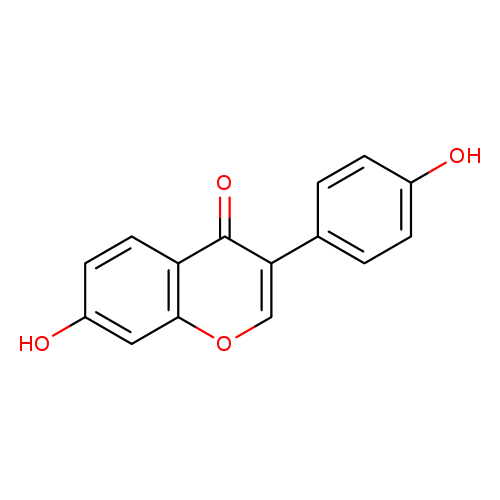
| Description | Daidzein, also known as daidzeol or isoaurostatin, belongs to the class of organic compounds known as isoflavones. These are polycyclic compounds containing a 2-isoflavene skeleton which bears a ketone group at the C4 carbon atom. Thus, daidzein is considered to be a flavonoid lipid molecule. Daidzein exists as a solid, very hydrophobic, practically insoluble (in water), and relatively neutral molecule. Daidzein is a potentially toxic compound. |
|---|
| Structure | |
|---|
| Synonyms | | Value | Source |
|---|
| 4',7-Dihydroxyisoflavone | ChEBI | | 7,4'-Dihydroxyisoflavone | ChEBI | | 7-Hydroxy-3-(4-hydroxyphenyl)-4-benzopyrone | ChEBI | | 7-Hydroxy-3-(4-hydroxyphenyl)-4H-1-benzopyran-4-one | ChEBI | | Daidzeol | ChEBI | | Isoaurostatin | ChEBI | | Diadzein | MeSH | | 4',7-Dihydroxy-isoflavone | HMDB |
|
|---|
| Chemical Formula | C15H10O4 |
|---|
| Average Molecular Weight | 254.241 |
|---|
| Monoisotopic Molecular Weight | 254.057908802 |
|---|
| IUPAC Name | 7-hydroxy-3-(4-hydroxyphenyl)-4H-chromen-4-one |
|---|
| Traditional Name | daidzein |
|---|
| CAS Registry Number | 486-66-8 |
|---|
| SMILES | OC1=CC=C(C=C1)C1=COC2=C(C=CC(O)=C2)C1=O |
|---|
| InChI Identifier | InChI=1S/C15H10O4/c16-10-3-1-9(2-4-10)13-8-19-14-7-11(17)5-6-12(14)15(13)18/h1-8,16-17H |
|---|
| InChI Key | ZQSIJRDFPHDXIC-UHFFFAOYSA-N |
|---|
| Chemical Taxonomy |
|---|
| Description | belongs to the class of organic compounds known as isoflavones. These are polycyclic compounds containing a 2-isoflavene skeleton which bears a ketone group at the C4 carbon atom. |
|---|
| Kingdom | Organic compounds |
|---|
| Super Class | Phenylpropanoids and polyketides |
|---|
| Class | Isoflavonoids |
|---|
| Sub Class | Isoflav-2-enes |
|---|
| Direct Parent | Isoflavones |
|---|
| Alternative Parents | |
|---|
| Substituents | - Isoflavone
- Hydroxyisoflavonoid
- Chromone
- Benzopyran
- 1-benzopyran
- Pyranone
- Phenol
- 1-hydroxy-2-unsubstituted benzenoid
- Benzenoid
- Monocyclic benzene moiety
- Pyran
- Heteroaromatic compound
- Oxacycle
- Organoheterocyclic compound
- Organooxygen compound
- Organic oxygen compound
- Hydrocarbon derivative
- Organic oxide
- Aromatic heteropolycyclic compound
|
|---|
| Molecular Framework | Aromatic heteropolycyclic compounds |
|---|
| External Descriptors | |
|---|
| Ontology |
|---|
| Status | Detected and Quantified |
|---|
| Origin | |
|---|
| Biofunction | Not Available |
|---|
| Application | Not Available |
|---|
| Cellular locations | |
|---|
| Physical Properties |
|---|
| State | Solid |
|---|
| Experimental Properties | | Property | Value | Reference |
|---|
| Melting Point | 323 °C | Not Available | | Boiling Point | Not Available | Not Available | | Water Solubility | Not Available | Not Available | | LogP | Not Available | Not Available |
|
|---|
| Predicted Properties | |
|---|
| Spectra |
|---|
| Spectra | |
|---|
| Biological Properties |
|---|
| Cellular Locations | |
|---|
| Biospecimen Locations | |
|---|
| Pathways | |
|---|
| Normal Concentrations |
|---|
| |
| Milk | Detected and Quantified | 0.00118 - 0.0224 uM | Not Specified | Not Specified | Normal | | details | | Milk | Detected and Quantified | 0.000393 - 0.00787 uM | Not Specified | Not Specified | Normal | | details | | Milk | Detected and Quantified | 7.159 uM | Not Specified | Not Specified | Normal | | details | | Milk | Detected and Quantified | 30.326 uM | Not Specified | Not Specified | Normal | | details | | Milk | Detected and Quantified | 2.635 uM | Not Specified | Not Specified | Normal | | details | | Milk | Detected and Quantified | 0.905 uM | Not Specified | Not Specified | Normal | | details |
|
|---|
| Abnormal Concentrations |
|---|
| Not Available |
|---|
| External Links |
|---|
| HMDB ID | HMDB0003312 |
|---|
| DrugBank ID | DB13182 |
|---|
| Phenol Explorer Compound ID | 394 |
|---|
| FooDB ID | FDB002608 |
|---|
| KNApSAcK ID | C00009380 |
|---|
| Chemspider ID | 4445025 |
|---|
| KEGG Compound ID | C10208 |
|---|
| BioCyc ID | DAIDZEIN |
|---|
| BiGG ID | Not Available |
|---|
| Wikipedia Link | Daidzein |
|---|
| METLIN ID | Not Available |
|---|
| PubChem Compound | 5281708 |
|---|
| PDB ID | Not Available |
|---|
| ChEBI ID | 28197 |
|---|
| References |
|---|
| Synthesis Reference | Baker, Wilson; Robinson, Robert; Simpson, N. M. Synthetical experiments in the isoflavone group. VII. Synthesis of daidzein. Journal of the Chemical Society (1933), 274-5. |
|---|
| Material Safety Data Sheet (MSDS) | Not Available |
|---|
| General References | - Antignac JP, Cariou R, Le Bizec B, Cravedi JP, Andre F: Identification of phytoestrogens in bovine milk using liquid chromatography/electrospray tandem mass spectrometry. Rapid Commun Mass Spectrom. 2003;17(12):1256-64. doi: 10.1002/rcm.1052. [PubMed:12811748 ]
- Steinshamn H, Purup S, Thuen E, Hansen-Moller J: Effects of clover-grass silages and concentrate supplementation on the content of phytoestrogens in dairy cow milk. J Dairy Sci. 2008 Jul;91(7):2715-25. doi: 10.3168/jds.2007-0857. [PubMed:18565930 ]
- Nielsen TS, Norgaard JV, Purup S, Frette XC, Bonefeld-Jorgensen EC: Estrogenic activity of bovine milk high or low in equol using immature mouse uterotrophic responses and an estrogen receptor transactivation assay. Cancer Epidemiol. 2009 Jul;33(1):61-8. doi: 10.1016/j.canep.2009.04.003. Epub 2009 May 31. [PubMed:19679050 ]
|
|---|