| Record Information |
|---|
| Version | 1.0 |
|---|
| Creation Date | 2016-09-30 23:04:07 UTC |
|---|
| Update Date | 2020-05-11 19:57:32 UTC |
|---|
| BMDB ID | BMDB0003375 |
|---|
| Secondary Accession Numbers | |
|---|
| Metabolite Identification |
|---|
| Common Name | (-)-Limonene |
|---|
| Description | D-Limonene, also known as L-limonen or dipentene, belongs to the class of organic compounds known as menthane monoterpenoids. These are monoterpenoids with a structure based on the o-, m-, or p-menthane backbone. P-menthane consists of the cyclohexane ring with a methyl group and a (2-methyl)-propyl group at the 1 and 4 ring position, respectively. The o- and m- menthanes are much rarer, and presumably arise by alkyl migration of p-menthanes. Thus, D-limonene is considered to be an isoprenoid lipid molecule. D-Limonene exists as a solid, very hydrophobic, practically insoluble (in water), and relatively neutral molecule. D-Limonene exists in all living organisms, ranging from bacteria to humans. |
|---|
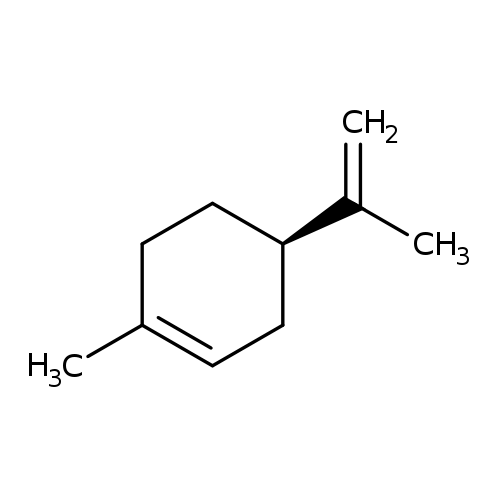
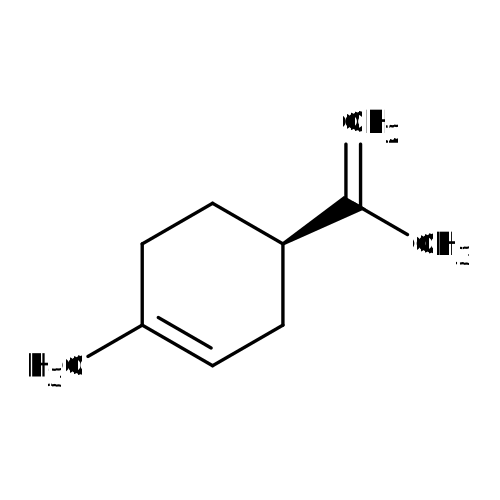
| Structure | |
|---|
| Synonyms | | Value | Source |
|---|
| (+)-(4R)-Limonene | ChEBI | | (+)-(R)-Limonene | ChEBI | | (+)-4-Isopropenyl-1-methylcyclohexene | ChEBI | | (+)-Limonene | ChEBI | | (4R)-1-Methyl-4-isopropenylcyclohex-1-ene | ChEBI | | (4R)-4-Isopropenyl-1-methylcyclohexene | ChEBI | | (R)-(+)-Limonene | ChEBI | | (R)-(+)-p-Mentha-1,8-diene | ChEBI | | (R)-1-Methyl-4-(1-methylethenyl)cyclohexene | ChEBI | | (R)-4-Isopropenyl-1-methyl-1-cyclohexene | ChEBI | | (R)-p-Mentha-1,8-diene | ChEBI | | 4BetaH-p-mentha-1,8-diene | ChEBI | | D-(+)-Limonene | ChEBI | | D-Limonen | ChEBI | | AISA 5203-L (+)limonene | HMDB | | Dipentene | HMDB | | (-)-Limonene | HMDB | | 1-Methyl-4-(1-methylethenyl)cyclohexene | HMDB | | Limonene | HMDB | | Limonene, (+-)-isomer | HMDB | | (D)-Limonene | HMDB | | 4-Mentha-1,8-diene | HMDB | | Limonene, (R)-isomer | HMDB | | (+)-Dipentene | HMDB | | (+)-alpha-Limonene | HMDB | | (+)-p-Mentha-1,8-diene | HMDB | | (+)-Α-limonene | HMDB | | (4R)-(+)-Limonene | HMDB | | (4R)-1-Methyl-4-(1-methylethenyl)cyclohexene | HMDB | | (4R)-Limonene | HMDB | | (R)-1-Methyl-4-(prop-1-en-2-yl)cyclohex-1-ene | HMDB | | (R)-Limonene | HMDB | | 1-Methyl-4-prop-1-en-2-yl-cyclohexene | HMDB | | (+)-(R)-4-Isopropenyl-1-methylcyclohexene | HMDB | | D Limonene | HMDB | | 4 Mentha 1,8 diene | HMDB | | (R)-4-Isopropenyl-1-methylcyclohexene | HMDB | | D-Limonene | ChEBI | | d-Limonene | HMDB | | (4R)-1-Methyl-4-(prop-1-en-2-yl)cyclohex-1-ene | HMDB | | R-Limonene | HMDB | | p-Mentha-1,8-diene | PhytoBank | | (±)-Dipentene | PhytoBank | | (±)-Limonene | PhytoBank | | (±)-alpha-Limonene | PhytoBank | | (±)-α-Limonene | PhytoBank | | 1,8-p-Menthadiene | PhytoBank | | 1-Methyl-4-(prop-1-en-2-yl)cyclohex-1-ene | PhytoBank | | 1-Methyl-4-isopropenyl-1-cyclohexene | PhytoBank | | 1-Methyl-4-isopropenylcyclohexene | PhytoBank | | 1-Methyl-p-isopropenyl-1-cyclohexene | PhytoBank | | 4-Isopropenyl-1-methyl-1-cyclohexene | PhytoBank | | 4-Isopropenyl-1-methylcyclohexene | PhytoBank | | dl-Limonene | PhytoBank | | Dipenten | PhytoBank | | Limonen | PhytoBank | | alpha-Limonene | PhytoBank | | α-Limonene | PhytoBank |
|
|---|
| Chemical Formula | C10H16 |
|---|
| Average Molecular Weight | 136.234 |
|---|
| Monoisotopic Molecular Weight | 136.125200512 |
|---|
| IUPAC Name | (4R)-1-methyl-4-(prop-1-en-2-yl)cyclohex-1-ene |
|---|
| Traditional Name | α-limonene |
|---|
| CAS Registry Number | 5989-54-8 |
|---|
| SMILES | CC(=C)[C@@H]1CCC(C)=CC1 |
|---|
| InChI Identifier | InChI=1S/C10H16/c1-8(2)10-6-4-9(3)5-7-10/h4,10H,1,5-7H2,2-3H3/t10-/m0/s1 |
|---|
| InChI Key | XMGQYMWWDOXHJM-JTQLQIEISA-N |
|---|
| Chemical Taxonomy |
|---|
| Description | belongs to the class of organic compounds known as menthane monoterpenoids. These are monoterpenoids with a structure based on the o-, m-, or p-menthane backbone. P-menthane consists of the cyclohexane ring with a methyl group and a (2-methyl)-propyl group at the 1 and 4 ring position, respectively. The o- and m- menthanes are much rarer, and presumably arise by alkyl migration of p-menthanes. |
|---|
| Kingdom | Organic compounds |
|---|
| Super Class | Lipids and lipid-like molecules |
|---|
| Class | Prenol lipids |
|---|
| Sub Class | Monoterpenoids |
|---|
| Direct Parent | Menthane monoterpenoids |
|---|
| Alternative Parents | |
|---|
| Substituents | - P-menthane monoterpenoid
- Monocyclic monoterpenoid
- Branched unsaturated hydrocarbon
- Cycloalkene
- Cyclic olefin
- Unsaturated aliphatic hydrocarbon
- Unsaturated hydrocarbon
- Olefin
- Hydrocarbon
- Aliphatic homomonocyclic compound
|
|---|
| Molecular Framework | Aliphatic homomonocyclic compounds |
|---|
| External Descriptors | |
|---|
| Ontology |
|---|
| Status | Detected but not Quantified |
|---|
| Origin | |
|---|
| Biofunction | Not Available |
|---|
| Application | Not Available |
|---|
| Cellular locations | - Cell membrane
- Cytoplasm
- Membrane
|
|---|
| Physical Properties |
|---|
| State | Liquid |
|---|
| Experimental Properties | | Property | Value | Reference |
|---|
| Melting Point | Not Available | Not Available | | Boiling Point | Not Available | Not Available | | Water Solubility | Not Available | Not Available | | LogP | Not Available | Not Available |
|
|---|
| Predicted Properties | |
|---|
| Spectra |
|---|
| Spectra | |
|---|