| Record Information |
|---|
| Version | 1.0 |
|---|
| Creation Date | 2016-09-30 23:04:21 UTC |
|---|
| Update Date | 2020-06-04 18:59:54 UTC |
|---|
| BMDB ID | BMDB0003407 |
|---|
| Secondary Accession Numbers | |
|---|
| Metabolite Identification |
|---|
| Common Name | Diacetyl |
|---|
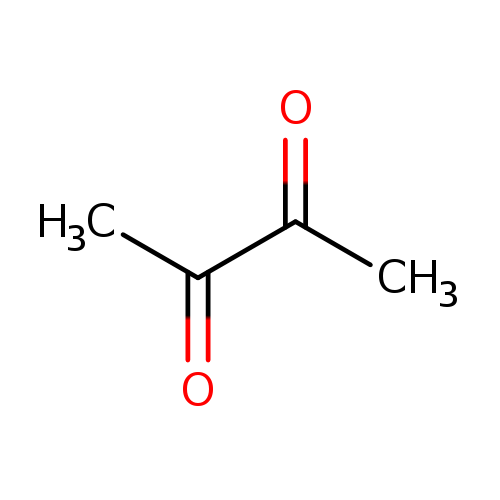
| Description | Diacetyl, also known as 2,3-butadione or dimethylglyoxal, belongs to the class of organic compounds known as alpha-diketones. These are organic compounds containing two ketone groups on two adjacent carbon atoms. Thus, diacetyl is considered to be an oxygenated hydrocarbon lipid molecule. Diacetyl exists as a liquid, very hydrophobic, practically insoluble (in water), and relatively neutral molecule. Diacetyl exists in all living species, ranging from bacteria to humans. Diacetyl is a potentially toxic compound. Diacetyl has been found to be associated with several diseases known as ulcerative colitis, nonalcoholic fatty liver disease, and crohn's disease; also diacetyl has been linked to the inborn metabolic disorders including celiac disease. |
|---|
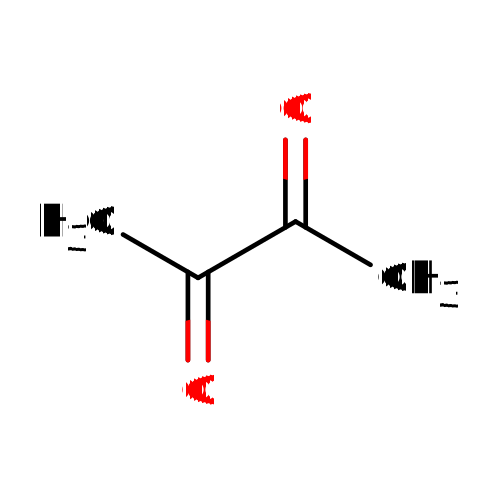
| Structure | |
|---|
| Synonyms | | Value | Source |
|---|
| 2,3-Butadione | ChEBI | | 2,3-Butandione | ChEBI | | 2,3-Butanedione | ChEBI | | 2,3-Diketobutane | ChEBI | | 2,3-Dioxobutane | ChEBI | | Biacetyl | ChEBI | | Dimethyl glyoxal | ChEBI | | Dimethylglyoxal | ChEBI | | 2,3 Butanedione | MeSH | | Diketobutane | MeSH | | Dimethyldiketone | MeSH | | Acetoacetaldehyde | HMDB | | Butadione | HMDB | | Butan-2,3-dione | HMDB | | Butane-2,3-dione | HMDB | | Butanedione | HMDB | | Dimethyl diketone | HMDB | | Diacetyl | ChEBI |
|
|---|
| Chemical Formula | C4H6O2 |
|---|
| Average Molecular Weight | 86.0892 |
|---|
| Monoisotopic Molecular Weight | 86.036779436 |
|---|
| IUPAC Name | butane-2,3-dione |
|---|
| Traditional Name | diacetyl |
|---|
| CAS Registry Number | 431-03-8 |
|---|
| SMILES | CC(=O)C(C)=O |
|---|
| InChI Identifier | InChI=1S/C4H6O2/c1-3(5)4(2)6/h1-2H3 |
|---|
| InChI Key | QSJXEFYPDANLFS-UHFFFAOYSA-N |
|---|
| Chemical Taxonomy |
|---|
| Description | belongs to the class of organic compounds known as alpha-diketones. These are organic compounds containing two ketone groups on two adjacent carbon atoms. |
|---|
| Kingdom | Organic compounds |
|---|
| Super Class | Organic oxygen compounds |
|---|
| Class | Organooxygen compounds |
|---|
| Sub Class | Carbonyl compounds |
|---|
| Direct Parent | Alpha-diketones |
|---|
| Alternative Parents | |
|---|
| Substituents | - Alpha-diketone
- Organic oxide
- Hydrocarbon derivative
- Aliphatic acyclic compound
|
|---|
| Molecular Framework | Aliphatic acyclic compounds |
|---|
| External Descriptors | |
|---|
| Ontology |
|---|
| Status | Detected and Quantified |
|---|
| Origin | |
|---|
| Biofunction | Not Available |
|---|
| Application | Not Available |
|---|
| Cellular locations | |
|---|
| Physical Properties |
|---|
| State | Liquid |
|---|
| Experimental Properties | | Property | Value | Reference |
|---|
| Melting Point | -2.4 °C | Not Available | | Boiling Point | Not Available | Not Available | | Water Solubility | 200 mg/mL at 15 °C | Not Available | | LogP | -1.34 | HANSCH,C ET AL. (1995) |
|
|---|
| Predicted Properties | |
|---|
| Spectra |
|---|
| Spectra | |
|---|
| Biological Properties |
|---|
| Cellular Locations | |
|---|
| Biospecimen Locations | - Milk
- Neuron
- Ovary
- Skeletal Muscle
- Testis
|
|---|
| Pathways | |
|---|
| Normal Concentrations |
|---|
| |
| Milk | Detected and Quantified | 0.13 +/- 0.19 mg/100g dry matter content | Not Specified | Not Specified | Normal | | details | | Milk | Detected and Quantified | 0.23 +/- 0.23 mg/100g dry matter content | Not Specified | Not Specified | Normal | | details | | Milk | Detected and Quantified | 0.00251 +/- 0.00203 uM | Not Specified | Not Specified | Normal | | details | | Milk | Detected and Quantified | 0.00359 +/- 0.00239 uM | Not Specified | Not Specified | Normal | | details | | Milk | Detected and Quantified | 0.0323 +/- 0.0587 uM | Not Specified | Not Specified | Normal | | details | | Neuron | Expected but not Quantified | Not Quantified | Not Specified | Not Specified | Normal | | details | | Ovary | Expected but not Quantified | Not Quantified | Not Specified | Not Specified | Normal | | details | | Skeletal Muscle | Expected but not Quantified | Not Quantified | Not Specified | Not Specified | Normal | | details | | Testis | Expected but not Quantified | Not Quantified | Not Specified | Not Specified | Normal | | details |
|
|---|
| Abnormal Concentrations |
|---|
| Not Available |
|---|
| External Links |
|---|
| HMDB ID | HMDB0003407 |
|---|
| DrugBank ID | Not Available |
|---|
| Phenol Explorer Compound ID | Not Available |
|---|
| FooDB ID | FDB011930 |
|---|
| KNApSAcK ID | C00050437 |
|---|
| Chemspider ID | 630 |
|---|
| KEGG Compound ID | C00741 |
|---|
| BioCyc ID | Not Available |
|---|
| BiGG ID | Not Available |
|---|
| Wikipedia Link | Diacetyl |
|---|
| METLIN ID | 6921 |
|---|
| PubChem Compound | 650 |
|---|
| PDB ID | Not Available |
|---|
| ChEBI ID | 16583 |
|---|
| References |
|---|
| Synthesis Reference | Xu, Ping; Chen, Hong; Du, Yi; Chen, Wanqiu; Xiao, Zijun. Method of preparation diacetyl by oxidization. Faming Zhuanli Shenqing Gongkai Shuomingshu (2005), 6 pp. |
|---|
| Material Safety Data Sheet (MSDS) | Not Available |
|---|
| General References | - Toso B, Procida G, Stefanon B: Determination of volatile compounds in cows' milk using headspace GC-MS. J Dairy Res. 2002 Nov;69(4):569-77. [PubMed:12463694 ]
- Brigitta Gaspardo, Giuseppe Procida, Saša Volarič, Sandy Sgorlon & Bruno Stefanon (2009). Brigitta Gaspardo et al. Determination of volatile fractions in raw milk and ripened cheese by means of GC-MS. Results of a survey performed in the marginal area between Italy and Slovenia. Italian Jounal of Animal Science Vol 8, 377-390, 2009. Italian Journal of Animal Science .
|
|---|