| Record Information |
|---|
| Version | 1.0 |
|---|
| Creation Date | 2016-09-30 23:08:32 UTC |
|---|
| Update Date | 2020-05-11 20:45:39 UTC |
|---|
| BMDB ID | BMDB0004215 |
|---|
| Secondary Accession Numbers | |
|---|
| Metabolite Identification |
|---|
| Common Name | 3,3',4'5-Tetrahydroxystilbene |
|---|
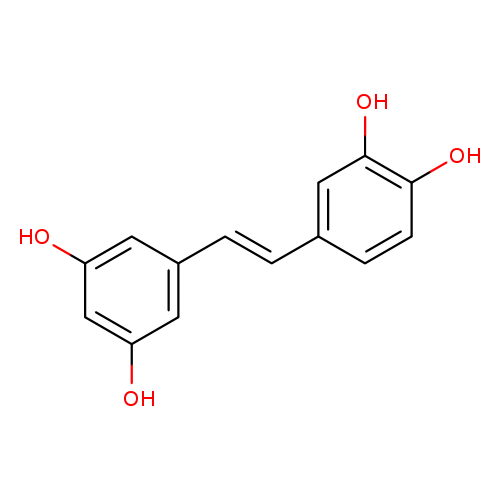
| Description | Piceatannol, also known as RSVL-1 or astringinin, belongs to the class of organic compounds known as stilbenes. These are organic compounds containing a 1,2-diphenylethylene moiety. Stilbenes (C6-C2-C6 ) are derived from the common phenylpropene (C6-C3) skeleton building block. The introduction of one or more hydroxyl groups to a phenyl ring lead to stilbenoids. Thus, piceatannol is considered to be an aromatic polyketide lipid molecule. Piceatannol is a very hydrophobic molecule, practically insoluble (in water), and relatively neutral. Piceatannol exists in all living species, ranging from bacteria to humans. |
|---|
| Structure | |
|---|
| Synonyms | | Value | Source |
|---|
| 3,5,3',4'-Tetrahydroxystilbene | ChEBI | | 3-Hydroxyresveratol | ChEBI | | 4-[(e)-2-(3,5-Dihydroxyphenyl)vinyl]benzene-1,2-diol | ChEBI | | 3,4,3',5'-Tetrahydroxy-trans-stilbene | HMDB | | 3,3',4',5-Tetrahydroxystilbene | HMDB | | 3,3',4,5'-Tetrahydroxy stilbene | HMDB | | RSVL-1 | HMDB | | 3'-Hydroxyresveratol | HMDB | | 3,3',4,5'-Tetrahydroxystilbene | HMDB | | 3,5,3',4'-Tetrahydroxy-trans-stilbene | HMDB | | Astringinin | HMDB | | Demethyl isorhapontigenin | HMDB | | Piceatanol | HMDB | | 3,5,3',4'-Tetrahydroxy-stilbene | HMDB | | Piceatannol | HMDB | | 3,3',4'5-Tetrahydroxystilbene | ChEBI | | (E)-3,3',4,5'-Stilbenetetrol | PhytoBank | | (E)-3,3’,4,5’-Stilbenetetrol | PhytoBank | | 4-[(1E)-2-(3,5-Dihydroxyphenyl)ethenyl]-1,2-benzenediol | PhytoBank | | (E)-Piceatannol | PhytoBank | | Astringenin | PhytoBank | | trans-3,3',4,5'-Tetrahydroxystilbene | PhytoBank | | trans-3,3’,4,5’-Tetrahydroxystilbene | PhytoBank | | trans-Piceatannol | PhytoBank |
|
|---|
| Chemical Formula | C14H12O4 |
|---|
| Average Molecular Weight | 244.246 |
|---|
| Monoisotopic Molecular Weight | 244.073558866 |
|---|
| IUPAC Name | 4-[(E)-2-(3,5-dihydroxyphenyl)ethenyl]benzene-1,2-diol |
|---|
| Traditional Name | 4-[(E)-2-(3,5-dihydroxyphenyl)ethenyl]benzene-1,2-diol |
|---|
| CAS Registry Number | 10083-24-6 |
|---|
| SMILES | OC1=CC(\C=C\C2=CC(O)=C(O)C=C2)=CC(O)=C1 |
|---|
| InChI Identifier | InChI=1S/C14H12O4/c15-11-5-10(6-12(16)8-11)2-1-9-3-4-13(17)14(18)7-9/h1-8,15-18H/b2-1+ |
|---|
| InChI Key | CDRPUGZCRXZLFL-OWOJBTEDSA-N |
|---|
| Chemical Taxonomy |
|---|
| Description | belongs to the class of organic compounds known as stilbenes. These are organic compounds containing a 1,2-diphenylethylene moiety. Stilbenes (C6-C2-C6 ) are derived from the common phenylpropene (C6-C3) skeleton building block. The introduction of one or more hydroxyl groups to a phenyl ring lead to stilbenoids. |
|---|
| Kingdom | Organic compounds |
|---|
| Super Class | Phenylpropanoids and polyketides |
|---|
| Class | Stilbenes |
|---|
| Sub Class | Not Available |
|---|
| Direct Parent | Stilbenes |
|---|
| Alternative Parents | |
|---|
| Substituents | - Stilbene
- Styrene
- Resorcinol
- Catechol
- 1-hydroxy-4-unsubstituted benzenoid
- 1-hydroxy-2-unsubstituted benzenoid
- Phenol
- Benzenoid
- Monocyclic benzene moiety
- Organic oxygen compound
- Hydrocarbon derivative
- Organooxygen compound
- Aromatic homomonocyclic compound
|
|---|
| Molecular Framework | Aromatic homomonocyclic compounds |
|---|
| External Descriptors | |
|---|
| Ontology |
|---|
| Status | Detected but not Quantified |
|---|
| Origin | |
|---|
| Biofunction | Not Available |
|---|
| Application | Not Available |
|---|
| Cellular locations | |
|---|
| Physical Properties |
|---|
| State | Solid |
|---|
| Experimental Properties | | Property | Value | Reference |
|---|
| Melting Point | Not Available | Not Available | | Boiling Point | Not Available | Not Available | | Water Solubility | Not Available | Not Available | | LogP | Not Available | Not Available |
|
|---|
| Predicted Properties | |
|---|
| Spectra |
|---|
| Spectra | |
|---|
| Synthesis Reference | Bajaj, Renu; Gill, Mark T.; McLaughlin, Jerry L. Improved preparative synthesis of piceatannol (3,4,3',5'-tetrahydroxy-trans-stilbene). Revista Latinoamericana de Quimica (1987), 18(2), 79-80. |
|---|
| General References | - Melzer N, Wittenburg D, Hartwig S, Jakubowski S, Kesting U, Willmitzer L, Lisec J, Reinsch N, Repsilber D: Investigating associations between milk metabolite profiles and milk traits of Holstein cows. J Dairy Sci. 2013 Mar;96(3):1521-34. doi: 10.3168/jds.2012-5743. [PubMed:23438684 ]
|
|---|