| Record Information |
|---|
| Version | 1.0 |
|---|
| Creation Date | 2016-09-30 23:09:06 UTC |
|---|
| Update Date | 2020-05-11 20:15:18 UTC |
|---|
| BMDB ID | BMDB0004304 |
|---|
| Secondary Accession Numbers | |
|---|
| Metabolite Identification |
|---|
| Common Name | Nivalenol |
|---|
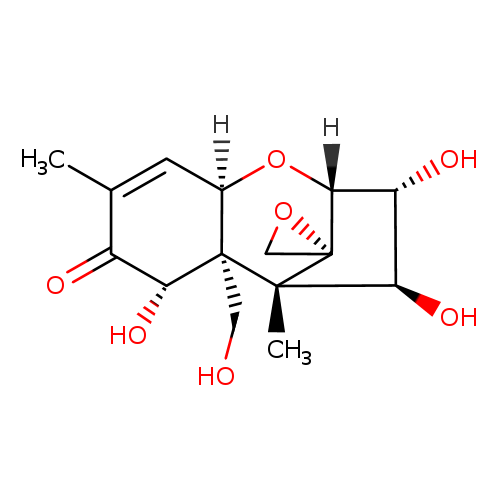
| Description | Nivalenol belongs to the class of organic compounds known as trichothecenes. These are sesquiterpene mycotoxins structurally characterized by the presence of an epoxide ring and a benzopyran derivative with a variant number of hydroxyl, acetyl, or other substituents. The most important structural features causing the biological activities of trichothecenes are the 12,13-epoxy ring, the presence of hydroxyl or acetyl groups at appropriate positions on the trichothecene nucleus and the structure and position of the side-chain. Based on a literature review a significant number of articles have been published on Nivalenol. |
|---|
| Structure | |
|---|
| Synonyms | Not Available |
|---|
| Chemical Formula | C15H20O7 |
|---|
| Average Molecular Weight | 312.3151 |
|---|
| Monoisotopic Molecular Weight | 312.120902994 |
|---|
| IUPAC Name | (1'S,2R,2'R,3'S,7'R,9'R,10'R,11'S)-3',10',11'-trihydroxy-2'-(hydroxymethyl)-1',5'-dimethyl-8'-oxaspiro[oxirane-2,12'-tricyclo[7.2.1.0²,⁷]dodecan]-5'-en-4'-one |
|---|
| Traditional Name | nivalenol |
|---|
| CAS Registry Number | 23282-20-4 |
|---|
| SMILES | [H][C@@]12O[C@]3([H])C=C(C)C(=O)[C@@H](O)[C@]3(CO)[C@@](C)([C@H](O)[C@H]1O)[C@@]21CO1 |
|---|
| InChI Identifier | InChI=1S/C15H20O7/c1-6-3-7-14(4-16,11(20)8(6)17)13(2)10(19)9(18)12(22-7)15(13)5-21-15/h3,7,9-12,16,18-20H,4-5H2,1-2H3/t7-,9-,10-,11-,12-,13-,14-,15-/m1/s1 |
|---|
| InChI Key | UKOTXHQERFPCBU-YQPARWETSA-N |
|---|
| Chemical Taxonomy |
|---|
| Description | belongs to the class of organic compounds known as trichothecenes. These are sesquiterpene mycotoxins structurally characterized by the presence of an epoxide ring and a benzopyran derivative with a variant number of hydroxyl, acetyl, or other substituents. The most important structural features causing the biological activities of trichothecenes are the 12,13-epoxy ring, the presence of hydroxyl or acetyl groups at appropriate positions on the trichothecene nucleus and the structure and position of the side-chain. |
|---|
| Kingdom | Organic compounds |
|---|
| Super Class | Lipids and lipid-like molecules |
|---|
| Class | Prenol lipids |
|---|
| Sub Class | Sesquiterpenoids |
|---|
| Direct Parent | Trichothecenes |
|---|
| Alternative Parents | |
|---|
| Substituents | - Trichothecene skeleton
- Cyclohexenone
- Oxepane
- Oxane
- Cyclic alcohol
- Ketone
- Secondary alcohol
- Cyclic ketone
- Dialkyl ether
- Oxirane
- Ether
- Oxacycle
- Polyol
- Organoheterocyclic compound
- Organic oxide
- Carbonyl group
- Organooxygen compound
- Hydrocarbon derivative
- Organic oxygen compound
- Alcohol
- Primary alcohol
- Aliphatic heteropolycyclic compound
|
|---|
| Molecular Framework | Aliphatic heteropolycyclic compounds |
|---|
| External Descriptors | |
|---|
| Ontology |
|---|
| Status | Expected but not Quantified |
|---|
| Origin | |
|---|
| Biofunction | Not Available |
|---|
| Application | Not Available |
|---|
| Cellular locations | |
|---|
| Physical Properties |
|---|
| State | Solid |
|---|
| Experimental Properties | | Property | Value | Reference |
|---|
| Melting Point | 222 °C | Not Available | | Boiling Point | Not Available | Not Available | | Water Solubility | Not Available | Not Available | | LogP | Not Available | Not Available |
|
|---|
| Predicted Properties | |
|---|
| Spectra |
|---|
| Spectra | |
|---|