| Record Information |
|---|
| Version | 1.0 |
|---|
| Creation Date | 2016-09-30 23:15:10 UTC |
|---|
| Update Date | 2020-04-22 15:15:17 UTC |
|---|
| BMDB ID | BMDB0005073 |
|---|
| Secondary Accession Numbers | |
|---|
| Metabolite Identification |
|---|
| Common Name | Leukotriene B5 |
|---|
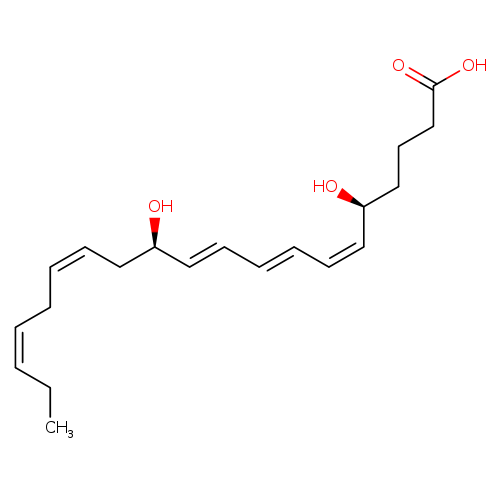
| Description | Leukotriene B5, also known as 5,12-dihepe or LTB5, belongs to the class of organic compounds known as hydroxyeicosapentaenoic acids. These are eicosanoic acids with an attached hydroxyl group and five CC double bonds. Thus, leukotriene B5 is considered to be an eicosanoid. Based on a literature review a significant number of articles have been published on Leukotriene B5. |
|---|
| Structure | |
|---|
| Synonyms | | Value | Source |
|---|
| (5S,6Z,8E,10E,12R,14Z)-5,12-Dihydroxy-6,8,10,14,17-eicosapentaenoic acid | ChEBI | | 5,12-DiHEPE | ChEBI | | LTB5 | ChEBI | | (5S,6Z,8E,10E,12R,14Z)-5,12-Dihydroxy-6,8,10,14,17-eicosapentaenoate | Generator | | 5,12-Dihydroxy-6-trans-leukotriene b(5) | HMDB | | 5,12-Dihydroxy-6E-LTB5 | HMDB | | 5,12-Dihydroxy-6,8,10,14,17-eicosapentaenoic acid | HMDB | | LTB 5 | HMDB | | Leukotriene b5 | MeSH |
|
|---|
| Chemical Formula | C20H30O4 |
|---|
| Average Molecular Weight | 334.4498 |
|---|
| Monoisotopic Molecular Weight | 334.214409448 |
|---|
| IUPAC Name | (5S,6Z,8E,10E,12R,14Z,17Z)-5,12-dihydroxyicosa-6,8,10,14,17-pentaenoic acid |
|---|
| Traditional Name | leukotriene B5 |
|---|
| CAS Registry Number | 80445-66-5 |
|---|
| SMILES | CC\C=C/C\C=C/C[C@@H](O)\C=C\C=C\C=C/[C@@H](O)CCCC(O)=O |
|---|
| InChI Identifier | InChI=1S/C20H30O4/c1-2-3-4-5-6-9-13-18(21)14-10-7-8-11-15-19(22)16-12-17-20(23)24/h3-4,6-11,14-15,18-19,21-22H,2,5,12-13,16-17H2,1H3,(H,23,24)/b4-3-,8-7+,9-6-,14-10+,15-11-/t18-,19-/m1/s1 |
|---|
| InChI Key | BISQPGCQOHLHQK-HDNPQISLSA-N |
|---|
| Chemical Taxonomy |
|---|
| Description | belongs to the class of organic compounds known as hydroxyeicosapentaenoic acids. These are eicosanoic acids with an attached hydroxyl group and five CC double bonds. |
|---|
| Kingdom | Organic compounds |
|---|
| Super Class | Lipids and lipid-like molecules |
|---|
| Class | Fatty Acyls |
|---|
| Sub Class | Eicosanoids |
|---|
| Direct Parent | Hydroxyeicosapentaenoic acids |
|---|
| Alternative Parents | |
|---|
| Substituents | - Hydroxyeicosapentaenoic acid
- Long-chain fatty acid
- Hydroxy fatty acid
- Fatty acid
- Unsaturated fatty acid
- Secondary alcohol
- Carboxylic acid derivative
- Carboxylic acid
- Monocarboxylic acid or derivatives
- Organic oxide
- Organic oxygen compound
- Alcohol
- Hydrocarbon derivative
- Carbonyl group
- Organooxygen compound
- Aliphatic acyclic compound
|
|---|
| Molecular Framework | Aliphatic acyclic compounds |
|---|
| External Descriptors | |
|---|
| Ontology |
|---|
| Status | Expected but not Quantified |
|---|
| Origin | |
|---|
| Biofunction | Not Available |
|---|
| Application | Not Available |
|---|
| Cellular locations | - Cell membrane
- Cytoplasm
- Membrane
|
|---|
| Physical Properties |
|---|
| State | Solid |
|---|
| Experimental Properties | | Property | Value | Reference |
|---|
| Melting Point | Not Available | Not Available | | Boiling Point | Not Available | Not Available | | Water Solubility | Not Available | Not Available | | LogP | 2.895 | Not Available |
|
|---|
| Predicted Properties | |
|---|
| Spectra |
|---|
| Spectra | |
|---|