| Record Information |
|---|
| Version | 1.0 |
|---|
| Creation Date | 2016-09-30 23:18:44 UTC |
|---|
| Update Date | 2020-04-22 15:16:23 UTC |
|---|
| BMDB ID | BMDB0005801 |
|---|
| Secondary Accession Numbers | |
|---|
| Metabolite Identification |
|---|
| Common Name | Kaempferol |
|---|
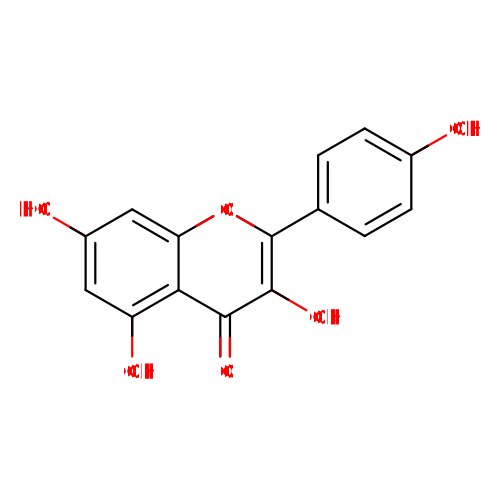
| Description | Kaempferol, also known as rhamnolutein or c.i. 75640, belongs to the class of organic compounds known as flavonols. Flavonols are compounds that contain a flavone (2-phenyl-1-benzopyran-4-one) backbone carrying a hydroxyl group at the 3-position. Thus, kaempferol is considered to be a flavonoid. Kaempferol exists in all eukaryotes, ranging from yeast to plants to humans. Based on a literature review a significant number of articles have been published on Kaempferol. |
|---|
| Structure | |
|---|
| Synonyms | | Value | Source |
|---|
| 3,4',5,7-Tetrahydroxyflavone | ChEBI | | 4H-1-Benzopyran-4-one, 3,5,7-trihydroxy-2-(4-hydroxyphenyl)-5,7,4'-trihydroxyflavonol | ChEBI | | 5,7,4'-Trihydroxyflavonol | ChEBI | | C.I. 75640 | ChEBI | | Campherol | ChEBI | | Indigo yellow | ChEBI | | Kaempherol | ChEBI | | Kampherol | ChEBI | | Kempferol | ChEBI | | Nimbecetin | ChEBI | | Pelargidenolon | ChEBI | | Populnetin | ChEBI | | Rhamnolutein | ChEBI | | Rhamnolutin | ChEBI | | Robigenin | ChEBI | | Swartziol | ChEBI | | Trifolitin | ChEBI | | 3,5,7-Trihydroxy-2-(4-hydroxyphenyl)-4H-1-benzopyran-4-one | Kegg | | 3,4',5,7-Tetrahydroxy-flavone (7ci,8ci) | HMDB | | 3,5,7-Trihydroxy-2-(4-hydroxyphenyl)-4H-chromen-4-one | HMDB | | Kampferol | HMDB | | 3,4’,5,7-Tetrahydroxyflavone | PhytoBank | | 3,5,7,4'-Tetrahydroxyflavone | PhytoBank | | 3,5,7,4’-Tetrahydroxyflavone | PhytoBank | | 3'-Deoxyquercetin | PhytoBank | | 3’-Deoxyquercetin | PhytoBank | | 5,7,4’-Trihydroxyflavonol | PhytoBank | | Kaemferol | PhytoBank | | Kaempferol | PhytoBank | | Kampcetin | PhytoBank | | Pelargidenon | PhytoBank |
|
|---|
| Chemical Formula | C15H10O6 |
|---|
| Average Molecular Weight | 286.2363 |
|---|
| Monoisotopic Molecular Weight | 286.047738052 |
|---|
| IUPAC Name | 3,5,7-trihydroxy-2-(4-hydroxyphenyl)-4H-chromen-4-one |
|---|
| Traditional Name | kaempferol |
|---|
| CAS Registry Number | 520-18-3 |
|---|
| SMILES | OC1=CC=C(C=C1)C1=C(O)C(=O)C2=C(O1)C=C(O)C=C2O |
|---|
| InChI Identifier | InChI=1S/C15H10O6/c16-8-3-1-7(2-4-8)15-14(20)13(19)12-10(18)5-9(17)6-11(12)21-15/h1-6,16-18,20H |
|---|
| InChI Key | IYRMWMYZSQPJKC-UHFFFAOYSA-N |
|---|
| Chemical Taxonomy |
|---|
| Description | belongs to the class of organic compounds known as flavonols. Flavonols are compounds that contain a flavone (2-phenyl-1-benzopyran-4-one) backbone carrying a hydroxyl group at the 3-position. |
|---|
| Kingdom | Organic compounds |
|---|
| Super Class | Phenylpropanoids and polyketides |
|---|
| Class | Flavonoids |
|---|
| Sub Class | Flavones |
|---|
| Direct Parent | Flavonols |
|---|
| Alternative Parents | |
|---|
| Substituents | - 3-hydroxyflavone
- 3-hydroxyflavonoid
- 4'-hydroxyflavonoid
- 5-hydroxyflavonoid
- 7-hydroxyflavonoid
- Hydroxyflavonoid
- Chromone
- Benzopyran
- 1-benzopyran
- 1-hydroxy-4-unsubstituted benzenoid
- 1-hydroxy-2-unsubstituted benzenoid
- Phenol
- Pyranone
- Monocyclic benzene moiety
- Pyran
- Benzenoid
- Heteroaromatic compound
- Vinylogous acid
- Polyol
- Organoheterocyclic compound
- Oxacycle
- Organic oxygen compound
- Organooxygen compound
- Hydrocarbon derivative
- Organic oxide
- Aromatic heteropolycyclic compound
|
|---|
| Molecular Framework | Aromatic heteropolycyclic compounds |
|---|
| External Descriptors | |
|---|
| Ontology |
|---|
| Status | Expected but not Quantified |
|---|
| Origin | |
|---|
| Biofunction | Not Available |
|---|
| Application | Not Available |
|---|
| Cellular locations | |
|---|
| Physical Properties |
|---|
| State | Solid |
|---|
| Experimental Properties | | Property | Value | Reference |
|---|
| Melting Point | 285 - 287 °C | Not Available | | Boiling Point | Not Available | Not Available | | Water Solubility | Not Available | Not Available | | LogP | Not Available | Not Available |
|
|---|
| Predicted Properties | |
|---|
| Spectra |
|---|
| Spectra | |
|---|