| Record Information |
|---|
| Version | 1.0 |
|---|
| Creation Date | 2016-10-03 18:21:47 UTC |
|---|
| Update Date | 2020-05-21 16:29:07 UTC |
|---|
| BMDB ID | BMDB0011618 |
|---|
| Secondary Accession Numbers | |
|---|
| Metabolite Identification |
|---|
| Common Name | All-trans-13,14-dihydroretinol |
|---|
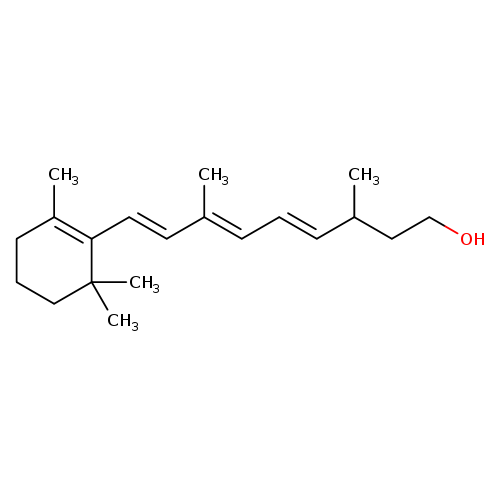
| Description | all-trans-13,14-Dihydroretinol belongs to the class of organic compounds known as retinoids. These are oxygenated derivatives of 3,7-dimethyl-1-(2,6,6-trimethylcyclohex-1-enyl)nona-1,3,5,7-tetraene and derivatives thereof. Thus, all-trans-All-trans-all-trans-13,14-dihydroretinol is considered to be an isoprenoid lipid molecule. all-trans-13,14-Dihydroretinol is a very hydrophobic molecule, practically insoluble (in water), and relatively neutral. all-trans-13,14-Dihydroretinol exists in all living organisms, ranging from bacteria to humans. all-trans-13,14-Dihydroretinol can be biosynthesized from vitamin a through its interaction with the enzyme all-trans-retinol 13,14-reductase. In cattle, all-trans-All-trans-all-trans-13,14-dihydroretinol is involved in the metabolic pathway called the retinol metabolism pathway. |
|---|
| Structure | |
|---|
| Synonyms | | Value | Source |
|---|
| 13,14-Dihydroretinol | ChEBI | | 13,14-Dihydro-all-trans-retinol | HMDB | | 13,14-Dihydro-retinol | HMDB |
|
|---|
| Chemical Formula | C20H32O |
|---|
| Average Molecular Weight | 288.4675 |
|---|
| Monoisotopic Molecular Weight | 288.245315646 |
|---|
| IUPAC Name | (4E,6E,8E)-3,7-dimethyl-9-(2,6,6-trimethylcyclohex-1-en-1-yl)nona-4,6,8-trien-1-ol |
|---|
| Traditional Name | 13,14-dihydroretinol |
|---|
| CAS Registry Number | 115797-14-3 |
|---|
| SMILES | CC(CCO)\C=C\C=C(/C)\C=C\C1=C(C)CCCC1(C)C |
|---|
| InChI Identifier | InChI=1S/C20H32O/c1-16(8-6-9-17(2)13-15-21)11-12-19-18(3)10-7-14-20(19,4)5/h6,8-9,11-12,17,21H,7,10,13-15H2,1-5H3/b9-6+,12-11+,16-8+ |
|---|
| InChI Key | OVBOQVAIYMSUDT-HRYGCDPOSA-N |
|---|
| Chemical Taxonomy |
|---|
| Description | belongs to the class of organic compounds known as retinoids. These are oxygenated derivatives of 3,7-dimethyl-1-(2,6,6-trimethylcyclohex-1-enyl)nona-1,3,5,7-tetraene and derivatives thereof. |
|---|
| Kingdom | Organic compounds |
|---|
| Super Class | Lipids and lipid-like molecules |
|---|
| Class | Prenol lipids |
|---|
| Sub Class | Retinoids |
|---|
| Direct Parent | Retinoids |
|---|
| Alternative Parents | |
|---|
| Substituents | - Retinoid skeleton
- Diterpenoid
- Fatty alcohol
- Fatty acyl
- Organic oxygen compound
- Hydrocarbon derivative
- Primary alcohol
- Organooxygen compound
- Alcohol
- Aliphatic homomonocyclic compound
|
|---|
| Molecular Framework | Aliphatic homomonocyclic compounds |
|---|
| External Descriptors | |
|---|
| Ontology |
|---|
| Status | Expected but not Quantified |
|---|
| Origin | |
|---|
| Biofunction | Not Available |
|---|
| Application | Not Available |
|---|
| Cellular locations | - Cell membrane
- Cytoplasm
- Membrane
|
|---|
| Physical Properties |
|---|
| State | Solid |
|---|
| Experimental Properties | | Property | Value | Reference |
|---|
| Melting Point | Not Available | Not Available | | Boiling Point | Not Available | Not Available | | Water Solubility | Not Available | Not Available | | LogP | Not Available | Not Available |
|
|---|
| Predicted Properties | |
|---|
| Spectra |
|---|
| Spectra | |
|---|