| Record Information |
|---|
| Version | 1.0 |
|---|
| Creation Date | 2016-10-03 18:24:02 UTC |
|---|
| Update Date | 2021-01-12 22:02:01 UTC |
|---|
| BMDB ID | BMDB0011753 |
|---|
| Secondary Accession Numbers | |
|---|
| Metabolite Identification |
|---|
| Common Name | Iminodiacetate |
|---|
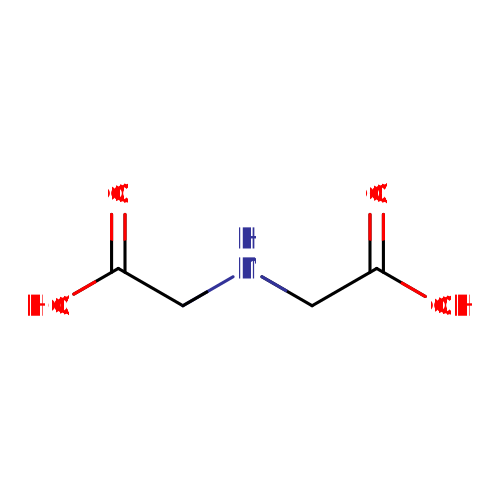
| Description | Iminodiacetic acid (IDA) is a dicarboxylic acid amine. It is a strongly acidic compound that is very water soluble. It naturally exists as a white powder. IDA is food by-product or intermediate produced via the reaction of glycine with acrylamide through the heating, baking or frying of carbohydrate-rich foods such as potatoes (PMID: 25212154 ). Acrylamide is typically produced through a Maillard reaction (a heating reaction) of asparagine and various reducing sugars in plant-derived foods (PMID: 12368844 ). Concentrations of IDA are reduced in the plasma of individuals with autism (PMID: 33087514 ) and elevated in individuals with acute respiratory distress syndrome (ARDS) (PMID: 30779905 ). In addition to its role in metabolism, IDA has many industrial applications or roles. For instance, it is an important intermediate in the manufacture the herbicide glyphosate. IDA is also used in capillary electrophoresis for modulating peptide mobility and can be used as a precursor for the manufacture of the indicator xylenol orange. The iminodiacetate anion can act as a tridentate ligand to form a metal complex with two, fused, five membered chelate rings. The proton on the nitrogen atom can be replaced by a carbon atom of a polymer to create an ion-exchange resin, such as chelex 100. Iminodiacetic acid is used in HIDA (hepatobiliary iminodiacetic acid) scans or cholescintigraphy scans, that employ the radionuclide Technetium 99m, to diagnose several diseases in the liver, gallbladder and bile duct. |
|---|
| Structure | |
|---|
| Synonyms | | Value | Source |
|---|
| 2,2'-Azanediyldiacetic acid | ChEBI | | 2-[(Carboxymethyl)amino]acetic acid | ChEBI | | Aminodiacetic acid | ChEBI | | Bis(carboxymethyl)amine | ChEBI | | Diglycine | ChEBI | | Diglycocoll | ChEBI | | IDA | ChEBI | | Iminobis(acetic acid) | ChEBI | | Iminodiethanoic acid | ChEBI | | N-(Carboxymethyl)glycine | ChEBI | | 2,2'-Azanediyldiacetate | Generator | | 2-[(Carboxymethyl)amino]acetate | Generator | | Aminodiacetate | Generator | | Iminobis(acetate) | Generator | | Iminodiethanoate | Generator | | Iminodiacetate | Generator | | Imidodiacetic acid | MeSH | | Iminodiacetic acid, disodium salt | MeSH | | Iminodiacetic acid, calcium salt (1:1) | MeSH | | Iminodiacetic acid, sodium salt | MeSH | | 2,2'-Iminodiacetic acid | ChEBI | | 2,2'-Iminodiacetate | Generator | | N-(Carboxymethyl)- glycine | HMDB | | Iminodiacetic acid | Generator |
|
|---|
| Chemical Formula | C4H7NO4 |
|---|
| Average Molecular Weight | 133.1027 |
|---|
| Monoisotopic Molecular Weight | 133.037507717 |
|---|
| IUPAC Name | 2-[(carboxymethyl)amino]acetic acid |
|---|
| Traditional Name | iminodiacetic acid |
|---|
| CAS Registry Number | 142-73-4 |
|---|
| SMILES | OC(=O)CNCC(O)=O |
|---|
| InChI Identifier | InChI=1S/C4H7NO4/c6-3(7)1-5-2-4(8)9/h5H,1-2H2,(H,6,7)(H,8,9) |
|---|
| InChI Key | NBZBKCUXIYYUSX-UHFFFAOYSA-N |
|---|
| Chemical Taxonomy |
|---|
| Description | belongs to the class of organic compounds known as alpha amino acids. These are amino acids in which the amino group is attached to the carbon atom immediately adjacent to the carboxylate group (alpha carbon). |
|---|
| Kingdom | Organic compounds |
|---|
| Super Class | Organic acids and derivatives |
|---|
| Class | Carboxylic acids and derivatives |
|---|
| Sub Class | Amino acids, peptides, and analogues |
|---|
| Direct Parent | Alpha amino acids |
|---|
| Alternative Parents | |
|---|
| Substituents | - Alpha-amino acid
- Dicarboxylic acid or derivatives
- Amino acid
- Carboxylic acid
- Secondary aliphatic amine
- Secondary amine
- Organic nitrogen compound
- Hydrocarbon derivative
- Organooxygen compound
- Organonitrogen compound
- Organic oxide
- Organopnictogen compound
- Organic oxygen compound
- Carbonyl group
- Amine
- Aliphatic acyclic compound
|
|---|
| Molecular Framework | Aliphatic acyclic compounds |
|---|
| External Descriptors | |
|---|
| Ontology |
|---|
| Status | Detected but not Quantified |
|---|
| Origin | |
|---|
| Biofunction | Not Available |
|---|
| Application | Not Available |
|---|
| Cellular locations | Not Available |
|---|
| Physical Properties |
|---|
| State | Solid |
|---|
| Experimental Properties | | Property | Value | Reference |
|---|
| Melting Point | Not Available | Not Available | | Boiling Point | Not Available | Not Available | | Water Solubility | Not Available | Not Available | | LogP | Not Available | Not Available |
|
|---|
| Predicted Properties | |
|---|
| Spectra |
|---|
| Spectra | |
|---|
| Biological Properties |
|---|
| Cellular Locations | Not Available |
|---|
| Biospecimen Locations | |
|---|
| Pathways | |
|---|
| Normal Concentrations |
|---|
| |
| Mammary Gland | Detected but not Quantified | Not Quantified | Not Specified | Not Specified | Normal | | details | | Mammary Gland | Detected but not Quantified | Not Quantified | Not Specified | Not Specified | Normal | | details |
|
|---|
| Abnormal Concentrations |
|---|
| Not Available |
|---|
| External Links |
|---|
| HMDB ID | HMDB0011753 |
|---|
| DrugBank ID | Not Available |
|---|
| Phenol Explorer Compound ID | Not Available |
|---|
| FooDB ID | FDB028424 |
|---|
| KNApSAcK ID | C00053341 |
|---|
| Chemspider ID | 8557 |
|---|
| KEGG Compound ID | C19911 |
|---|
| BioCyc ID | CPD-10189 |
|---|
| BiGG ID | Not Available |
|---|
| Wikipedia Link | Iminodiacetic_acid |
|---|
| METLIN ID | Not Available |
|---|
| PubChem Compound | 8897 |
|---|
| PDB ID | Not Available |
|---|
| ChEBI ID | 24786 |
|---|
| References |
|---|
| Synthesis Reference | Not Available |
|---|
| Material Safety Data Sheet (MSDS) | Not Available |
|---|
| General References | - Liu J, Chen F, Man Y, Dong J, Hu X: The pathways for the removal of acrylamide in model systems using glycine based on the identification of reaction products. Food Chem. 2011 Sep 15;128(2):442-9. doi: 10.1016/j.foodchem.2011.03.051. Epub 2011 Mar 12. [PubMed:25212154 ]
- Mottram DS, Wedzicha BL, Dodson AT: Acrylamide is formed in the Maillard reaction. Nature. 2002 Oct 3;419(6906):448-9. doi: 10.1038/419448a. [PubMed:12368844 ]
- Kang DW, Adams JB, Vargason T, Santiago M, Hahn J, Krajmalnik-Brown R: Distinct Fecal and Plasma Metabolites in Children with Autism Spectrum Disorders and Their Modulation after Microbiota Transfer Therapy. mSphere. 2020 Oct 21;5(5). pii: 5/5/e00314-20. doi: 10.1128/mSphere.00314-20. [PubMed:33087514 ]
- Lin S, Yue X, Wu H, Han TL, Zhu J, Wang C, Lei M, Zhang M, Liu Q, Xu F: Explore potential plasma biomarkers of acute respiratory distress syndrome (ARDS) using GC-MS metabolomics analysis. Clin Biochem. 2019 Apr;66:49-56. doi: 10.1016/j.clinbiochem.2019.02.009. Epub 2019 Feb 16. [PubMed:30779905 ]
|
|---|