| Record Information |
|---|
| Version | 1.0 |
|---|
| Creation Date | 2016-09-30 22:36:37 UTC |
|---|
| Update Date | 2020-06-04 19:14:35 UTC |
|---|
| BMDB ID | BMDB0000791 |
|---|
| Secondary Accession Numbers | |
|---|
| Metabolite Identification |
|---|
| Common Name | L-Octanoylcarnitine |
|---|
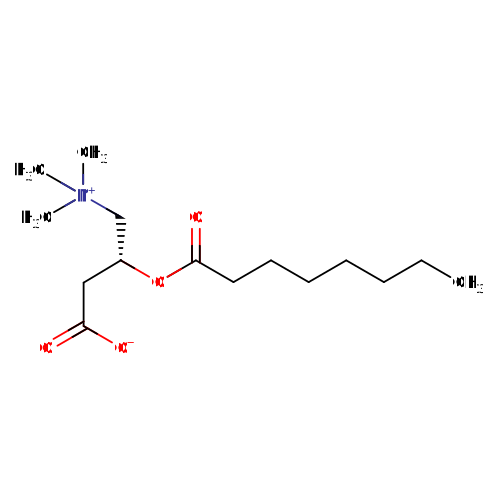
| Description | L-Octanoylcarnitine belongs to the class of organic compounds known as acyl carnitines. These are organic compounds containing a fatty acid with the carboxylic acid attached to carnitine through an ester bond. Thus, L-octanoylcarnitine is considered to be a fatty ester lipid molecule. L-Octanoylcarnitine is a very hydrophobic molecule, practically insoluble (in water), and relatively neutral. L-Octanoylcarnitine has been found to be associated with several diseases known as pregnancy, colorectal cancer, and ulcerative colitis; also l-octanoylcarnitine has been linked to several inborn metabolic disorders including celiac disease and very long chain acyl-coa dehydrogenase deficiency. |
|---|
| Structure | |
|---|
| Synonyms | | Value | Source |
|---|
| L-Octanoyl-L-carnitine | ChEBI | | O-Octanoyl-(R)-carnitine | ChEBI | | O-Octanoyl-R-carnitine | ChEBI | | (-)-Octanoylcarnitine | HMDB | | L-Carnitine octanoyl ester | HMDB | | L-O-Octanoylcarnitine | HMDB | | Octanoic acid ester with L-(3-carboxy-2-hydroxypropyl)trimethylammonium hydroxide inner salt | HMDB | | Octanoyl-L-carnitine | HMDB | | Octanoylcarnitine | HMDB | | Octanoylcarnitine chloride, (R)-isomer | HMDB | | Octanoylcarnitine, (R)-isomer | HMDB | | Octanoylcarnitine chloride | HMDB | | Octanoylcarnitine chloride, (+-)-isomer | HMDB | | Octanoylcarnitine, (+-)-isomer | HMDB | | C8-Carnitine | HMDB | | L-Octanoylcarnitine | ChEBI |
|
|---|
| Chemical Formula | C15H29NO4 |
|---|
| Average Molecular Weight | 287.3951 |
|---|
| Monoisotopic Molecular Weight | 287.209658421 |
|---|
| IUPAC Name | (3R)-3-(octanoyloxy)-4-(trimethylazaniumyl)butanoate |
|---|
| Traditional Name | L-octanoylcarnitine |
|---|
| CAS Registry Number | 25243-95-2 |
|---|
| SMILES | CCCCCCCC(=O)O[C@H](CC([O-])=O)C[N+](C)(C)C |
|---|
| InChI Identifier | InChI=1S/C15H29NO4/c1-5-6-7-8-9-10-15(19)20-13(11-14(17)18)12-16(2,3)4/h13H,5-12H2,1-4H3/t13-/m1/s1 |
|---|
| InChI Key | CXTATJFJDMJMIY-CYBMUJFWSA-N |
|---|
| Chemical Taxonomy |
|---|
| Description | belongs to the class of organic compounds known as acyl carnitines. These are organic compounds containing a fatty acid with the carboxylic acid attached to carnitine through an ester bond. |
|---|
| Kingdom | Organic compounds |
|---|
| Super Class | Lipids and lipid-like molecules |
|---|
| Class | Fatty Acyls |
|---|
| Sub Class | Fatty acid esters |
|---|
| Direct Parent | Acyl carnitines |
|---|
| Alternative Parents | |
|---|
| Substituents | - Acyl-carnitine
- Dicarboxylic acid or derivatives
- Tetraalkylammonium salt
- Quaternary ammonium salt
- Carboxylic acid ester
- Carboxylic acid salt
- Carboxylic acid derivative
- Carboxylic acid
- Organic nitrogen compound
- Organooxygen compound
- Organonitrogen compound
- Organic salt
- Hydrocarbon derivative
- Organic oxide
- Organopnictogen compound
- Organic oxygen compound
- Carbonyl group
- Amine
- Aliphatic acyclic compound
|
|---|
| Molecular Framework | Aliphatic acyclic compounds |
|---|
| External Descriptors | |
|---|
| Ontology |
|---|
| Status | Detected and Quantified |
|---|
| Origin | |
|---|
| Biofunction | Not Available |
|---|
| Application | Not Available |
|---|
| Cellular locations | - Cell membrane
- Cytoplasm
- Membrane
- Mitochondria
|
|---|
| Physical Properties |
|---|
| State | Solid |
|---|
| Experimental Properties | | Property | Value | Reference |
|---|
| Melting Point | Not Available | Not Available | | Boiling Point | Not Available | Not Available | | Water Solubility | Not Available | Not Available | | LogP | Not Available | Not Available |
|
|---|
| Predicted Properties | |
|---|
| Spectra |
|---|
| Spectra | |
|---|
| Biological Properties |
|---|
| Cellular Locations | - Cell membrane
- Cytoplasm
- Membrane
- Mitochondria
|
|---|
| Biospecimen Locations | - Blood
- Liver
- Longissimus Thoracis Muscle
- Milk
- Placenta
- Ruminal Fluid
- Semimembranosus Muscle
- Testis
|
|---|
| Pathways | |
|---|
| Normal Concentrations |
|---|
| |
| Blood | Detected and Quantified | 0.02 +/- 0.01 uM | Not Specified | Not Specified | Normal | | details | | Liver | Detected and Quantified | 0.09 +/- 0.02 nmol/g of tissue | Not Specified | Not Specified | Normal | | details | | Longissimus Thoracis Muscle | Detected and Quantified | 0.26 +/- 0.32 nmol/g of tissue | Not Specified | Not Specified | Normal | | details | | Milk | Detected but not Quantified | Not Quantified | Not Specified | Not Specified | Normal | | details | | Placenta | Expected but not Quantified | Not Quantified | Not Specified | Not Specified | Normal | | details | | Ruminal Fluid | Detected and Quantified | 0.014 +/- 0.003 uM | Not Specified | Not Specified | Normal | | details | | Semimembranosus Muscle | Detected and Quantified | 0.27 +/- 0.24 nmol/g of tissue | Not Specified | Not Specified | Normal | | details | | Testis | Detected and Quantified | 0.06 +/- 0.01 nmol/g of tissue | Not Specified | Not Specified | Normal | | details |
|
|---|
| Abnormal Concentrations |
|---|
| Not Available |
|---|
| External Links |
|---|
| HMDB ID | HMDB0000791 |
|---|
| DrugBank ID | Not Available |
|---|
| Phenol Explorer Compound ID | Not Available |
|---|
| FooDB ID | FDB022246 |
|---|
| KNApSAcK ID | Not Available |
|---|
| Chemspider ID | 10128115 |
|---|
| KEGG Compound ID | C02838 |
|---|
| BioCyc ID | L-OCTANOYLCARNITINE |
|---|
| BiGG ID | Not Available |
|---|
| Wikipedia Link | Not Available |
|---|
| METLIN ID | Not Available |
|---|
| PubChem Compound | 11953814 |
|---|
| PDB ID | Not Available |
|---|
| ChEBI ID | 18102 |
|---|
| References |
|---|
| Synthesis Reference | Duhr, Edward F.; Mauro, J. Matthew; Clennan, Edward L.; Barden, Roland E. The synthesis and biological activity of thiolcarnitine and its thiolesters. Lipids (1983), 18(5), 382-6. |
|---|
| Material Safety Data Sheet (MSDS) | Not Available |
|---|
| General References | - Pan L, Yu J, Mi Z, Mo L, Jin H, Yao C, Ren D, Menghe B: A Metabolomics Approach Uncovers Differences between Traditional and Commercial Dairy Products in Buryatia (Russian Federation). Molecules. 2018 Mar 22;23(4). pii: molecules23040735. doi: 10.3390/molecules23040735. [PubMed:29565828 ]
|
|---|