| Record Information |
|---|
| Version | 1.0 |
|---|
| Creation Date | 2016-09-30 22:36:46 UTC |
|---|
| Update Date | 2020-05-21 16:28:37 UTC |
|---|
| BMDB ID | BMDB0000801 |
|---|
| Secondary Accession Numbers | |
|---|
| Metabolite Identification |
|---|
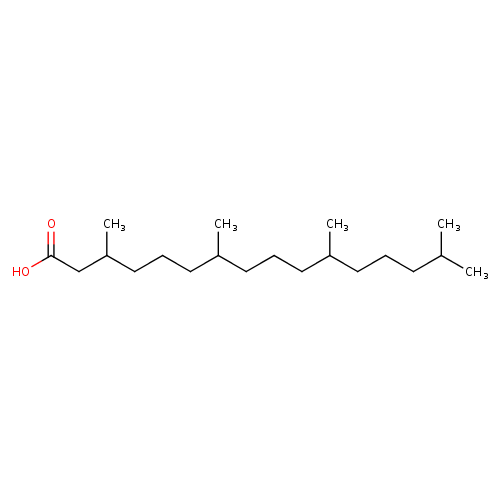
| Common Name | Phytanic acid |
|---|
| Description | Phytanic acid, also known as phytanate or acid, phytanic, belongs to the class of organic compounds known as acyclic diterpenoids. These are diterpenoids (compounds made of four consecutive isoprene units) that do not contain a cycle. Phytanic acid is possibly soluble (in water) and a very weakly acidic compound (based on its pKa). In cattle, phytanic acid is involved in the metabolic pathway called the phytanic Acid peroxisomal oxidation pathway. Phytanic acid is a potentially toxic compound. Phytanic acid has been found to be associated with several diseases known as cerebrotendinous xanthomatosis, rhizomelic chondrodysplasia punctata, and pseudoneonatal adrenoleukodystrophy; also phytanic acid has been linked to several inborn metabolic disorders including adrenoleukodystrophy and peroxisomal biogenesis defect. |
|---|
| Structure | |
|---|
| Synonyms | | Value | Source |
|---|
| 3,7,11,15-Tetramethyl hexadecanoic acid | ChEBI | | 3,7,11,15-Tetramethyl-hexadecanoic acid | ChEBI | | 3,7,11,15-Tetramethyl-hexadecansaeure | ChEBI | | 3,7,11,15-Tetramethylhexadecanoic acid | Kegg | | 3,7,11,15-Tetramethyl hexadecanoate | Generator | | 3,7,11,15-Tetramethyl-hexadecanoate | Generator | | 3,7,11,15-Tetramethylhexadecanoate | Generator | | Phytanate | Generator | | 3,7,11,15-Tetramethylhexadecoanoate | HMDB | | 3,7,11,15-Tetramethylhexadecoanoic acid | HMDB | | Phytanoate | HMDB | | Phytanoic acid | HMDB | | Acid, phytanic | HMDB |
|
|---|
| Chemical Formula | C20H40O2 |
|---|
| Average Molecular Weight | 312.5304 |
|---|
| Monoisotopic Molecular Weight | 312.302830524 |
|---|
| IUPAC Name | 3,7,11,15-tetramethylhexadecanoic acid |
|---|
| Traditional Name | phytanic acid |
|---|
| CAS Registry Number | 14721-66-5 |
|---|
| SMILES | CC(C)CCCC(C)CCCC(C)CCCC(C)CC(O)=O |
|---|
| InChI Identifier | InChI=1S/C20H40O2/c1-16(2)9-6-10-17(3)11-7-12-18(4)13-8-14-19(5)15-20(21)22/h16-19H,6-15H2,1-5H3,(H,21,22) |
|---|
| InChI Key | RLCKHJSFHOZMDR-UHFFFAOYSA-N |
|---|
| Chemical Taxonomy |
|---|
| Description | belongs to the class of organic compounds known as acyclic diterpenoids. These are diterpenoids (compounds made of four consecutive isoprene units) that do not contain a cycle. |
|---|
| Kingdom | Organic compounds |
|---|
| Super Class | Lipids and lipid-like molecules |
|---|
| Class | Prenol lipids |
|---|
| Sub Class | Diterpenoids |
|---|
| Direct Parent | Acyclic diterpenoids |
|---|
| Alternative Parents | |
|---|
| Substituents | - Acyclic diterpenoid
- Long-chain fatty acid
- Methyl-branched fatty acid
- Branched fatty acid
- Fatty acyl
- Fatty acid
- Monocarboxylic acid or derivatives
- Carboxylic acid
- Carboxylic acid derivative
- Organic oxygen compound
- Organic oxide
- Hydrocarbon derivative
- Organooxygen compound
- Carbonyl group
- Aliphatic acyclic compound
|
|---|
| Molecular Framework | Aliphatic acyclic compounds |
|---|
| External Descriptors | |
|---|
| Ontology |
|---|
| Status | Detected but not Quantified |
|---|
| Origin | |
|---|
| Biofunction | Not Available |
|---|
| Application | Not Available |
|---|
| Cellular locations | - Cell membrane
- Cytoplasm
- Membrane
- Myelin sheath
- Peroxisome
|
|---|
| Physical Properties |
|---|
| State | Solid |
|---|
| Experimental Properties | | Property | Value | Reference |
|---|
| Melting Point | Not Available | Not Available | | Boiling Point | Not Available | Not Available | | Water Solubility | Not Available | Not Available | | LogP | Not Available | Not Available |
|
|---|
| Predicted Properties | |
|---|
| Spectra |
|---|
| Spectra | |
|---|