| Record Information |
|---|
| Version | 1.0 |
|---|
| Creation Date | 2016-09-30 22:39:07 UTC |
|---|
| Update Date | 2020-05-19 22:01:22 UTC |
|---|
| BMDB ID | BMDB0000957 |
|---|
| Secondary Accession Numbers | |
|---|
| Metabolite Identification |
|---|
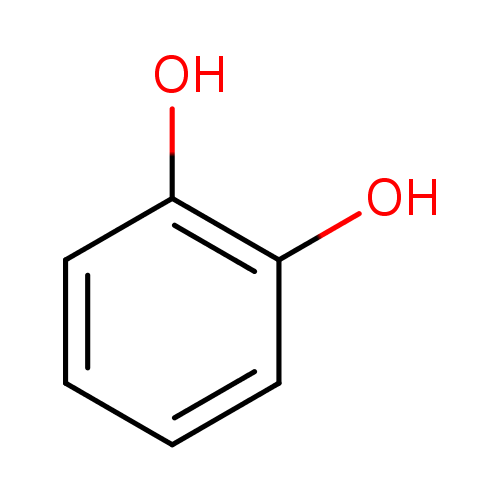
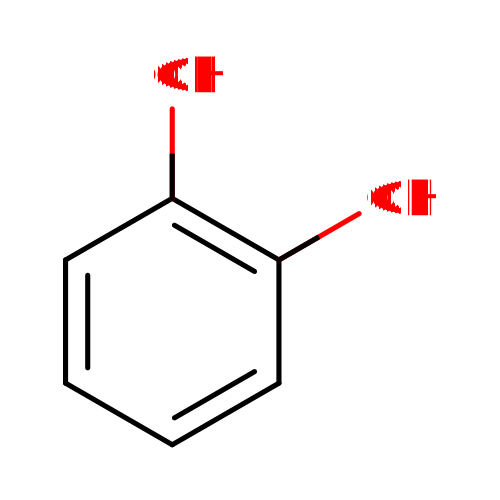
| Common Name | Pyrocatechol |
|---|
| Description | Pyrocatechol, also known as 1,2-benzenediol or 2-hydroxyphenol, belongs to the class of organic compounds known as catechols. Catechols are compounds containing a 1,2-benzenediol moiety. Pyrocatechol exists as a solid, possibly soluble (in water), and an extremely weak basic (essentially neutral) compound (based on its pKa) molecule. Pyrocatechol exists in all living organisms, ranging from bacteria to humans. Pyrocatechol is formally rated as a possible carcinogen (by IARC 2B) and is also a potentially toxic compound. |
|---|
| Structure | |
|---|
| Synonyms | | Value | Source |
|---|
| 1,2-Benzenediol | ChEBI | | 1,2-Dihydroxybenzene | ChEBI | | 2-Hydroxyphenol | ChEBI | | alpha-Hydroxyphenol | ChEBI | | Brenzcatechin | ChEBI | | O-Benzenediol | ChEBI | | O-Hydroxyphenol | ChEBI | | Pyrocatechin | ChEBI | | a-Hydroxyphenol | Generator | | Α-hydroxyphenol | Generator | | Catechol | HMDB | | Durafur developer C | HMDB | | Fouramine PCH | HMDB | | Fourrine 68 | HMDB | | O-Dihydroxybenzene | HMDB | | O-Dioxybenzene | HMDB | | O-Hydroquinone | HMDB | | O-Phenylenediol | HMDB | | Oxyphenate | HMDB | | Oxyphenic acid | HMDB | | Pelagol grey C | HMDB | | Phthalhydroquinone | HMDB | | Phthalic alcohol | HMDB | | Pyrocatechine | HMDB | | 1,3-Dihydroxybenzene | HMDB | | Catechol dipotassium salt | HMDB | | Catechol, 14C-labeled CPD | HMDB | | Catechol sodium salt | HMDB | | Benzene-1,2-diol | PhytoBank | | Pyrocatechol | PhytoBank | | 1,2-Hydroxybenzene | PhytoBank |
|
|---|
| Chemical Formula | C6H6O2 |
|---|
| Average Molecular Weight | 110.1106 |
|---|
| Monoisotopic Molecular Weight | 110.036779436 |
|---|
| IUPAC Name | benzene-1,2-diol |
|---|
| Traditional Name | catechol |
|---|
| CAS Registry Number | 120-80-9 |
|---|
| SMILES | OC1=CC=CC=C1O |
|---|
| InChI Identifier | InChI=1S/C6H6O2/c7-5-3-1-2-4-6(5)8/h1-4,7-8H |
|---|
| InChI Key | YCIMNLLNPGFGHC-UHFFFAOYSA-N |
|---|
| Chemical Taxonomy |
|---|
| Description | belongs to the class of organic compounds known as catechols. Catechols are compounds containing a 1,2-benzenediol moiety. |
|---|
| Kingdom | Organic compounds |
|---|
| Super Class | Benzenoids |
|---|
| Class | Phenols |
|---|
| Sub Class | Benzenediols |
|---|
| Direct Parent | Catechols |
|---|
| Alternative Parents | |
|---|
| Substituents | - Catechol
- 1-hydroxy-4-unsubstituted benzenoid
- 1-hydroxy-2-unsubstituted benzenoid
- Monocyclic benzene moiety
- Organic oxygen compound
- Hydrocarbon derivative
- Organooxygen compound
- Aromatic homomonocyclic compound
|
|---|
| Molecular Framework | Aromatic homomonocyclic compounds |
|---|
| External Descriptors | |
|---|
| Ontology |
|---|
| Status | Detected but not Quantified |
|---|
| Origin | |
|---|
| Biofunction | Not Available |
|---|
| Application | Not Available |
|---|
| Cellular locations | |
|---|
| Physical Properties |
|---|
| State | Solid |
|---|
| Experimental Properties | | Property | Value | Reference |
|---|
| Melting Point | 105 °C | Not Available | | Boiling Point | Not Available | Not Available | | Water Solubility | 461.0 mg/mL | Not Available | | LogP | 0.88 | HANSCH,C ET AL. (1995) |
|
|---|
| Predicted Properties | |
|---|
| Spectra |
|---|
| Spectra | |
|---|
| Biological Properties |
|---|
| Cellular Locations | |
|---|
| Biospecimen Locations | - Adipose Tissue
- Adrenal Gland
- Bone Marrow
- Brain
- Intestine
- Liver
- Milk
- Neuron
- Prostate Tissue
|
|---|
| Pathways | |
|---|
| Normal Concentrations |
|---|
| |
| Adipose Tissue | Expected but not Quantified | Not Quantified | Not Specified | Not Specified | Normal | | details | | Adrenal Gland | Expected but not Quantified | Not Quantified | Not Specified | Not Specified | Normal | | details | | Bone Marrow | Expected but not Quantified | Not Quantified | Not Specified | Not Specified | Normal | | details | | Brain | Expected but not Quantified | Not Quantified | Not Specified | Not Specified | Normal | | details | | Intestine | Expected but not Quantified | Not Quantified | Not Specified | Not Specified | Normal | | details | | Liver | Expected but not Quantified | Not Quantified | Not Specified | Not Specified | Normal | | details | | Milk | Detected but not Quantified | Not Quantified | Not Specified | Not Specified | Normal | | details | | Milk | Detected but not Quantified | Not Quantified | Not Specified | Not Specified | Normal | | details | | Neuron | Expected but not Quantified | Not Quantified | Not Specified | Not Specified | Normal | | details | | Prostate Tissue | Expected but not Quantified | Not Quantified | Not Specified | Not Specified | Normal | | details |
|
|---|
| Abnormal Concentrations |
|---|
| Not Available |
|---|
| External Links |
|---|
| HMDB ID | HMDB0000957 |
|---|
| DrugBank ID | DB02232 |
|---|
| Phenol Explorer Compound ID | 654 |
|---|
| FooDB ID | FDB001512 |
|---|
| KNApSAcK ID | C00002644 |
|---|
| Chemspider ID | 13837760 |
|---|
| KEGG Compound ID | C15571 |
|---|
| BioCyc ID | CATECHOL |
|---|
| BiGG ID | Not Available |
|---|
| Wikipedia Link | Catechol |
|---|
| METLIN ID | 282 |
|---|
| PubChem Compound | 289 |
|---|
| PDB ID | Not Available |
|---|
| ChEBI ID | 18135 |
|---|
| References |
|---|
| Synthesis Reference | Lauterbach, Manfred; Zimmermann, Volker; Jaeger, Guenter; Radig, Wolfram; Adam, Johannes; Blady, Regina. Extraction and purification of pyrocatechol. Ger. (East) (1986), 4 pp. |
|---|
| Material Safety Data Sheet (MSDS) | Not Available |
|---|
| General References | - Mung D, Li L: Development of Chemical Isotope Labeling LC-MS for Milk Metabolomics: Comprehensive and Quantitative Profiling of the Amine/Phenol Submetabolome. Anal Chem. 2017 Apr 18;89(8):4435-4443. doi: 10.1021/acs.analchem.6b03737. Epub 2017 Mar 28. [PubMed:28306241 ]
- Mung D, Li L: Applying quantitative metabolomics based on chemical isotope labeling LC-MS for detecting potential milk adulterant in human milk. Anal Chim Acta. 2018 Feb 25;1001:78-85. doi: 10.1016/j.aca.2017.11.019. Epub 2017 Nov 14. [PubMed:29291809 ]
|
|---|