| Record Information |
|---|
| Version | 1.0 |
|---|
| Creation Date | 2016-09-30 22:40:24 UTC |
|---|
| Update Date | 2020-05-21 16:28:42 UTC |
|---|
| BMDB ID | BMDB0001051 |
|---|
| Secondary Accession Numbers | |
|---|
| Metabolite Identification |
|---|
| Common Name | Glyceraldehyde |
|---|
| Description | Glyceraldehyde, also known as aldotriose or glycerose, belongs to the class of organic compounds known as monosaccharides. Monosaccharides are compounds containing one carbohydrate unit not glycosidically linked to another such unit, and no set of two or more glycosidically linked carbohydrate units. Monosaccharides have the general formula CnH2nOn. Glyceraldehyde exists as a solid, possibly soluble (in water), and an extremely weak basic (essentially neutral) compound (based on its pKa) molecule. Glyceraldehyde exists in all living species, ranging from bacteria to humans. Glyceraldehyde is a potentially toxic compound. |
|---|
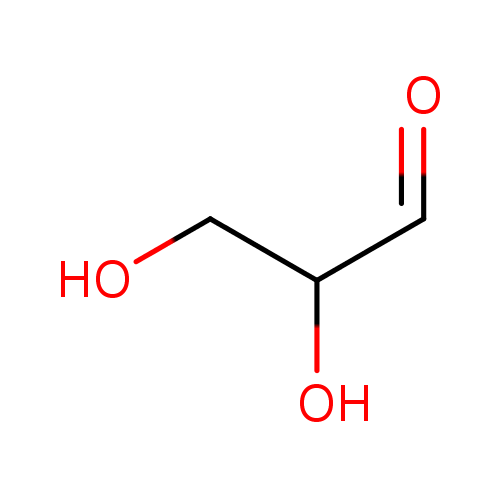
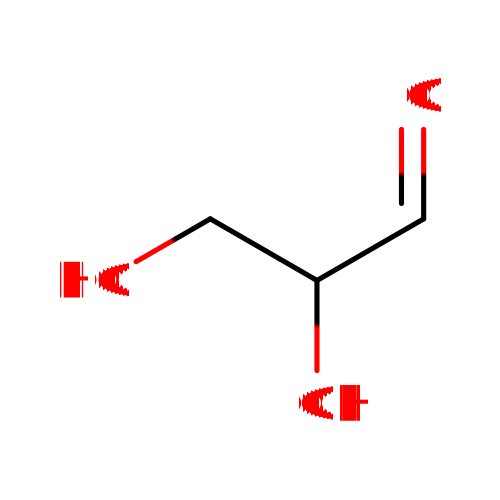
| Structure | |
|---|
| Synonyms | | Value | Source |
|---|
| (+-)-Glyceraldehyde | ChEBI | | 2,3-Dihydroxypropanal | ChEBI | | 2,3-Dihydroxypropionaldehyde | ChEBI | | Aldotriose | ChEBI | | alpha,beta-Dihydroxypropionaldehyde | ChEBI | | DL-Glyceraldehyde | ChEBI | | Gliceraldehido | ChEBI | | Glyceraldehyd | ChEBI | | Glyceric aldehyde | ChEBI | | Glycerinaldehyd | ChEBI | | Glycerinaldehyde | ChEBI | | Glycerinformal | ChEBI | | Glycerose | ChEBI | | Glyzerinaldehyd | ChEBI | | a,b-Dihydroxypropionaldehyde | Generator | | Α,β-dihydroxypropionaldehyde | Generator | | (+/-)-2,3-dihydroxy-propanal | HMDB | | (+/-)-glyceraldehyde | HMDB | | D-(+)-Glyceraldehyde | HMDB | | D-2,3-Dihydroxypropanal | HMDB | | D-2,3-Dihydroxypropionaldehyde | HMDB | | D-Aldotriose | HMDB | | D-Glyceraldehyde | HMDB | | D-Glycerose | HMDB | | delta-(+)-Glyceraldehyde | HMDB | | delta-2,3-Dihydroxypropanal | HMDB | | delta-2,3-Dihydroxypropionaldehyde | HMDB | | delta-Aldotriose | HMDB | | delta-Glyceraldehyde | HMDB | | delta-Glycerose | HMDB | | Dihydroxypropionaldehyde | HMDB |
|
|---|
| Chemical Formula | C3H6O3 |
|---|
| Average Molecular Weight | 90.0779 |
|---|
| Monoisotopic Molecular Weight | 90.031694058 |
|---|
| IUPAC Name | 2,3-dihydroxypropanal |
|---|
| Traditional Name | (+/-)-glyceraldehyde |
|---|
| CAS Registry Number | 56-82-6 |
|---|
| SMILES | OCC(O)C=O |
|---|
| InChI Identifier | InChI=1S/C3H6O3/c4-1-3(6)2-5/h1,3,5-6H,2H2 |
|---|
| InChI Key | MNQZXJOMYWMBOU-UHFFFAOYSA-N |
|---|
| Chemical Taxonomy |
|---|
| Description | belongs to the class of organic compounds known as monosaccharides. Monosaccharides are compounds containing one carbohydrate unit not glycosidically linked to another such unit, and no set of two or more glycosidically linked carbohydrate units. Monosaccharides have the general formula CnH2nOn. |
|---|
| Kingdom | Organic compounds |
|---|
| Super Class | Organic oxygen compounds |
|---|
| Class | Organooxygen compounds |
|---|
| Sub Class | Carbohydrates and carbohydrate conjugates |
|---|
| Direct Parent | Monosaccharides |
|---|
| Alternative Parents | |
|---|
| Substituents | - Monosaccharide
- Alpha-hydroxyaldehyde
- Secondary alcohol
- 1,2-diol
- Organic oxide
- Hydrocarbon derivative
- Short-chain aldehyde
- Primary alcohol
- Carbonyl group
- Aldehyde
- Alcohol
- Aliphatic acyclic compound
|
|---|
| Molecular Framework | Aliphatic acyclic compounds |
|---|
| External Descriptors | |
|---|
| Ontology |
|---|
| Status | Detected but not Quantified |
|---|
| Origin | |
|---|
| Biofunction | Not Available |
|---|
| Application | Not Available |
|---|
| Cellular locations | |
|---|
| Physical Properties |
|---|
| State | Solid |
|---|
| Experimental Properties | | Property | Value | Reference |
|---|
| Melting Point | 145 °C | Not Available | | Boiling Point | Not Available | Not Available | | Water Solubility | 17 mg/mL | Not Available | | LogP | Not Available | Not Available |
|
|---|
| Predicted Properties | |
|---|
| Spectra |
|---|
| Spectra | |
|---|
| Biological Properties |
|---|
| Cellular Locations | |
|---|
| Biospecimen Locations | |
|---|
| Pathways | |
|---|
| Normal Concentrations |
|---|
| |
| Milk | Detected but not Quantified | Not Quantified | Not Specified | Not Specified | Normal | | details | | Neuron | Expected but not Quantified | Not Quantified | Not Specified | Not Specified | Normal | | details |
|
|---|
| Abnormal Concentrations |
|---|
| Not Available |
|---|
| External Links |
|---|
| HMDB ID | HMDB0250760 |
|---|
| DrugBank ID | Not Available |
|---|
| Phenol Explorer Compound ID | Not Available |
|---|
| FooDB ID | FDB022392 |
|---|
| KNApSAcK ID | C00007413 |
|---|
| Chemspider ID | 731 |
|---|
| KEGG Compound ID | C02154 |
|---|
| BioCyc ID | CPD0-1551 |
|---|
| BiGG ID | Not Available |
|---|
| Wikipedia Link | Glyceraldehyde |
|---|
| METLIN ID | Not Available |
|---|
| PubChem Compound | 751 |
|---|
| PDB ID | Not Available |
|---|
| ChEBI ID | 5445 |
|---|
| References |
|---|
| Synthesis Reference | Wan, Xin-Jun; Song, Ming-You; Wu, Rong; Chu, Dao-Bao. Synthesis of glyceraldehyde by indirect electrooxidation. Yingyong Huaxue (2003), 20(6), 578-581. |
|---|
| Material Safety Data Sheet (MSDS) | Not Available |
|---|
| General References | - Qian L, Zhao A, Zhang Y, Chen T, Zeisel SH, Jia W, Cai W: Metabolomic Approaches to Explore Chemical Diversity of Human Breast-Milk, Formula Milk and Bovine Milk. Int J Mol Sci. 2016 Dec 17;17(12). pii: ijms17122128. doi: 10.3390/ijms17122128. [PubMed:27999311 ]
|
|---|