| Record Information |
|---|
| Version | 1.0 |
|---|
| Creation Date | 2016-09-30 22:42:21 UTC |
|---|
| Update Date | 2020-05-21 16:29:01 UTC |
|---|
| BMDB ID | BMDB0001191 |
|---|
| Secondary Accession Numbers | |
|---|
| Metabolite Identification |
|---|
| Common Name | Deoxyuridine triphosphate |
|---|
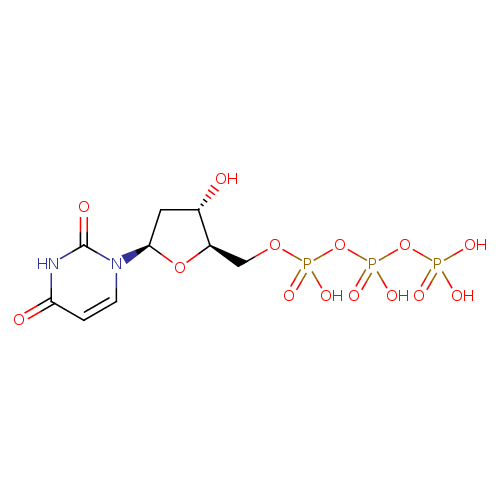
| Description | Deoxyuridine triphosphate, also known as deoxy-UTP or dUTP, belongs to the class of organic compounds known as pyrimidine 2'-deoxyribonucleoside triphosphates. These are pyrimidine nucleotides with a triphosphate group linked to the ribose moiety lacking a hydroxyl group at position 2. Deoxyuridine triphosphate is an extremely weak basic (essentially neutral) compound (based on its pKa). Deoxyuridine triphosphate exists in all living species, ranging from bacteria to humans. Within cattle, deoxyuridine triphosphate participates in a number of enzymatic reactions. In particular, deoxyuridine triphosphate can be converted into dUMP through its interaction with the enzyme deoxyuridine 5'-triphosphate nucleotidohydrolase, mitochondrial. In addition, deoxyuridine triphosphate can be converted into dUDP through the action of the enzyme nucleoside diphosphate kinase 6. In cattle, deoxyuridine triphosphate is involved in the metabolic pathway called the pyrimidine metabolism pathway. Deoxyuridine triphosphate is a potentially toxic compound. |
|---|
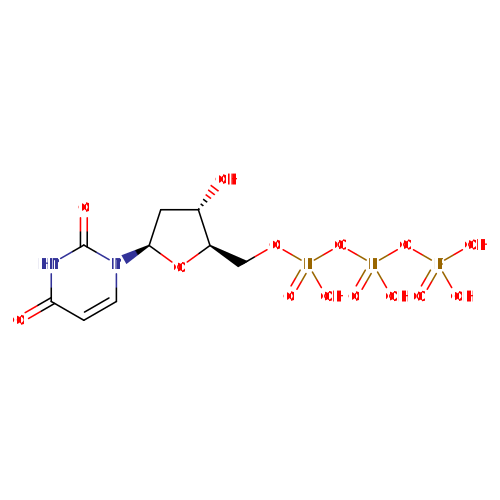
| Structure | |
|---|
| Synonyms | | Value | Source |
|---|
| 2'-Deoxyuridine 5'-triphosphate | ChEBI | | 2'-Deoxyuridine 5'-triphosphoric acid | Generator | | Deoxyuridine triphosphoric acid | Generator | | 2'-Deoxyuridine-5'-triphosphorate | HMDB | | 2'-Deoxyuridine-5'-triphosphoric acid | HMDB | | 2'-Deoxyuridine-5'-triphosphoric acid = dUTP | HMDB | | Deoxy-UTP | HMDB | | Deoxyuridine-5'-triphosphate | HMDB | | dUTP | HMDB | | 2'-Deoxyuridine 5'-(tetrahydrogen triphosphate) | HMDB | | 2'-deoxy-UTP | HMDB | | 2’-Deoxyuridine 5’-(tetrahydrogen triphosphate) | HMDB | | 2’-Deoxyuridine 5’-triphosphate | HMDB | | 2’-deoxy-UTP | HMDB | | Deoxyuridine 5'-triphosphate | HMDB | | Deoxyuridine 5’-triphosphate | HMDB | | Deoxyuridine triphosphate | HMDB |
|
|---|
| Chemical Formula | C9H15N2O14P3 |
|---|
| Average Molecular Weight | 468.1417 |
|---|
| Monoisotopic Molecular Weight | 467.973612734 |
|---|
| IUPAC Name | ({[({[(2R,3S,5R)-5-(2,4-dioxo-1,2,3,4-tetrahydropyrimidin-1-yl)-3-hydroxyoxolan-2-yl]methoxy}(hydroxy)phosphoryl)oxy](hydroxy)phosphoryl}oxy)phosphonic acid |
|---|
| Traditional Name | dUTP |
|---|
| CAS Registry Number | 1173-82-6 |
|---|
| SMILES | O[C@H]1C[C@@H](O[C@@H]1COP(O)(=O)OP(O)(=O)OP(O)(O)=O)N1C=CC(=O)NC1=O |
|---|
| InChI Identifier | InChI=1S/C9H15N2O14P3/c12-5-3-8(11-2-1-7(13)10-9(11)14)23-6(5)4-22-27(18,19)25-28(20,21)24-26(15,16)17/h1-2,5-6,8,12H,3-4H2,(H,18,19)(H,20,21)(H,10,13,14)(H2,15,16,17)/t5-,6+,8+/m0/s1 |
|---|
| InChI Key | AHCYMLUZIRLXAA-SHYZEUOFSA-N |
|---|
| Chemical Taxonomy |
|---|
| Description | belongs to the class of organic compounds known as pyrimidine 2'-deoxyribonucleoside triphosphates. These are pyrimidine nucleotides with a triphosphate group linked to the ribose moiety lacking a hydroxyl group at position 2. |
|---|
| Kingdom | Organic compounds |
|---|
| Super Class | Nucleosides, nucleotides, and analogues |
|---|
| Class | Pyrimidine nucleotides |
|---|
| Sub Class | Pyrimidine deoxyribonucleotides |
|---|
| Direct Parent | Pyrimidine 2'-deoxyribonucleoside triphosphates |
|---|
| Alternative Parents | |
|---|
| Substituents | - Pyrimidine 2'-deoxyribonucleoside triphosphate
- Pyrimidone
- Monoalkyl phosphate
- Hydroxypyrimidine
- Hydropyrimidine
- Organic phosphoric acid derivative
- Phosphoric acid ester
- Pyrimidine
- Alkyl phosphate
- Tetrahydrofuran
- Heteroaromatic compound
- Secondary alcohol
- Organoheterocyclic compound
- Azacycle
- Oxacycle
- Organopnictogen compound
- Organonitrogen compound
- Organic oxygen compound
- Organic nitrogen compound
- Alcohol
- Organooxygen compound
- Hydrocarbon derivative
- Organic oxide
- Aromatic heteromonocyclic compound
|
|---|
| Molecular Framework | Aromatic heteromonocyclic compounds |
|---|
| External Descriptors | |
|---|
| Ontology |
|---|
| Status | Expected but not Quantified |
|---|
| Origin | |
|---|
| Biofunction | Not Available |
|---|
| Application | Not Available |
|---|
| Cellular locations | - Cytoplasm
- Mitochondria
- Nucleus
|
|---|
| Physical Properties |
|---|
| State | Solid |
|---|
| Experimental Properties | | Property | Value | Reference |
|---|
| Melting Point | Not Available | Not Available | | Boiling Point | Not Available | Not Available | | Water Solubility | Not Available | Not Available | | LogP | Not Available | Not Available |
|
|---|
| Predicted Properties | |
|---|
| Spectra |
|---|
| Spectra | |
|---|