Record Information
Version1.0
Creation Date2016-09-30 23:13:32 UTC
Update Date2020-05-11 20:57:18 UTC
BMDB IDBMDB0004947
Secondary Accession Numbers
  • BMDB04947
Metabolite Identification
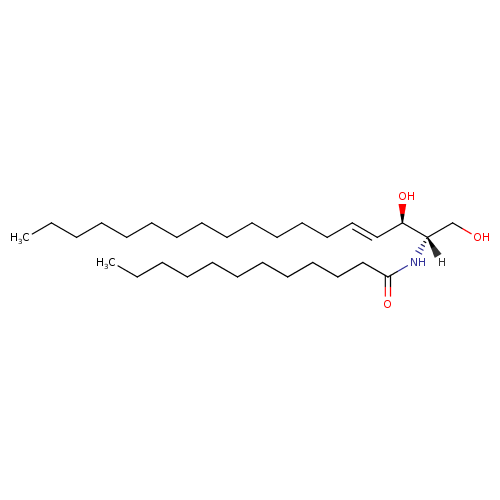
Common NameCeramide (d18:1/12:0)
DescriptionCeramide (d18:1/12:0), also known as N-(lauroyl)sphing-4-enine or N-(dodecanoyl)ceramide, belongs to the class of organic compounds known as ceramides. These are lipid molecules containing a sphingosine in which the amine group is linked to a fatty acid. Thus, ceramide (D18:1/12:0) is considered to be a ceramide lipid molecule. Ceramide (d18:1/12:0) is a very hydrophobic molecule, practically insoluble (in water), and relatively neutral.
Structure
Thumb
Synonyms
ValueSource
Cer(d18:1/12:0)ChEBI
Dodecyl sphingosineChEBI
LaurylsphingosineChEBI
N-(Dodecanoyl)ceramideChEBI
N-(Dodecanoyl)sphing-4-enineChEBI
N-(Lauroyl)ceramideChEBI
N-(Lauroyl)sphing-4-enineChEBI
N-Dodecanoylsphing-4-enineChEBI
N-Lauroylsphing-4-enineChEBI
N-LauroylsphingosineChEBI
(2S,3R,4E)-2-acylamino-1,3-Octadec-4-enediolHMDB
(2S,3R,4E)-2-Acylaminooctadec-4-ene-1,3-diolHMDB
CerHMDB
CeramideHMDB
N-AcylsphingosineHMDB
N-[(1S,2R,3E)-2-Hydroxy-1-(hydroxymethyl)-3-heptadecenyl]-octadecanamideHMDB
C12-CeramideHMDB
Cer d18:1/12:0HMDB
Ceramide (d18:1,C12:0)HMDB
Ceramide (d18:1/12:0)HMDB
Ceramide 12HMDB
Ceramide(d18:1/12:0)HMDB
N-Lauroyl-D-erythro-sphingosineHMDB
N-LaurylsphingosineHMDB
Chemical FormulaC30H59NO3
Average Molecular Weight481.7944
Monoisotopic Molecular Weight481.449494759
IUPAC NameN-[(2S,3R,4E)-1,3-dihydroxyoctadec-4-en-2-yl]dodecanamide
Traditional NameN-(dodecanoyl)-ceramide
CAS Registry Number74713-60-3
SMILES
CCCCCCCCCCCCC\C=C\[C@@H](O)[C@H](CO)NC(=O)CCCCCCCCCCC
InChI Identifier
InChI=1S/C30H59NO3/c1-3-5-7-9-11-13-14-15-16-18-19-21-23-25-29(33)28(27-32)31-30(34)26-24-22-20-17-12-10-8-6-4-2/h23,25,28-29,32-33H,3-22,24,26-27H2,1-2H3,(H,31,34)/b25-23+/t28-,29+/m0/s1
InChI KeyHXFPPRPLRSPNIB-VARSQMIESA-N
Chemical Taxonomy
Description belongs to the class of organic compounds known as ceramides. These are lipid molecules containing a sphingosine in which the amine group is linked to a fatty acid.
KingdomOrganic compounds
Super ClassLipids and lipid-like molecules
ClassSphingolipids
Sub ClassCeramides
Direct ParentCeramides
Alternative Parents
Substituents
  • Ceramide
  • Fatty amide
  • N-acyl-amine
  • Fatty acyl
  • Carboxamide group
  • Secondary alcohol
  • Secondary carboxylic acid amide
  • Carboxylic acid derivative
  • Primary alcohol
  • Organooxygen compound
  • Organonitrogen compound
  • Organic oxide
  • Organopnictogen compound
  • Organic oxygen compound
  • Alcohol
  • Organic nitrogen compound
  • Carbonyl group
  • Hydrocarbon derivative
  • Aliphatic acyclic compound
Molecular FrameworkAliphatic acyclic compounds
External Descriptors
Ontology
StatusExpected but not Quantified
Origin
  • Endogenous
  • Exogenous
BiofunctionNot Available
ApplicationNot Available
Cellular locations
  • Cell membrane
  • Cytoplasm
  • Endosome
  • Intracellular membrane
  • Membrane
  • Mitochondria
  • Myelin sheath
Physical Properties
StateSolid
Experimental Properties
PropertyValueReference
Melting PointNot AvailableNot Available
Boiling PointNot AvailableNot Available
Water SolubilityInsolubleNot Available
LogPNot AvailableNot Available
Predicted Properties
PropertyValueSource
logP8.63ALOGPS
logP9.09ChemAxon
logS-6.8ALOGPS
pKa (Strongest Acidic)13.62ChemAxon
pKa (Strongest Basic)-1ChemAxon
Physiological Charge0ChemAxon
Hydrogen Acceptor Count3ChemAxon
Hydrogen Donor Count3ChemAxon
Polar Surface Area69.56 ŲChemAxon
Rotatable Bond Count26ChemAxon
Refractivity147.37 m³·mol⁻¹ChemAxon
Polarizability64.7 ųChemAxon
Number of Rings0ChemAxon
BioavailabilityYesChemAxon
Rule of FiveYesChemAxon
Ghose FilterYesChemAxon
Veber's RuleYesChemAxon
MDDR-like RuleYesChemAxon
Spectra
Spectra
Spectrum TypeDescriptionSplash Key
Predicted GC-MSPredicted GC-MS Spectrum - GC-MS (2 TMS) - 70eV, Positivesplash10-022i-5785598000-7031136168734e1ef5eeView in MoNA
Predicted GC-MSPredicted GC-MS Spectrum - GC-MS (Non-derivatized) - 70eV, PositiveNot AvailableView in JSpectraViewer
LC-MS/MSLC-MS/MS Spectrum - 40V, Positivesplash10-03di-2090000000-ae80000c40a296a1c5d8View in MoNA
LC-MS/MSLC-MS/MS Spectrum - 40V, Positivesplash10-03di-2090000000-a13bd310025f03a29721View in MoNA
LC-MS/MSLC-MS/MS Spectrum - 40V, Positivesplash10-03di-2090000000-8d5084b0da3675b3f3f3View in MoNA
LC-MS/MSLC-MS/MS Spectrum - 40V, Positivesplash10-03di-2090000000-d4824df02fcc2092417cView in MoNA
LC-MS/MSLC-MS/MS Spectrum - 40V, Positivesplash10-03di-2090000000-f919f09dc660be85f13eView in MoNA
Predicted LC-MS/MSPredicted LC-MS/MS Spectrum - 10V, Positivesplash10-001i-0000900000-fe0f573db63b1b90fd2fView in MoNA
Predicted LC-MS/MSPredicted LC-MS/MS Spectrum - 20V, Positivesplash10-01q9-0050900000-612b7fe1fb533df6232bView in MoNA
Predicted LC-MS/MSPredicted LC-MS/MS Spectrum - 40V, Positivesplash10-03e9-0090600000-9abebdbdb27db5a25cb2View in MoNA
Predicted LC-MS/MSPredicted LC-MS/MS Spectrum - 10V, Negativesplash10-001i-0000900000-fa0543ff22d51d18b573View in MoNA
Predicted LC-MS/MSPredicted LC-MS/MS Spectrum - 20V, Negativesplash10-001i-0010900000-3de9968cb166260af69fView in MoNA
Predicted LC-MS/MSPredicted LC-MS/MS Spectrum - 40V, Negativesplash10-001k-0220900000-1f62f1430f619c4887d9View in MoNA
Predicted LC-MS/MSPredicted LC-MS/MS Spectrum - 10V, Positivesplash10-000i-0000900000-2b1019f1dfd77202b1a5View in MoNA
Predicted LC-MS/MSPredicted LC-MS/MS Spectrum - 20V, Positivesplash10-000i-0000900000-2b1019f1dfd77202b1a5View in MoNA
Predicted LC-MS/MSPredicted LC-MS/MS Spectrum - 40V, Positivesplash10-00di-0000900000-aa4c78e902645a2bb092View in MoNA
Predicted LC-MS/MSPredicted LC-MS/MS Spectrum - 10V, Positivesplash10-001i-0000900000-5acec5af0818f408e044View in MoNA
Predicted LC-MS/MSPredicted LC-MS/MS Spectrum - 20V, Positivesplash10-01q9-0050900000-f3ad47a5043cb0aa6c70View in MoNA
Predicted LC-MS/MSPredicted LC-MS/MS Spectrum - 40V, Positivesplash10-03e9-0090600000-797db203768da46183b0View in MoNA
Biological Properties
Cellular Locations
  • Cell membrane
  • Cytoplasm
  • Endosome
  • Intracellular membrane
  • Membrane
  • Mitochondria
  • Myelin sheath
Biospecimen Locations
  • Brain
  • Epidermis
  • Fibroblasts
  • Intestine
  • Kidney
  • Liver
  • Neuron
  • Pancreas
  • Placenta
  • Platelet
  • Skeletal Muscle
  • Spleen
  • Testis
  • Thyroid Gland
Pathways
Normal Concentrations
BiospecimenStatusValueAgeSexConditionReferenceDetails
BrainExpected but not QuantifiedNot QuantifiedNot SpecifiedNot SpecifiedNormal
  • Not Applicable
details
EpidermisExpected but not QuantifiedNot QuantifiedNot SpecifiedNot SpecifiedNormal
  • Not Applicable
details
FibroblastsExpected but not QuantifiedNot QuantifiedNot SpecifiedNot SpecifiedNormal
  • Not Applicable
details
IntestineExpected but not QuantifiedNot QuantifiedNot SpecifiedNot SpecifiedNormal
  • Not Applicable
details
KidneyExpected but not QuantifiedNot QuantifiedNot SpecifiedNot SpecifiedNormal
  • Not Applicable
details
LiverExpected but not QuantifiedNot QuantifiedNot SpecifiedNot SpecifiedNormal
  • Not Applicable
details
NeuronExpected but not QuantifiedNot QuantifiedNot SpecifiedNot SpecifiedNormal
  • Not Applicable
details
PancreasExpected but not QuantifiedNot QuantifiedNot SpecifiedNot SpecifiedNormal
  • Not Applicable
details
PlacentaExpected but not QuantifiedNot QuantifiedNot SpecifiedNot SpecifiedNormal
  • Not Applicable
details
PlateletExpected but not QuantifiedNot QuantifiedNot SpecifiedNot SpecifiedNormal
  • Not Applicable
details
Skeletal MuscleExpected but not QuantifiedNot QuantifiedNot SpecifiedNot SpecifiedNormal
  • Not Applicable
details
SpleenExpected but not QuantifiedNot QuantifiedNot SpecifiedNot SpecifiedNormal
  • Not Applicable
details
TestisExpected but not QuantifiedNot QuantifiedNot SpecifiedNot SpecifiedNormal
  • Not Applicable
details
Thyroid GlandExpected but not QuantifiedNot QuantifiedNot SpecifiedNot SpecifiedNormal
  • Not Applicable
details
Abnormal Concentrations
Not Available
HMDB IDHMDB0004947
DrugBank IDNot Available
Phenol Explorer Compound IDNot Available
FooDB IDFDB006397
KNApSAcK IDNot Available
Chemspider ID4446675
KEGG Compound IDC00195
BioCyc IDCERAMIDE
BiGG IDNot Available
Wikipedia LinkNot Available
METLIN ID7200
PubChem Compound5283562
PDB IDNot Available
ChEBI ID72956
References
Synthesis ReferenceNot Available
Material Safety Data Sheet (MSDS)Not Available
General ReferencesNot Available

Enzymes

General function:
Involved in ceramidase activity
Specific function:
Lysosomal ceramidase that hydrolyzes sphingolipid ceramides into sphingosine and free fatty acids at acidic pH (By similarity). Ceramides, sphingosine, and its phosphorylated form sphingosine-1-phosphate are bioactive lipids that mediate cellular signaling pathways regulating several biological processes including cell proliferation, apoptosis and differentiation (By similarity). Has a higher catalytic efficiency towards C12-ceramides versus other ceramides (By similarity). Also catalyzes the reverse reaction allowing the synthesis of ceramides from fatty acids and sphingosine (By similarity). For the reverse synthetic reaction, the natural sphingosine D-erythro isomer is more efficiently utilized as a substrate compared to D-erythro-dihydrosphingosine and D-erythro-phytosphingosine, while the fatty acids with chain lengths of 12 or 14 carbons are the most efficiently used (By similarity). Has also an N-acylethanolamine hydrolase activity (By similarity). By regulating the levels of ceramides, sphingosine and sphingosine-1-phosphate in the epidermis, mediates the calcium-induced differentiation of epidermal keratinocytes (By similarity). Also indirectly regulates tumor necrosis factor/TNF-induced apoptosis (By similarity). By regulating the intracellular balance between ceramides and sphingosine, in adrenocortical cells, probably also acts as a regulator of steroidogenesis (By similarity).
Gene Name:
ASAH1
Uniprot ID:
Q17QB3
Molecular weight:
44965.0
General function:
Involved in hydrolase activity, acting on glycosyl bonds
Specific function:
Converts sphingomyelin to ceramide. Also has phospholipase C activities toward 1,2-diacylglycerolphosphocholine and 1,2-diacylglycerolphosphoglycerol.
Gene Name:
SMPD1
Uniprot ID:
Q0VD19
Molecular weight:
69392.0
General function:
Involved in cation binding
Specific function:
Glucosylceramidase that catalyzes, within the lysosomal compartment, the hydrolysis of glucosylceramide/GlcCer into free ceramide and glucose. Thereby, plays a central role in the degradation of complex lipids and the turnover of cellular membranes. Through the production of ceramides, participates to the PKC-activated salvage pathway of ceramide formation. Also plays a role in cholesterol metabolism. May either catalyze the glucosylation of cholesterol, through a transglucosylation reaction that transfers glucose from glucosylceramide to cholesterol. The short chain saturated C8:0-GlcCer and the mono-unsaturated C18:0-GlcCer being the most effective glucose donors for that transglucosylation reaction. Under specific conditions, may alternatively catalyze the reverse reaction, transferring glucose from cholesteryl-beta-D-glucoside to ceramide. Finally, may also hydrolyze cholesteryl-beta-D-glucoside to produce D-glucose and cholesterol.
Gene Name:
GBA
Uniprot ID:
Q2KHZ8
Molecular weight:
59855.0
General function:
Involved in lipid transport
Specific function:
Shelters ceramides and diacylglycerol lipids inside its START domain and mediates the intracellular trafficking of ceramides and diacylglycerol lipids in a non-vesicular manner.
Gene Name:
CERT1
Uniprot ID:
Q9GKI7
Molecular weight:
70847.0