| Record Information |
|---|
| Version | 1.0 |
|---|
| Creation Date | 2016-09-30 23:39:46 UTC |
|---|
| Update Date | 2020-05-21 16:26:46 UTC |
|---|
| BMDB ID | BMDB0007558 |
|---|
| Secondary Accession Numbers | |
|---|
| Metabolite Identification |
|---|
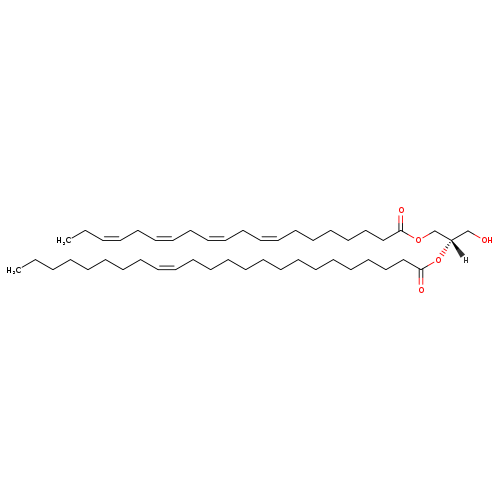
| Common Name | DG(20:4(8Z,11Z,14Z,17Z)/24:1(15Z)/0:0) |
|---|
| Description | DG(20:4(8Z,11Z,14Z,17Z)/24:1(15Z)/0:0), also known as dg(20:4(8z,11z,14z,17z)/24:1(15z)/0:0) or DG(20:4/24:1), belongs to the class of organic compounds known as 1,2-dg(20:4(8z,11z,14z,17z)/24:1(15z)/0:0)s. These are dg(20:4(8z,11z,14z,17z)/24:1(15z)/0:0)s containing a glycerol acylated at positions 1 and 2. DG(20:4(8Z,11Z,14Z,17Z)/24:1(15Z)/0:0) is possibly soluble (in water) and an extremely weak basic (essentially neutral) compound (based on its pKa). DG(20:4(8Z,11Z,14Z,17Z)/24:1(15Z)/0:0) participates in a number of enzymatic reactions, within cattle. In particular, CDP-Ethanolamine and DG(20:4(8Z,11Z,14Z,17Z)/24:1(15Z)/0:0) can be converted into cytidine monophosphate and PE(20:4(8Z,11Z,14Z,17Z)/24:1(15Z)); which is mediated by the enzyme choline/ethanolaminephosphotransferase. In addition, DG(20:4(8Z,11Z,14Z,17Z)/24:1(15Z)/0:0) can be biosynthesized from PA(20:4(8Z,11Z,14Z,17Z)/24:1(15Z)) through the action of the enzyme phosphatidate phosphatase. In cattle, DG(20:4(8Z,11Z,14Z,17Z)/24:1(15Z)/0:0) is involved in a couple of metabolic pathways, which include phosphatidylethanolamine biosynthesis pe(20:4(8Z,11Z,14Z,17Z)/24:1(15Z)) pathway and de novo triacylglycerol biosynthesis TG(20:4(8Z,11Z,14Z,17Z)/24:1(15Z)/24:1(15Z)) pathway. |
|---|
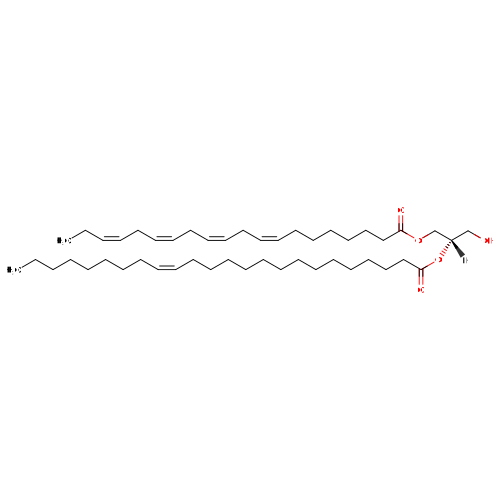
| Structure | |
|---|
| Synonyms | | Value | Source |
|---|
| Diacylglycerol(20:4/24:1) | HMDB | | Diglyceride | HMDB | | DG(20:4/24:1) | HMDB | | DAG(20:4/24:1) | HMDB | | 1-Eicsoatetraenoyl-2-nervonoyl-sn-glycerol | HMDB | | DG(44:5) | HMDB | | Diacylglycerol | HMDB | | Diacylglycerol(44:5) | HMDB | | 1-(8Z,11Z,14Z,17Z-Eicosapentaenoyl)-2-(15Z-tetracosanoyl)-sn-glycerol | HMDB | | DAG(44:5) | HMDB | | DG(20:4(8Z,11Z,14Z,17Z)/24:1(15Z)/0:0) | Lipid Annotator |
|
|---|
| Chemical Formula | C47H82O5 |
|---|
| Average Molecular Weight | 727.151 |
|---|
| Monoisotopic Molecular Weight | 726.616225734 |
|---|
| IUPAC Name | (2S)-1-hydroxy-3-[(8Z,11Z,14Z,17Z)-icosa-8,11,14,17-tetraenoyloxy]propan-2-yl (15Z)-tetracos-15-enoate |
|---|
| Traditional Name | (2S)-1-hydroxy-3-[(8Z,11Z,14Z,17Z)-icosa-8,11,14,17-tetraenoyloxy]propan-2-yl (15Z)-tetracos-15-enoate |
|---|
| CAS Registry Number | Not Available |
|---|
| SMILES | [H][C@](CO)(COC(=O)CCCCCC\C=C/C\C=C/C\C=C/C\C=C/CC)OC(=O)CCCCCCCCCCCCC\C=C/CCCCCCCC |
|---|
| InChI Identifier | InChI=1S/C47H82O5/c1-3-5-7-9-11-13-15-17-19-21-22-23-24-26-28-30-32-34-36-38-40-42-47(50)52-45(43-48)44-51-46(49)41-39-37-35-33-31-29-27-25-20-18-16-14-12-10-8-6-4-2/h6,8,12,14,17-20,27,29,45,48H,3-5,7,9-11,13,15-16,21-26,28,30-44H2,1-2H3/b8-6-,14-12-,19-17-,20-18-,29-27-/t45-/m0/s1 |
|---|
| InChI Key | NAFAFUNATWUZJQ-HMKRARAHSA-N |
|---|
| Chemical Taxonomy |
|---|
| Description | belongs to the class of organic compounds known as 1,2-diacylglycerols. These are diacylglycerols containing a glycerol acylated at positions 1 and 2. |
|---|
| Kingdom | Organic compounds |
|---|
| Super Class | Lipids and lipid-like molecules |
|---|
| Class | Glycerolipids |
|---|
| Sub Class | Diradylglycerols |
|---|
| Direct Parent | 1,2-diacylglycerols |
|---|
| Alternative Parents | |
|---|
| Substituents | - 1,2-acyl-sn-glycerol
- Fatty acid ester
- Fatty acyl
- Dicarboxylic acid or derivatives
- Carboxylic acid ester
- Carboxylic acid derivative
- Organic oxygen compound
- Organic oxide
- Hydrocarbon derivative
- Primary alcohol
- Organooxygen compound
- Carbonyl group
- Alcohol
- Aliphatic acyclic compound
|
|---|
| Molecular Framework | Aliphatic acyclic compounds |
|---|
| External Descriptors | Not Available |
|---|
| Ontology |
|---|
| Status | Expected but not Quantified |
|---|
| Origin | |
|---|
| Biofunction | Not Available |
|---|
| Application | Not Available |
|---|
| Cellular locations | |
|---|
| Physical Properties |
|---|
| State | Solid |
|---|
| Experimental Properties | | Property | Value | Reference |
|---|
| Melting Point | Not Available | Not Available | | Boiling Point | Not Available | Not Available | | Water Solubility | Not Available | Not Available | | LogP | Not Available | Not Available |
|
|---|
| Predicted Properties | |
|---|
| Spectra |
|---|
| Spectra | |
|---|
| Pathways | |
|---|