| Record Information |
|---|
| Version | 1.0 |
|---|
| Creation Date | 2016-09-30 22:42:52 UTC |
|---|
| Update Date | 2020-05-21 16:27:05 UTC |
|---|
| BMDB ID | BMDB0001238 |
|---|
| Secondary Accession Numbers | |
|---|
| Metabolite Identification |
|---|
| Common Name | N-Acetylserotonin |
|---|
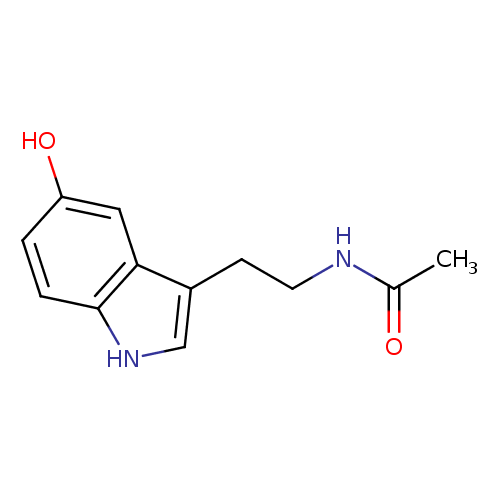
| Description | N-Acetylserotonin, also known as 5-hydroxymelatonin or ASE, belongs to the class of organic compounds known as hydroxyindoles. These are organic compounds containing an indole moiety that carries a hydroxyl group. N-Acetylserotonin is possibly soluble (in water) and an extremely weak basic (essentially neutral) compound (based on its pKa). N-Acetylserotonin exists in all living organisms, ranging from bacteria to humans. N-Acetylserotonin participates in a number of enzymatic reactions, within cattle. In particular, N-Acetylserotonin can be biosynthesized from serotonin and acetyl-CoA; which is mediated by the enzyme serotonin N-acetyltransferase. In addition, N-Acetylserotonin and S-adenosylmethionine can be converted into melatonin and S-adenosylhomocysteine; which is catalyzed by the enzyme acetylserotonin O-methyltransferase. In cattle, N-acetylserotonin is involved in the metabolic pathway called the tryptophan metabolism pathway. |
|---|
| Structure | |
|---|
| Synonyms | | Value | Source |
|---|
| N-(2-(5-Hydroxy-1H-indol-3-yl)ethyl)acetamide | ChEBI | | N-Acetyl-5-hydroxytryptamine | ChEBI | | 5-Hydroxy-N-acetyltryptamine | HMDB | | 5-Hydroxymelatonin | HMDB | | ASE | HMDB | | Desmethylmelatonin | HMDB | | O-Demethylmelatonin | HMDB | | N-Acetylhydroxytryptamine | HMDB |
|
|---|
| Chemical Formula | C12H14N2O2 |
|---|
| Average Molecular Weight | 218.2518 |
|---|
| Monoisotopic Molecular Weight | 218.105527702 |
|---|
| IUPAC Name | N-[2-(5-hydroxy-1H-indol-3-yl)ethyl]acetamide |
|---|
| Traditional Name | N-acetylserotonin |
|---|
| CAS Registry Number | 1210-83-9 |
|---|
| SMILES | CC(=O)NCCC1=CNC2=C1C=C(O)C=C2 |
|---|
| InChI Identifier | InChI=1S/C12H14N2O2/c1-8(15)13-5-4-9-7-14-12-3-2-10(16)6-11(9)12/h2-3,6-7,14,16H,4-5H2,1H3,(H,13,15) |
|---|
| InChI Key | MVAWJSIDNICKHF-UHFFFAOYSA-N |
|---|
| Chemical Taxonomy |
|---|
| Description | belongs to the class of organic compounds known as hydroxyindoles. These are organic compounds containing an indole moiety that carries a hydroxyl group. |
|---|
| Kingdom | Organic compounds |
|---|
| Super Class | Organoheterocyclic compounds |
|---|
| Class | Indoles and derivatives |
|---|
| Sub Class | Hydroxyindoles |
|---|
| Direct Parent | Hydroxyindoles |
|---|
| Alternative Parents | |
|---|
| Substituents | - Hydroxyindole
- 3-alkylindole
- Indole
- 1-hydroxy-2-unsubstituted benzenoid
- Substituted pyrrole
- Benzenoid
- Pyrrole
- Heteroaromatic compound
- Carboximidic acid
- Carboximidic acid derivative
- Azacycle
- Propargyl-type 1,3-dipolar organic compound
- Organic 1,3-dipolar compound
- Organic oxygen compound
- Organooxygen compound
- Organopnictogen compound
- Hydrocarbon derivative
- Organic nitrogen compound
- Organonitrogen compound
- Aromatic heteropolycyclic compound
|
|---|
| Molecular Framework | Aromatic heteropolycyclic compounds |
|---|
| External Descriptors | |
|---|
| Ontology |
|---|
| Status | Detected but not Quantified |
|---|
| Origin | |
|---|
| Biofunction | Not Available |
|---|
| Application | Not Available |
|---|
| Cellular locations | - Cell membrane
- Cytoplasm
- Membrane
|
|---|
| Physical Properties |
|---|
| State | Solid |
|---|
| Experimental Properties | | Property | Value | Reference |
|---|
| Melting Point | Not Available | Not Available | | Boiling Point | Not Available | Not Available | | Water Solubility | Not Available | Not Available | | LogP | Not Available | Not Available |
|
|---|
| Predicted Properties | |
|---|
| Spectra |
|---|
| Spectra | |
|---|
| Biological Properties |
|---|
| Cellular Locations | - Cell membrane
- Cytoplasm
- Membrane
|
|---|
| Biospecimen Locations | |
|---|
| Pathways | |
|---|
| Normal Concentrations |
|---|
| |
| Kidney | Expected but not Quantified | Not Quantified | Not Specified | Not Specified | Normal | | details | | Liver | Expected but not Quantified | Not Quantified | Not Specified | Not Specified | Normal | | details | | Milk | Detected but not Quantified | Not Quantified | Not Specified | Not Specified | Normal | | details |
|
|---|
| Abnormal Concentrations |
|---|
| Not Available |
|---|
| External Links |
|---|
| HMDB ID | HMDB0001238 |
|---|
| DrugBank ID | DB04275 |
|---|
| Phenol Explorer Compound ID | Not Available |
|---|
| FooDB ID | FDB031021 |
|---|
| KNApSAcK ID | Not Available |
|---|
| Chemspider ID | 879 |
|---|
| KEGG Compound ID | C00978 |
|---|
| BioCyc ID | N-ACETYL-SEROTONIN |
|---|
| BiGG ID | 36527 |
|---|
| Wikipedia Link | N-acetyl-serotonin |
|---|
| METLIN ID | 366 |
|---|
| PubChem Compound | 903 |
|---|
| PDB ID | Not Available |
|---|
| ChEBI ID | 17697 |
|---|
| References |
|---|
| Synthesis Reference | Balemans M G; Mans D; Smith I; Van Benthem J The influence of GABA on the synthesis of N-acetylserotonin, melatonin, O-acetyl-5-hydroxytryptophol and O-acetyl-5-methoxytryptophol in the pineal gland of the male Wistar rat. Reproduction, nutrition, development (1983), 23(1), 151-60. |
|---|
| Material Safety Data Sheet (MSDS) | Not Available |
|---|
| General References | - Pan L, Yu J, Mi Z, Mo L, Jin H, Yao C, Ren D, Menghe B: A Metabolomics Approach Uncovers Differences between Traditional and Commercial Dairy Products in Buryatia (Russian Federation). Molecules. 2018 Mar 22;23(4). pii: molecules23040735. doi: 10.3390/molecules23040735. [PubMed:29565828 ]
|
|---|