| Record Information |
|---|
| Version | 1.0 |
|---|
| Creation Date | 2016-09-30 22:27:51 UTC |
|---|
| Update Date | 2020-06-04 20:13:25 UTC |
|---|
| BMDB ID | BMDB0000288 |
|---|
| Secondary Accession Numbers | |
|---|
| Metabolite Identification |
|---|
| Common Name | Uridine 5'-monophosphate |
|---|
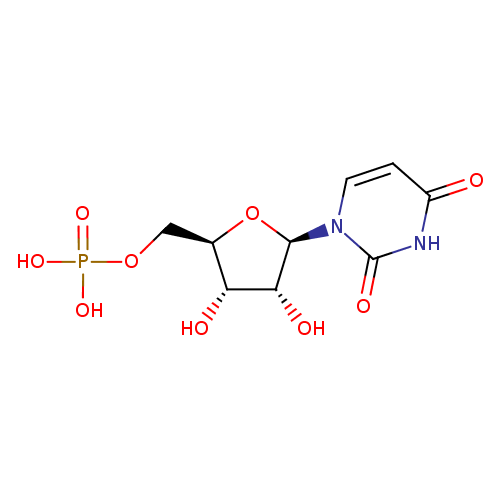
| Description | Uridine 5'-monophosphate, also known as uridylic acid or UMP, belongs to the class of organic compounds known as pyrimidine ribonucleoside monophosphates. These are pyrimidine ribobucleotides with monophosphate group linked to the ribose moiety. Uridine 5'-monophosphate is possibly soluble (in water) and an extremely weak basic (essentially neutral) compound (based on its pKa). Uridine 5'-monophosphate exists in all living species, ranging from bacteria to humans. Uridine 5'-monophosphate participates in a number of enzymatic reactions, within cattle. In particular, Uridine 5'-monophosphate can be converted into uridine 5'-diphosphate; which is mediated by the enzyme UMP-CMP kinase. In addition, Uridine 5'-monophosphate can be biosynthesized from uridine 5'-diphosphate; which is catalyzed by the enzyme soluble calcium-activated nucleotidase 1. In cattle, uridine 5'-monophosphate is involved in the metabolic pathway called lactose synthesis pathway. |
|---|
| Structure | |
|---|
| Synonyms | | Value | Source |
|---|
| 5'-UMP | ChEBI | | 5'Uridylic acid | ChEBI | | pU | ChEBI | | UMP | ChEBI | | Uridine 5'-(dihydrogen phosphate) | ChEBI | | Uridine 5'-phosphate | ChEBI | | Uridine 5'-phosphoric acid | ChEBI | | Uridine monophosphate | ChEBI | | URIDINE-5'-monophosphATE | ChEBI | | Uridylate | ChEBI | | Uridylic acid | ChEBI | | 5'Uridylate | Generator | | Uridine 5'-(dihydrogen phosphoric acid) | Generator | | Uridine monophosphoric acid | Generator | | URIDINE-5'-monophosphoric acid | Generator | | Uridine 5'-monophosphoric acid | Generator | | Uridine 5'-phosphorate | HMDB | | Uridine mono(dihydrogen phosphate) | HMDB | | Uridine phosphate | HMDB | | Acids, uridylic | HMDB | | monoPhosphate, uridine | HMDB | | 5'-monoPhosphate, uridine | HMDB | | Uridylic acids | HMDB | | Acid, uridylic | HMDB | | Uridine 5' monophosphate | HMDB |
|
|---|
| Chemical Formula | C9H13N2O9P |
|---|
| Average Molecular Weight | 324.1813 |
|---|
| Monoisotopic Molecular Weight | 324.035866536 |
|---|
| IUPAC Name | {[(2R,3S,4R,5R)-5-(2,4-dioxo-1,2,3,4-tetrahydropyrimidin-1-yl)-3,4-dihydroxyoxolan-2-yl]methoxy}phosphonic acid |
|---|
| Traditional Name | uridine monophosphate |
|---|
| CAS Registry Number | 58-97-9 |
|---|
| SMILES | O[C@H]1[C@@H](O)[C@@H](O[C@@H]1COP(O)(O)=O)N1C=CC(=O)NC1=O |
|---|
| InChI Identifier | InChI=1S/C9H13N2O9P/c12-5-1-2-11(9(15)10-5)8-7(14)6(13)4(20-8)3-19-21(16,17)18/h1-2,4,6-8,13-14H,3H2,(H,10,12,15)(H2,16,17,18)/t4-,6-,7-,8-/m1/s1 |
|---|
| InChI Key | DJJCXFVJDGTHFX-XVFCMESISA-N |
|---|
| Chemical Taxonomy |
|---|
| Description | belongs to the class of organic compounds known as pyrimidine ribonucleoside monophosphates. These are pyrimidine ribobucleotides with monophosphate group linked to the ribose moiety. |
|---|
| Kingdom | Organic compounds |
|---|
| Super Class | Nucleosides, nucleotides, and analogues |
|---|
| Class | Pyrimidine nucleotides |
|---|
| Sub Class | Pyrimidine ribonucleotides |
|---|
| Direct Parent | Pyrimidine ribonucleoside monophosphates |
|---|
| Alternative Parents | |
|---|
| Substituents | - Pyrimidine ribonucleoside monophosphate
- Pentose phosphate
- Pentose-5-phosphate
- Glycosyl compound
- N-glycosyl compound
- Monosaccharide phosphate
- Pentose monosaccharide
- Pyrimidone
- Monoalkyl phosphate
- Hydropyrimidine
- Monosaccharide
- Organic phosphoric acid derivative
- Phosphoric acid ester
- Pyrimidine
- Alkyl phosphate
- Vinylogous amide
- Heteroaromatic compound
- Tetrahydrofuran
- 1,2-diol
- Urea
- Secondary alcohol
- Lactam
- Azacycle
- Oxacycle
- Organoheterocyclic compound
- Organic oxygen compound
- Alcohol
- Organopnictogen compound
- Organonitrogen compound
- Organooxygen compound
- Organic oxide
- Hydrocarbon derivative
- Organic nitrogen compound
- Aromatic heteromonocyclic compound
|
|---|
| Molecular Framework | Aromatic heteromonocyclic compounds |
|---|
| External Descriptors | |
|---|
| Ontology |
|---|
| Status | Detected and Quantified |
|---|
| Origin | |
|---|
| Biofunction | Not Available |
|---|
| Application | Not Available |
|---|
| Cellular locations | - Cytoplasm
- Endoplasmic reticulum
- Golgi
- Lysosome
- Mitochondria
- Nucleus
|
|---|
| Physical Properties |
|---|
| State | Solid |
|---|
| Experimental Properties | | Property | Value | Reference |
|---|
| Melting Point | Not Available | Not Available | | Boiling Point | Not Available | Not Available | | Water Solubility | Not Available | Not Available | | LogP | Not Available | Not Available |
|
|---|
| Predicted Properties | |
|---|
| Spectra |
|---|
| Spectra | |
|---|
| General References | - Gil A, Sanchez-Medina F: Acid-soluble nucleotides of cow's, goat's and sheep's milks, at different stages of lactation. J Dairy Res. 1981 Feb;48(1):35-44. [PubMed:7196410 ]
- Melzer N, Wittenburg D, Hartwig S, Jakubowski S, Kesting U, Willmitzer L, Lisec J, Reinsch N, Repsilber D: Investigating associations between milk metabolite profiles and milk traits of Holstein cows. J Dairy Sci. 2013 Mar;96(3):1521-34. doi: 10.3168/jds.2012-5743. [PubMed:23438684 ]
|
|---|