Record Information
Version1.0
Creation Date2016-09-30 22:47:31 UTC
Update Date2020-05-21 16:28:51 UTC
BMDB IDBMDB0001547
Secondary Accession Numbers
  • BMDB01547
Metabolite Identification
Common NameCorticosterone
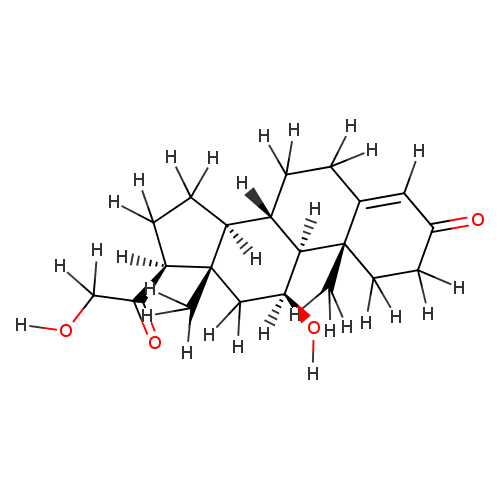
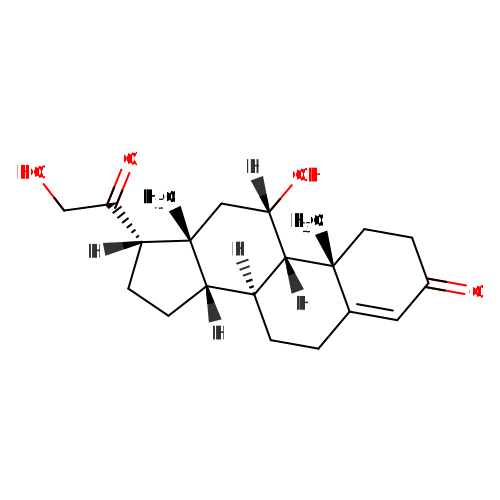
DescriptionCorticosterone, also known as Corticosterone, belongs to the class of organic compounds known as 21-hydroxysteroids. These are steroids carrying a hydroxyl group at the 21-position of the steroid backbone. Thus, corticosterone is considered to be a steroid lipid molecule. Corticosterone exists as a solid, very hydrophobic, practically insoluble (in water), and relatively neutral molecule. Corticosterone participates in a number of enzymatic reactions, within cattle. In particular, Corticosterone can be converted into 18-hydroxycorticosterone through its interaction with the enzyme cytochrome P450 11B1. In addition, Corticosterone can be biosynthesized from 11b-hydroxyprogesterone; which is catalyzed by the enzyme steroid 21-hydroxylase. In cattle, corticosterone is involved in the metabolic pathway called the steroidogenesis pathway. Corticosterone is a potentially toxic compound.
Structure
Thumb
Synonyms
ValueSource
(11beta)-11,21-Dihydroxypregn-4-ene-3,20-dioneChEBI
11beta,21-Dihydroxy-4-pregnene-3,20-dioneChEBI
11beta,21-DihydroxyprogesteroneChEBI
17-DeoxycortisolChEBI
Kendall's compound bChEBI
Reichstein's substance HChEBI
(11b)-11,21-Dihydroxypregn-4-ene-3,20-dioneGenerator
(11Β)-11,21-dihydroxypregn-4-ene-3,20-dioneGenerator
11b,21-Dihydroxy-4-pregnene-3,20-dioneGenerator
11Β,21-dihydroxy-4-pregnene-3,20-dioneGenerator
11b,21-DihydroxyprogesteroneGenerator
11Β,21-dihydroxyprogesteroneGenerator
11,21-Dihydroxypregn-4-ene-3,20-dioneHMDB
11,21-DihydroxyprogesteroneHMDB
11-HydroxycorticoaldosteroneHMDB
4-Pregnene-11 corticosteronHMDB
Chemical FormulaC21H30O4
Average Molecular Weight346.4605
Monoisotopic Molecular Weight346.214409448
IUPAC Name(1S,2R,10S,11S,14S,15S,17S)-17-hydroxy-14-(2-hydroxyacetyl)-2,15-dimethyltetracyclo[8.7.0.0^{2,7}.0^{11,15}]heptadec-6-en-5-one
Traditional Name(1S,2R,10S,11S,14S,15S,17S)-17-hydroxy-14-(2-hydroxyacetyl)-2,15-dimethyltetracyclo[8.7.0.0^{2,7}.0^{11,15}]heptadec-6-en-5-one
CAS Registry Number50-22-6
SMILES
[H]OC([H])([H])C(=O)[C@@]1([H])C([H])([H])C([H])([H])[C@@]2([H])[C@]3([H])C([H])([H])C([H])([H])C4=C([H])C(=O)C([H])([H])C([H])([H])[C@]4(C([H])([H])[H])[C@@]3([H])[C@@]([H])(O[H])C([H])([H])[C@]12C([H])([H])[H]
InChI Identifier
InChI=1S/C21H30O4/c1-20-8-7-13(23)9-12(20)3-4-14-15-5-6-16(18(25)11-22)21(15,2)10-17(24)19(14)20/h9,14-17,19,22,24H,3-8,10-11H2,1-2H3/t14-,15-,16+,17-,19+,20-,21-/m0/s1
InChI KeyOMFXVFTZEKFJBZ-HJTSIMOOSA-N
Chemical Taxonomy
Description belongs to the class of organic compounds known as 21-hydroxysteroids. These are steroids carrying a hydroxyl group at the 21-position of the steroid backbone.
KingdomOrganic compounds
Super ClassLipids and lipid-like molecules
ClassSteroids and steroid derivatives
Sub ClassHydroxysteroids
Direct Parent21-hydroxysteroids
Alternative Parents
Substituents
  • Progestogin-skeleton
  • 21-hydroxysteroid
  • Pregnane-skeleton
  • 20-oxosteroid
  • 3-oxo-delta-4-steroid
  • 3-oxosteroid
  • 11-hydroxysteroid
  • 11-beta-hydroxysteroid
  • Oxosteroid
  • Delta-4-steroid
  • Cyclohexenone
  • Alpha-hydroxy ketone
  • Cyclic alcohol
  • Ketone
  • Secondary alcohol
  • Cyclic ketone
  • Hydrocarbon derivative
  • Organic oxide
  • Carbonyl group
  • Organic oxygen compound
  • Alcohol
  • Organooxygen compound
  • Primary alcohol
  • Aliphatic homopolycyclic compound
Molecular FrameworkAliphatic homopolycyclic compounds
External Descriptors
Ontology
StatusDetected but not Quantified
Origin
  • Endogenous
  • Exogenous
BiofunctionNot Available
ApplicationNot Available
Cellular locations
  • Cell membrane
  • Cytoplasm
  • Endoplasmic reticulum
  • Membrane
  • Mitochondria
Physical Properties
StateSolid
Experimental Properties
PropertyValueReference
Melting Point179 °CNot Available
Boiling PointNot AvailableNot Available
Water Solubility0.199 mg/mLNot Available
LogP1.94HANSCH,C ET AL. (1995)
Predicted Properties
PropertyValueSource
logP2.09ALOGPS
logP2.02ChemAxon
logS-3.9ALOGPS
pKa (Strongest Acidic)13.86ChemAxon
pKa (Strongest Basic)-0.26ChemAxon
Physiological Charge0ChemAxon
Hydrogen Acceptor Count4ChemAxon
Hydrogen Donor Count2ChemAxon
Polar Surface Area74.6 ŲChemAxon
Rotatable Bond Count2ChemAxon
Refractivity96 m³·mol⁻¹ChemAxon
Polarizability38.83 ųChemAxon
Number of Rings4ChemAxon
BioavailabilityYesChemAxon
Rule of FiveYesChemAxon
Ghose FilterYesChemAxon
Veber's RuleYesChemAxon
MDDR-like RuleYesChemAxon
Spectra
Spectra
Biological Properties
Cellular Locations
  • Cell membrane
  • Cytoplasm
  • Endoplasmic reticulum
  • Membrane
  • Mitochondria
Biospecimen Locations
  • Adipose Tissue
  • Adrenal Cortex
  • Adrenal Gland
  • Brain
  • Epidermis
  • Fibroblasts
  • Intestine
  • Kidney
  • Liver
  • Mammary Gland
  • Neuron
  • Ovary
  • Placenta
  • Platelet
  • Spleen
  • Testis
Pathways
Normal Concentrations
BiospecimenStatusValueAgeSexConditionReferenceDetails
Adipose TissueExpected but not QuantifiedNot QuantifiedNot SpecifiedNot SpecifiedNormal
  • Not Applicable
details
Adrenal CortexExpected but not QuantifiedNot QuantifiedNot SpecifiedNot SpecifiedNormal
  • Not Applicable
details
Adrenal GlandExpected but not QuantifiedNot QuantifiedNot SpecifiedNot SpecifiedNormal
  • Not Applicable
details
BrainExpected but not QuantifiedNot QuantifiedNot SpecifiedNot SpecifiedNormal
  • Not Applicable
details
EpidermisExpected but not QuantifiedNot QuantifiedNot SpecifiedNot SpecifiedNormal
  • Not Applicable
details
FibroblastsExpected but not QuantifiedNot QuantifiedNot SpecifiedNot SpecifiedNormal
  • Not Applicable
details
IntestineExpected but not QuantifiedNot QuantifiedNot SpecifiedNot SpecifiedNormal
  • Not Applicable
details
KidneyExpected but not QuantifiedNot QuantifiedNot SpecifiedNot SpecifiedNormal
  • Not Applicable
details
LiverDetected but not QuantifiedNot QuantifiedNot SpecifiedNot Specified
Normal
details
LiverDetected but not QuantifiedNot QuantifiedNot SpecifiedNot Specified
Normal
details
Mammary GlandDetected but not QuantifiedNot QuantifiedNot SpecifiedNot Specified
Normal
details
Mammary GlandDetected but not QuantifiedNot QuantifiedNot SpecifiedNot Specified
Normal
details
NeuronExpected but not QuantifiedNot QuantifiedNot SpecifiedNot SpecifiedNormal
  • Not Applicable
details
OvaryExpected but not QuantifiedNot QuantifiedNot SpecifiedNot SpecifiedNormal
  • Not Applicable
details
PlacentaExpected but not QuantifiedNot QuantifiedNot SpecifiedNot SpecifiedNormal
  • Not Applicable
details
PlateletExpected but not QuantifiedNot QuantifiedNot SpecifiedNot SpecifiedNormal
  • Not Applicable
details
SpleenExpected but not QuantifiedNot QuantifiedNot SpecifiedNot SpecifiedNormal
  • Not Applicable
details
TestisExpected but not QuantifiedNot QuantifiedNot SpecifiedNot SpecifiedNormal
  • Not Applicable
details
Abnormal Concentrations
Not Available
HMDB IDHMDB0001547
DrugBank IDDB04652
Phenol Explorer Compound IDNot Available
FooDB IDFDB022684
KNApSAcK IDNot Available
Chemspider ID5550
KEGG Compound IDC02140
BioCyc IDCORTICOSTERONE
BiGG ID39187
Wikipedia LinkCorticosterone
METLIN ID6314
PubChem Compound5753
PDB IDNot Available
ChEBI ID16827
References
Synthesis ReferenceOliveto, Eugene P.; Smith, Herbert Q.; Gerold, Corinne; Rausser, Richard; Hershberg, E. B. 11-Oxygenated steroids. XIV. New syntheses of corticosterone. Journal of the American Chemical Society (1956), 78 1414-16.
Material Safety Data Sheet (MSDS)Not Available
General ReferencesNot Available

Enzymes

General function:
Secondary metabolites biosynthesis, transport and catabolism
Specific function:
A cytochrome P450 monooxygenase involved in the biosynthesis of adrenal corticoids. Catalyzes the hydroxylation of carbon hydrogen bond at 11-beta position of 11-deoxycortisol and 11-deoxycorticosterone/21-hydroxyprogesterone yielding cortisol or corticosterone, respectively. Mechanistically, uses molecular oxygen inserting one oxygen atom into a substrate and reducing the second into a water molecule. Two electrons are provided by NADPH via a two-protein mitochondrial transfer system comprising flavoprotein FDXR (adrenodoxin/ferredoxin reductase) and nonheme iron-sulfur protein FDX1 or FDX2 (adrenodoxin/ferredoxin).
Gene Name:
CYP11B1
Uniprot ID:
P15150
Molecular weight:
57847.0
Reactions
Deoxycorticosterone + Oxygen + Reduced adrenal ferredoxin → Corticosterone + Water + Oxidized adrenal ferredoxindetails
General function:
Secondary metabolites biosynthesis, transport and catabolism
Specific function:
Specifically catalyzes the 21-hydroxylation of steroids. Required for the adrenal synthesis of mineralocorticoids and glucocorticoids.
Gene Name:
CYP21
Uniprot ID:
P00191
Molecular weight:
56077.0
Reactions
11b-Hydroxyprogesterone + Oxygen + Reduced acceptor → Corticosterone + Water + Acceptordetails
General function:
Lipid transport and metabolism
Specific function:
Catalyzes the conversion of cortisol to the inactive metabolite cortisone. Modulates intracellular glucocorticoid levels, thus protecting the nonselective mineralocorticoid receptor from occupation by glucocorticoids. Affinity towards corticosterone is higher than cortisol or dexamethasone.
Gene Name:
HSD11B2
Uniprot ID:
O77667
Molecular weight:
43987.0
Reactions
Corticosterone + NADP → 11-Dehydrocorticosterone + NADPHdetails
General function:
Lipid transport and metabolism
Specific function:
Not Available
Gene Name:
HSD11B1L
Uniprot ID:
Q6Q7D1
Molecular weight:
31126.0
Reactions
Corticosterone + NADP → 11-Dehydrocorticosterone + NADPHdetails