| Record Information |
|---|
| Version | 1.0 |
|---|
| Creation Date | 2016-09-30 22:55:22 UTC |
|---|
| Update Date | 2020-05-21 16:28:35 UTC |
|---|
| BMDB ID | BMDB0002434 |
|---|
| Secondary Accession Numbers | |
|---|
| Metabolite Identification |
|---|
| Common Name | Hydroquinone |
|---|
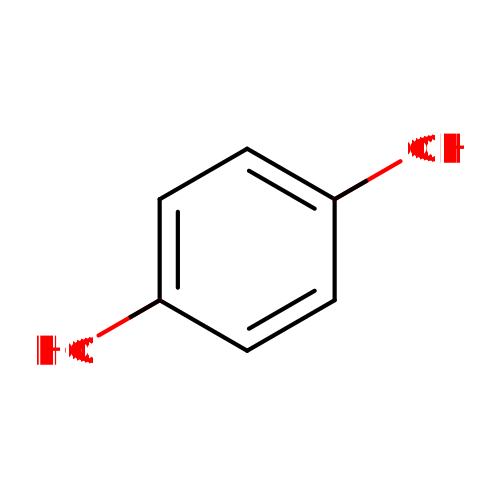
| Description | Hydroquinone, also known as quinol or 1,4-benzenediol, belongs to the class of organic compounds known as hydroquinones. Hydroquinones are compounds containing a hydroquinone moiety, which consists of a benzene ring with a hydroxyl groups at positions 1 and 4. Hydroquinone exists in all living organisms, ranging from bacteria to humans. In cattle, hydroquinone is involved in the metabolic pathway called the riboflavin metabolism pathway. Based on a literature review a significant number of articles have been published on Hydroquinone. |
|---|
| Structure | |
|---|
| Synonyms | | Value | Source |
|---|
| 1,4-Benzenediol | ChEBI | | 1,4-Dihydroxybenzene | ChEBI | | 4-Hydroxyphenol | ChEBI | | Benzene-1,4-diol | ChEBI | | Eldoquin | ChEBI | | p-Benzenediol | ChEBI | | p-Hydroquinone | ChEBI | | p-Hydroxyphenol | ChEBI | | Quinol | ChEBI | | Artra | MeSH | | Eldopaque | MeSH | | Esoterica | MeSH | | Hidroquilaude | MeSH | | Hidroquin | MeSH | | Hidroquinona isdin | MeSH | | Licostrata | MeSH | | Lustra | MeSH | | Melanasa | MeSH | | Melanex | MeSH | | Melpaque | MeSH | | Melquin | MeSH | | Neostrata HQ | MeSH | | Phiaquin | MeSH | | Solaquin | MeSH | | Ultraquin | MeSH | | beta-Quinol | MeSH | | Hydroquinone, copper (1+) salt | MeSH | | Hydroquinone, lead (2+) salt (2:1) | MeSH | | Hydroquinone, monocopper (2+) salt | MeSH | | 1,4-Dihydroxy-benzeen | HMDB | | 1,4-Dihydroxy-benzol | HMDB | | 1,4-Dihydroxybenzen | HMDB | | 1,4-Diidrobenzene | HMDB | | a-Hydroquinone | HMDB | | alpha-Hydroquinone | HMDB | | b-Quinol | HMDB | | Benzohydroquinone | HMDB | | Benzoquinol | HMDB | | Dihydroquinone | HMDB | | Dihydroxybenzene | HMDB | | Hydrochinon | HMDB | | Hydrochinone | HMDB | | Hydroquinol | HMDB | | Hydroquinole | HMDB | | Hydroquinone for synthesis | HMDB | | Hydroquinone GR | HMDB | | Hydroquinoue | HMDB | | Idrochinone | HMDB | | p-Dihydroxybenzene | HMDB | | P-Dioxobenzene | HMDB | | p-Dioxybenzene | HMDB | | P-Hydroxybenzene | HMDB | | Solaquin forte | HMDB | | Eldoquin forte | MeSH, HMDB | | Stratus brand 1 OF hydroquinone | MeSH, HMDB | | ICN brand 1 OF hydroquinone | MeSH, HMDB | | Plough brand 2 OF hydroquinone | MeSH, HMDB | | Eldopaque forte | MeSH, HMDB | | ICN brand 4 OF hydroquinone | MeSH, HMDB | | Black and white | MeSH, HMDB | | ICN brand 2 OF hydroquinone | MeSH, HMDB | | ICN brand 3 OF hydroquinone | MeSH, HMDB | | Plough brand 1 OF hydroquinone | MeSH, HMDB | | Stratus brand 2 OF hydroquinone | MeSH, HMDB | | 1,4-Benzoquinol | PhytoBank | | 1,4-Phenylenediol | PhytoBank | | 1,4-p-Benzenediol | PhytoBank | | p-Dihydroquinone | PhytoBank | | p-Phenylenediol | PhytoBank | | p-Quinol | PhytoBank |
|
|---|
| Chemical Formula | C6H6O2 |
|---|
| Average Molecular Weight | 110.1106 |
|---|
| Monoisotopic Molecular Weight | 110.036779436 |
|---|
| IUPAC Name | benzene-1,4-diol |
|---|
| Traditional Name | α-hydroquinone |
|---|
| CAS Registry Number | 123-31-9 |
|---|
| SMILES | OC1=CC=C(O)C=C1 |
|---|
| InChI Identifier | InChI=1S/C6H6O2/c7-5-1-2-6(8)4-3-5/h1-4,7-8H |
|---|
| InChI Key | QIGBRXMKCJKVMJ-UHFFFAOYSA-N |
|---|
| Chemical Taxonomy |
|---|
| Description | belongs to the class of organic compounds known as hydroquinones. Hydroquinones are compounds containing a hydroquinone moiety, which consists of a benzene ring with a hydroxyl groups at positions 1 and 4. |
|---|
| Kingdom | Organic compounds |
|---|
| Super Class | Benzenoids |
|---|
| Class | Phenols |
|---|
| Sub Class | Benzenediols |
|---|
| Direct Parent | Hydroquinones |
|---|
| Alternative Parents | |
|---|
| Substituents | - Hydroquinone
- 1-hydroxy-2-unsubstituted benzenoid
- Monocyclic benzene moiety
- Organic oxygen compound
- Hydrocarbon derivative
- Organooxygen compound
- Aromatic homomonocyclic compound
|
|---|
| Molecular Framework | Aromatic homomonocyclic compounds |
|---|
| External Descriptors | |
|---|
| Ontology |
|---|
| Status | Expected but not Quantified |
|---|
| Origin | |
|---|
| Biofunction | Not Available |
|---|
| Application | Not Available |
|---|
| Cellular locations | |
|---|
| Physical Properties |
|---|
| State | Solid |
|---|
| Experimental Properties | | Property | Value | Reference |
|---|
| Melting Point | 172.3 °C | Not Available | | Boiling Point | Not Available | Not Available | | Water Solubility | 72.0 mg/mL at 25 °C | Not Available | | LogP | 0.59 | HANSCH,C ET AL. (1995) |
|
|---|
| Predicted Properties | |
|---|
| Spectra |
|---|
| Spectra | |
|---|