| Record Information |
|---|
| Version | 1.0 |
|---|
| Creation Date | 2016-09-30 22:34:28 UTC |
|---|
| Update Date | 2020-06-04 20:58:44 UTC |
|---|
| BMDB ID | BMDB0000660 |
|---|
| Secondary Accession Numbers | |
|---|
| Metabolite Identification |
|---|
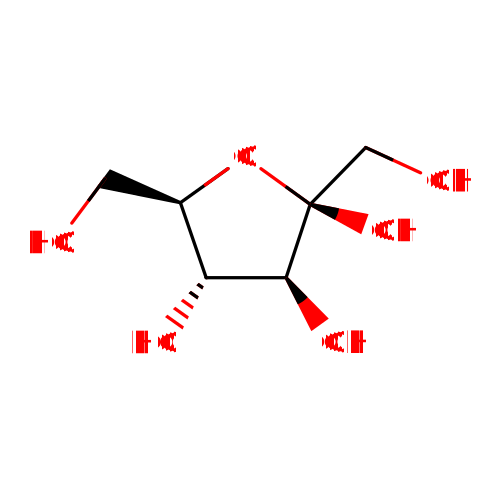
| Common Name | D-Fructose |
|---|
| Description | D-Fructose, also known as D-tagatose or D-lyxo-2-hexulose, belongs to the class of organic compounds known as monosaccharides. Monosaccharides are compounds containing one carbohydrate unit not glycosidically linked to another such unit, and no set of two or more glycosidically linked carbohydrate units. Monosaccharides have the general formula CnH2nOn. D-Fructose exists as a solid, possibly soluble (in water), and an extremely weak basic (essentially neutral) compound (based on its pKa) molecule. D-Fructose exists in all living species, ranging from bacteria to humans. D-Fructose participates in a number of enzymatic reactions, within cattle. In particular, D-Fructose can be biosynthesized from sorbitol through its interaction with the enzyme sorbitol dehydrogenase. In addition, D-Fructose can be biosynthesized from Beta-D-fructose 2-phosphate through the action of the enzyme 14 kda phosphohistidine phosphatase. In cattle, D-fructose is involved in the metabolic pathway called the fructose and mannose degradation pathway. D-Fructose is a potentially toxic compound. |
|---|
| Structure | |
|---|
| Synonyms | | Value | Source |
|---|
| beta-D-Arabino-hexulose | ChEBI | | beta-D-Fructose | ChEBI | | beta-Fruit sugar | ChEBI | | beta-Levulose | ChEBI | | FRUCTOSE | ChEBI | | b-D-Arabino-hexulose | Generator | | Β-D-arabino-hexulose | Generator | | b-D-Fructose | Generator | | Β-D-fructose | Generator | | b-Fruit sugar | Generator | | Β-fruit sugar | Generator | | b-Levulose | Generator | | Β-levulose | Generator | | beta-D-Fructofuranose | HMDB | | beta-delta-Arabino-hexulose | HMDB | | beta-delta-Fructofuranose | HMDB | | beta-delta-Fructose | HMDB | | D-(-)-Fructose | HMDB | | delta-(-)-Fructose | HMDB | | delta-Fructose | HMDB | | FRU | HMDB | | Fructon | HMDB | | Levulose | HMDB | | Braun brand OF fructose | HMDB | | Fleboplast levulosa | HMDB | | Fresenius kabi brand OF fructose | HMDB | | Instituto farmacologico brand OF fructose | HMDB | | Levulosa | HMDB | | Levulosa ife | HMDB | | Grifols brand OF fructose | HMDB | | Levulosa baxter | HMDB | | Levulosado braun | HMDB | | Ern brand OF fructose | HMDB | | Levulosa grifols | HMDB | | Levulosa mein | HMDB | | Levulosado vitulia | HMDB | | Apir levulosa | HMDB | | Baxter brand OF fructose | HMDB | | Bieffe brand OF fructose | HMDB | | Levulosa braun | HMDB | | Levulosa ibys | HMDB | | Levulosa, apir | HMDB | | Levulosa, fleboplast | HMDB | | Levulosado bieffe medit | HMDB | | Plast apyr levulosa mein | HMDB |
|
|---|
| Chemical Formula | C6H12O6 |
|---|
| Average Molecular Weight | 180.1559 |
|---|
| Monoisotopic Molecular Weight | 180.063388116 |
|---|
| IUPAC Name | (2R,3S,4S,5R)-2,5-bis(hydroxymethyl)oxolane-2,3,4-triol |
|---|
| Traditional Name | fructose |
|---|
| CAS Registry Number | 53188-23-1 |
|---|
| SMILES | OC[C@H]1O[C@](O)(CO)[C@@H](O)[C@@H]1O |
|---|
| InChI Identifier | InChI=1S/C6H12O6/c7-1-3-4(9)5(10)6(11,2-8)12-3/h3-5,7-11H,1-2H2/t3-,4-,5+,6-/m1/s1 |
|---|
| InChI Key | RFSUNEUAIZKAJO-ARQDHWQXSA-N |
|---|
| Chemical Taxonomy |
|---|
| Description | belongs to the class of organic compounds known as c-glycosyl compounds. These are glycoside in which a sugar group is bonded through one carbon to another group via a C-glycosidic bond. |
|---|
| Kingdom | Organic compounds |
|---|
| Super Class | Organic oxygen compounds |
|---|
| Class | Organooxygen compounds |
|---|
| Sub Class | Carbohydrates and carbohydrate conjugates |
|---|
| Direct Parent | C-glycosyl compounds |
|---|
| Alternative Parents | |
|---|
| Substituents | - C-glycosyl compound
- Pentose monosaccharide
- Monosaccharide
- Tetrahydrofuran
- Secondary alcohol
- Hemiacetal
- Oxacycle
- Organoheterocyclic compound
- Polyol
- Hydrocarbon derivative
- Primary alcohol
- Alcohol
- Aliphatic heteromonocyclic compound
|
|---|
| Molecular Framework | Aliphatic heteromonocyclic compounds |
|---|
| External Descriptors | |
|---|
| Ontology |
|---|
| Status | Detected and Quantified |
|---|
| Origin | |
|---|
| Biofunction | Not Available |
|---|
| Application | Not Available |
|---|
| Cellular locations | Not Available |
|---|
| Physical Properties |
|---|
| State | Solid |
|---|
| Experimental Properties | | Property | Value | Reference |
|---|
| Melting Point | 119 - 122 °C | Not Available | | Boiling Point | Not Available | Not Available | | Water Solubility | 778 mg/mL at 20 °C | YALKOWSKY,SH & DANNENFELSER,RM (1992) | | LogP | Not Available | Not Available |
|
|---|
| Predicted Properties | |
|---|
| Spectra |
|---|
| Spectra | |
|---|
| Biological Properties |
|---|
| Cellular Locations | Not Available |
|---|
| Biospecimen Locations | - Liver
- Mammary Gland
- Milk
- Placenta
- Prostate Tissue
- Ruminal Fluid
- Semen
|
|---|
| Pathways | |
|---|
| Normal Concentrations |
|---|
| |
| Liver | Detected but not Quantified | Not Quantified | Not Specified | Not Specified | Normal | | details | | Mammary Gland | Detected but not Quantified | Not Quantified | Not Specified | Not Specified | Normal | | details | | Mammary Gland | Detected but not Quantified | Not Quantified | Not Specified | Not Specified | Normal | | details | | Milk | Detected but not Quantified | Not Quantified | Not Specified | Not Specified | Normal | | details | | Placenta | Expected but not Quantified | Not Quantified | Not Specified | Not Specified | Normal | | details | | Prostate Tissue | Expected but not Quantified | Not Quantified | Not Specified | Not Specified | Normal | | details | | Ruminal Fluid | Detected and Quantified | 763.813 +/- 751.731 uM | Not Specified | Not Specified | Normal | | details | | Ruminal Fluid | Detected but not Quantified | Not Quantified | Not Specified | Not Specified | Normal | | details | | Semen | Detected but not Quantified | Not Quantified | Not Specified | Not Specified | Normal | | details |
|
|---|
| Abnormal Concentrations |
|---|
| |
| Ruminal Fluid | Detected and Quantified | 2415.813 +/- 1248.434 uM | Not Specified | Not Specified | Rumen acidosis | | details |
|
|---|
| External Links |
|---|
| HMDB ID | HMDB0000660 |
|---|
| DrugBank ID | Not Available |
|---|
| Phenol Explorer Compound ID | Not Available |
|---|
| FooDB ID | FDB031286 |
|---|
| KNApSAcK ID | C00001117 |
|---|
| Chemspider ID | 388775 |
|---|
| KEGG Compound ID | C02336 |
|---|
| BioCyc ID | BETA-D-FRUCTOSE |
|---|
| BiGG ID | 33835 |
|---|
| Wikipedia Link | Fructose |
|---|
| METLIN ID | 135 |
|---|
| PubChem Compound | 439709 |
|---|
| PDB ID | FRU |
|---|
| ChEBI ID | 28645 |
|---|
| References |
|---|
| Synthesis Reference | Liu, Hong; Han, Dong; Meng, Xiang-bao; Li, Zhong-jun. Improved synthesis of fructose-derived 1,3,4-oxadiazole as novel antitumor agents. Journal of Chinese Pharmaceutical Sciences (2005), 14(4), 209-212. |
|---|
| Material Safety Data Sheet (MSDS) | Not Available |
|---|
| General References | - Scano P, Murgia A, Pirisi FM, Caboni P: A gas chromatography-mass spectrometry-based metabolomic approach for the characterization of goat milk compared with cow milk. J Dairy Sci. 2014 Oct;97(10):6057-66. doi: 10.3168/jds.2014-8247. Epub 2014 Aug 6. [PubMed:25108860 ]
- A. Foroutan et al. (2019). A. Foroutan et al. The Chemical Composition of Commercial Cow's Milk (in preparation). Journal of Agricultural and Food Chemistry.
|
|---|