Record Information
Version1.0
Creation Date2016-09-30 22:26:28 UTC
Update Date2020-05-21 16:27:08 UTC
BMDB IDBMDB0000189
Secondary Accession Numbers
  • BMDB00189
Metabolite Identification
Common NameInosine triphosphate
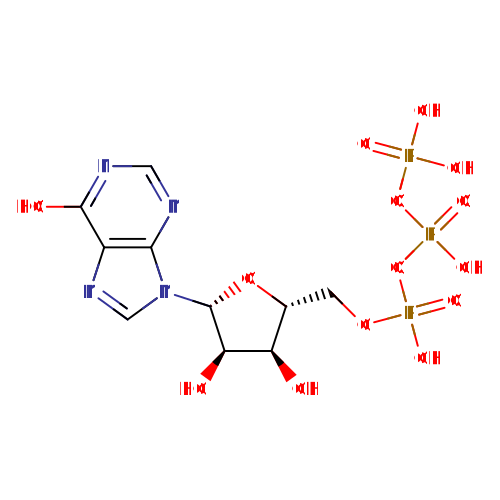
DescriptionInosine triphosphate belongs to the class of organic compounds known as purine ribonucleoside triphosphates. These are purine ribobucleotides with a triphosphate group linked to the ribose moiety. Inosine triphosphate is an extremely weak basic (essentially neutral) compound (based on its pKa). Inosine triphosphate exists in all living species, ranging from bacteria to humans.
Structure
Thumb
Synonyms
ValueSource
2'-Inosine-5'-triphosphateChEBI
Inosine 5'-triphosphateChEBI
Inosine tripolyphosphateChEBI
O(5')-(Tetrahydroxytriphosphoryl)inosineChEBI
2'-Inosine-5'-triphosphoric acidGenerator
Inosine 5'-triphosphoric acidGenerator
Inosine tripolyphosphoric acidGenerator
Inosine triphosphoric acidGenerator
5'-ITPHMDB
5-ITPHMDB
Inosine 5HMDB
Inosine 5'-(tetrahydrogen triphosphate)HMDB
Inosine 5(tetrahydrogen triphosphate)HMDB
Inosine 5-triphopshateHMDB
ITPHMDB
ITTHMDB
Triphosphate, inosineMeSH, HMDB
Inosine triphosphateChEBI
Chemical FormulaC10H15N4O14P3
Average Molecular Weight508.1658
Monoisotopic Molecular Weight507.979760744
IUPAC Name({[({[(2R,3S,4R,5R)-3,4-dihydroxy-5-(6-hydroxy-9H-purin-9-yl)oxolan-2-yl]methoxy}(hydroxy)phosphoryl)oxy](hydroxy)phosphoryl}oxy)phosphonic acid
Traditional Name({[(2R,3S,4R,5R)-3,4-dihydroxy-5-(6-hydroxypurin-9-yl)oxolan-2-yl]methoxy(hydroxy)phosphoryl}oxy(hydroxy)phosphoryl)oxyphosphonic acid
CAS Registry Number132-06-9
SMILES
O[C@@H]1[C@@H](COP(O)(=O)OP(O)(=O)OP(O)(O)=O)O[C@H]([C@@H]1O)N1C=NC2=C1N=CN=C2O
InChI Identifier
InChI=1S/C10H15N4O14P3/c15-6-4(1-25-30(21,22)28-31(23,24)27-29(18,19)20)26-10(7(6)16)14-3-13-5-8(14)11-2-12-9(5)17/h2-4,6-7,10,15-16H,1H2,(H,21,22)(H,23,24)(H,11,12,17)(H2,18,19,20)/t4-,6-,7-,10-/m1/s1
InChI KeyHAEJPQIATWHALX-KQYNXXCUSA-N
Chemical Taxonomy
Description belongs to the class of organic compounds known as purine ribonucleoside triphosphates. These are purine ribobucleotides with a triphosphate group linked to the ribose moiety.
KingdomOrganic compounds
Super ClassNucleosides, nucleotides, and analogues
ClassPurine nucleotides
Sub ClassPurine ribonucleotides
Direct ParentPurine ribonucleoside triphosphates
Alternative Parents
Substituents
  • Purine ribonucleoside triphosphate
  • Purine ribonucleoside monophosphate
  • Pentose phosphate
  • Pentose-5-phosphate
  • Glycosyl compound
  • N-glycosyl compound
  • 6-oxopurine
  • Hypoxanthine
  • Monosaccharide phosphate
  • Imidazopyrimidine
  • Purine
  • Pyrimidone
  • Monoalkyl phosphate
  • Alkyl phosphate
  • Pyrimidine
  • Phosphoric acid ester
  • Monosaccharide
  • Organic phosphoric acid derivative
  • N-substituted imidazole
  • Tetrahydrofuran
  • Vinylogous amide
  • Azole
  • Imidazole
  • Heteroaromatic compound
  • Secondary alcohol
  • 1,2-diol
  • Organoheterocyclic compound
  • Azacycle
  • Oxacycle
  • Alcohol
  • Organic oxide
  • Organopnictogen compound
  • Organic oxygen compound
  • Organic nitrogen compound
  • Organooxygen compound
  • Hydrocarbon derivative
  • Organonitrogen compound
  • Aromatic heteropolycyclic compound
Molecular FrameworkAromatic heteropolycyclic compounds
External Descriptors
Ontology
StatusExpected but not Quantified
Origin
  • Endogenous
BiofunctionNot Available
ApplicationNot Available
Cellular locations
  • Cytoplasm
  • Mitochondria
  • Nucleus
Physical Properties
StateSolid
Experimental Properties
PropertyValueReference
Melting PointNot AvailableNot Available
Boiling PointNot AvailableNot Available
Water Solubility903.5 mg/mLNot Available
LogPNot AvailableNot Available
Predicted Properties
PropertyValueSource
logP-0.67ALOGPS
logP-2.7ChemAxon
logS-2ALOGPS
pKa (Strongest Acidic)0.91ChemAxon
pKa (Strongest Basic)-0.5ChemAxon
Physiological Charge-3ChemAxon
Hydrogen Acceptor Count14ChemAxon
Hydrogen Donor Count7ChemAxon
Polar Surface Area273.34 ŲChemAxon
Rotatable Bond Count8ChemAxon
Refractivity93.09 m³·mol⁻¹ChemAxon
Polarizability38.09 ųChemAxon
Number of Rings3ChemAxon
BioavailabilityYesChemAxon
Rule of FiveYesChemAxon
Ghose FilterYesChemAxon
Veber's RuleYesChemAxon
MDDR-like RuleYesChemAxon
Spectra
Spectra
Biological Properties
Cellular Locations
  • Cytoplasm
  • Mitochondria
  • Nucleus
Biospecimen Locations
  • Erythrocyte
Pathways
Normal Concentrations
BiospecimenStatusValueAgeSexConditionReferenceDetails
ErythrocyteExpected but not QuantifiedNot QuantifiedNot SpecifiedNot SpecifiedNormal
  • Not Applicable
details
Abnormal Concentrations
Not Available
HMDB IDHMDB0000189
DrugBank IDNot Available
Phenol Explorer Compound IDNot Available
FooDB IDFDB021902
KNApSAcK IDNot Available
Chemspider IDNot Available
KEGG Compound IDC00081
BioCyc IDITP
BiGG IDNot Available
Wikipedia LinkInosine triphosphate
METLIN IDNot Available
PubChem Compound8583
PDB IDNot Available
ChEBI ID16039
References
Synthesis ReferenceNakayama, Kiyoshi; Tanaka, Haruo. Fermentative preparation of inosine di- and triphosphate. Jpn. Tokkyo Koho (1972), 2 pp.
Material Safety Data Sheet (MSDS)Not Available
General ReferencesNot Available

Enzymes

General function:
Not Available
Specific function:
Canalicular ectonucleoside NTPDase responsible for the main hepatic NTPDase activity. Ectonucleoside NTPDases catalyze the hydrolysis of gamma- and beta-phosphate residues of nucleotides, playing a central role in concentration of extracellular nucleotides. Has activity toward ATP, ADP, UTP and UDP, but not toward AMP (By similarity).
Gene Name:
ENTPD8
Uniprot ID:
A0JND9
Molecular weight:
53240.0
Reactions
Inosine triphosphate + Water → IDP + Hydrogen phosphatedetails
General function:
Nucleotide transport and metabolism
Specific function:
Catalyzes the irreversible NADPH-dependent deamination of GMP to IMP. It functions in the conversion of nucleobase, nucleoside and nucleotide derivatives of G to A nucleotides, and in maintaining the intracellular balance of A and G nucleotides (Probable). Plays a role in modulating cellular differentiation (By similarity).
Gene Name:
GMPR2
Uniprot ID:
Q32L93
Molecular weight:
38033.0
General function:
Nucleotide transport and metabolism
Specific function:
Major role in the synthesis of nucleoside triphosphates other than ATP. The ATP gamma phosphate is transferred to the NDP beta phosphate via a ping-pong mechanism, using a phosphorylated active-site intermediate (By similarity).
Gene Name:
NME7
Uniprot ID:
Q5E9Y9
Molecular weight:
42599.0
Reactions
Adenosine triphosphate + IDP → ADP + Inosine triphosphatedetails
General function:
Nucleotide transport and metabolism
Specific function:
Pyrophosphatase that hydrolyzes the non-canonical purine nucleotides inosine triphosphate (ITP), deoxyinosine triphosphate (dITP) as well as 2'-deoxy-N-6-hydroxylaminopurine triposphate (dHAPTP) and xanthosine 5'-triphosphate (XTP) to their respective monophosphate derivatives. The enzyme does not distinguish between the deoxy- and ribose forms. Probably excludes non-canonical purines from RNA and DNA precursor pools, thus preventing their incorporation into RNA and DNA and avoiding chromosomal lesions.
Gene Name:
ITPA
Uniprot ID:
Q2KIC5
Molecular weight:
23061.0
Reactions
Inosine triphosphate + Water → Inosinic acid + Pyrophosphatedetails
General function:
Nucleotide transport and metabolism
Specific function:
Catalyzes the irreversible NADPH-dependent deamination of GMP to IMP. It functions in the conversion of nucleobase, nucleoside and nucleotide derivatives of G to A nucleotides, and in maintaining the intracellular balance of A and G nucleotides.
Gene Name:
GMPR
Uniprot ID:
Q08DA2
Molecular weight:
37504.0
General function:
Nucleotide transport and metabolism
Specific function:
Catalyzes the conversion of inosine 5'-phosphate (IMP) to xanthosine 5'-phosphate (XMP), the first committed and rate-limiting step in the de novo synthesis of guanine nucleotides, and therefore plays an important role in the regulation of cell growth. Could also have a single-stranded nucleic acid-binding activity and could play a role in RNA and/or DNA metabolism. It may also have a role in the development of malignancy and the growth progression of some tumors.
Gene Name:
IMPDH2
Uniprot ID:
Q3SWY3
Molecular weight:
55763.0
General function:
Nucleotide transport and metabolism
Specific function:
Catalyzes the conversion of inosine 5'-phosphate (IMP) to xanthosine 5'-phosphate (XMP), the first committed and rate-limiting step in the de novo synthesis of guanine nucleotides, and therefore plays an important role in the regulation of cell growth. Could also have a single-stranded nucleic acid-binding activity and could play a role in RNA and/or DNA metabolism. It may also have a role in the development of malignancy and the growth progression of some tumors.
Gene Name:
IMPDH1
Uniprot ID:
A0JNA3
Molecular weight:
55424.0