| Record Information |
|---|
| Version | 1.0 |
|---|
| Creation Date | 2016-09-30 22:26:33 UTC |
|---|
| Update Date | 2020-06-04 20:52:13 UTC |
|---|
| BMDB ID | BMDB0000193 |
|---|
| Secondary Accession Numbers | |
|---|
| Metabolite Identification |
|---|
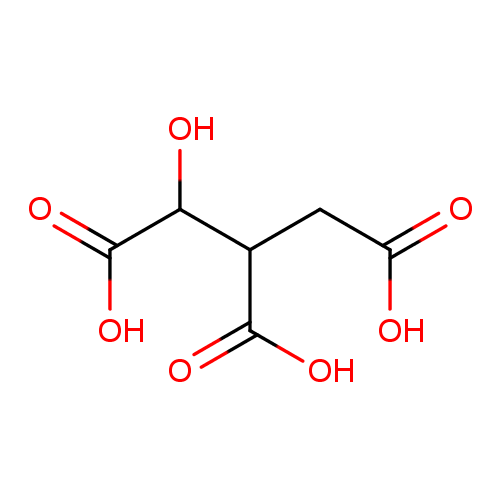
| Common Name | Isocitric acid |
|---|
| Description | Isocitric acid, also known as isocitrate or i-cit, belongs to the class of organic compounds known as tricarboxylic acids and derivatives. These are carboxylic acids containing exactly three carboxyl groups. Isocitric acid exists as a solid, possibly soluble (in water), and an extremely weak basic (essentially neutral) compound (based on its pKa) molecule. Isocitric acid exists in all living species, ranging from bacteria to humans. |
|---|
| Structure | |
|---|
| Synonyms | | Value | Source |
|---|
| 1-Hydroxypropane-1,2,3-tricarboxylic acid | ChEBI | | 1-Hydroxytricarballylic acid | ChEBI | | 1-Hydroxypropane-1,2,3-tricarboxylate | Generator | | 1-Hydroxytricarballylate | Generator | | Isocitrate | Generator | | 1-Hydroxy-1,2,3-propanetricarboxylate | HMDB | | 1-Hydroxy-1,2,3-propanetricarboxylic acid | HMDB | | 3-Carboxy-2,3-dideoxy-1-hydroxypropan-1,2,3-tricarboxylate | HMDB | | 3-Carboxy-2,3-dideoxy-1-hydroxypropan-1,2,3-tricarboxylic acid | HMDB | | 3-Carboxy-2,3-dideoxy-pentarate | HMDB | | 3-Carboxy-2,3-dideoxy-pentaric acid | HMDB | | D-Isocitrate | HMDB | | I-cit | HMDB | | Threo-D(S)-iso-citrate | HMDB | | Threo-DS-isocitrate | HMDB | | Isocitric acid, sodium salt | HMDB | | Isocitric acid, trisodium salt | HMDB | | Isocitric acid, disodium salt | HMDB | | Isocitric acid, (11)C-labeled | HMDB | | Isocitric acid, calcium salt | HMDB | | Isocitric acid, potassium salt | HMDB |
|
|---|
| Chemical Formula | C6H8O7 |
|---|
| Average Molecular Weight | 192.1235 |
|---|
| Monoisotopic Molecular Weight | 192.02700261 |
|---|
| IUPAC Name | 1-hydroxypropane-1,2,3-tricarboxylic acid |
|---|
| Traditional Name | isocitric acid |
|---|
| CAS Registry Number | 320-77-4 |
|---|
| SMILES | OC(C(CC(O)=O)C(O)=O)C(O)=O |
|---|
| InChI Identifier | InChI=1S/C6H8O7/c7-3(8)1-2(5(10)11)4(9)6(12)13/h2,4,9H,1H2,(H,7,8)(H,10,11)(H,12,13) |
|---|
| InChI Key | ODBLHEXUDAPZAU-UHFFFAOYSA-N |
|---|
| Chemical Taxonomy |
|---|
| Description | belongs to the class of organic compounds known as tricarboxylic acids and derivatives. These are carboxylic acids containing exactly three carboxyl groups. |
|---|
| Kingdom | Organic compounds |
|---|
| Super Class | Organic acids and derivatives |
|---|
| Class | Carboxylic acids and derivatives |
|---|
| Sub Class | Tricarboxylic acids and derivatives |
|---|
| Direct Parent | Tricarboxylic acids and derivatives |
|---|
| Alternative Parents | |
|---|
| Substituents | - Tricarboxylic acid or derivatives
- Beta-hydroxy acid
- Monosaccharide
- Hydroxy acid
- Alpha-hydroxy acid
- Secondary alcohol
- Carboxylic acid
- Organic oxygen compound
- Organic oxide
- Hydrocarbon derivative
- Organooxygen compound
- Carbonyl group
- Alcohol
- Aliphatic acyclic compound
|
|---|
| Molecular Framework | Aliphatic acyclic compounds |
|---|
| External Descriptors | |
|---|
| Ontology |
|---|
| Status | Detected and Quantified |
|---|
| Origin | |
|---|
| Biofunction | Not Available |
|---|
| Application | Not Available |
|---|
| Cellular locations | - Cytoplasm
- Mitochondria
- Peroxisome
|
|---|
| Physical Properties |
|---|
| State | Solid |
|---|
| Experimental Properties | | Property | Value | Reference |
|---|
| Melting Point | 162 - 165 °C | Not Available | | Boiling Point | Not Available | Not Available | | Water Solubility | 466 mg/mL | Not Available | | LogP | Not Available | Not Available |
|
|---|
| Predicted Properties | |
|---|
| Spectra |
|---|
| Spectra | |
|---|
| Biological Properties |
|---|
| Cellular Locations | - Cytoplasm
- Mitochondria
- Peroxisome
|
|---|
| Biospecimen Locations | - Adrenal Gland
- Mammary Gland
- Milk
|
|---|
| Pathways | |
|---|
| Normal Concentrations |
|---|
| |
| Adrenal Gland | Expected but not Quantified | Not Quantified | Not Specified | Not Specified | Normal | | details | | Mammary Gland | Detected but not Quantified | Not Quantified | Not Specified | Not Specified | Normal | | details | | Mammary Gland | Detected but not Quantified | Not Quantified | Not Specified | Not Specified | Normal | | details | | Milk | Detected but not Quantified | Not Quantified | Not Specified | Not Specified | Normal | | details | | Milk | Detected and Quantified | 108.4 uM | Not Specified | Not Specified | Normal | | details | | Milk | Detected and Quantified | 243 uM | Not Specified | Not Specified | Normal | | details | | Milk | Detected and Quantified | 191 uM | Not Specified | Not Specified | Normal | | details | | Milk | Detected and Quantified | 219 uM | Not Specified | Not Specified | Normal | | details |
|
|---|
| Abnormal Concentrations |
|---|
| Not Available |
|---|
| External Links |
|---|
| HMDB ID | HMDB0000193 |
|---|
| DrugBank ID | Not Available |
|---|
| Phenol Explorer Compound ID | Not Available |
|---|
| FooDB ID | FDB003281 |
|---|
| KNApSAcK ID | C00001188 |
|---|
| Chemspider ID | 1161 |
|---|
| KEGG Compound ID | C00311 |
|---|
| BioCyc ID | Isocitrate |
|---|
| BiGG ID | 34579 |
|---|
| Wikipedia Link | Isocitric_acid |
|---|
| METLIN ID | 3328 |
|---|
| PubChem Compound | 1198 |
|---|
| PDB ID | Not Available |
|---|
| ChEBI ID | 30887 |
|---|
| References |
|---|
| Synthesis Reference | Finogenova, T. V.; Kamzolova, S. V.; Dedyukhina, E. G.; Shishkanova, N. V.; Il'chenko, A. P.; Morgunov, I. G.; Chernyavskaya, O. G.; Sokolov, A. P. Biosynthesis of citric and isocitric acids from ethanol by mutant Yarrowia lipolytica N 1 under continuous cultivation. Applied Microbiology and Biotechnology (2002), 59(4-5), 493-500. |
|---|
| Material Safety Data Sheet (MSDS) | Not Available |
|---|
| General References | - Faulkner A, Pollock HT: Changes in the concentration of metabolites in milk from cows fed on diets supplemented with soyabean oil or fatty acids. J Dairy Res. 1989 May;56(2):179-83. [PubMed:2760296 ]
- Hurtaud C, Rulquin H, Verite R: Effects of graded duodenal infusions of glucose on yield and composition of milk from dairy cows. 1. Diets based on corn silage. J Dairy Sci. 1998 Dec;81(12):3239-47. doi: 10.3168/jds.S0022-0302(98)75888-6. [PubMed:9891269 ]
- Hurtaud C, Lemosquet S, Rulquin H: Effect of graded duodenal infusions of glucose on yield and composition of milk from dairy cows. 2. Diets based on grass silage. J Dairy Sci. 2000 Dec;83(12):2952-62. doi: 10.3168/jds.S0022-0302(00)75195-2. [PubMed:11132867 ]
- Melzer N, Wittenburg D, Hartwig S, Jakubowski S, Kesting U, Willmitzer L, Lisec J, Reinsch N, Repsilber D: Investigating associations between milk metabolite profiles and milk traits of Holstein cows. J Dairy Sci. 2013 Mar;96(3):1521-34. doi: 10.3168/jds.2012-5743. [PubMed:23438684 ]
|
|---|