Record Information
Version1.0
Creation Date2016-09-30 22:26:51 UTC
Update Date2020-06-04 20:57:15 UTC
BMDB IDBMDB0000215
Secondary Accession Numbers
  • BMDB00215
Metabolite Identification
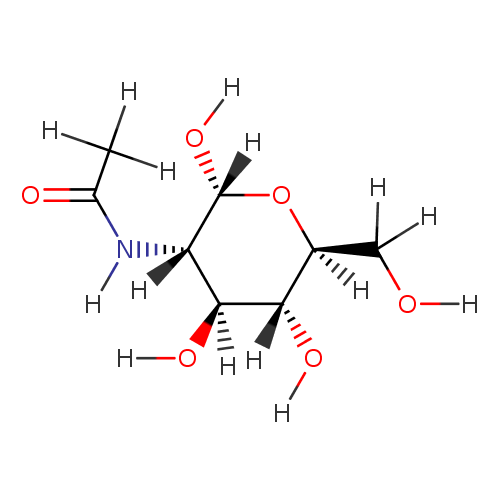
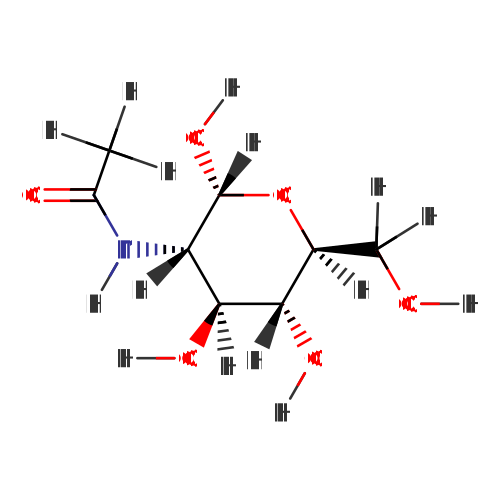
Common NameN-Acetyl-D-glucosamine
DescriptionN-Acetyl-D-glucosamine belongs to the class of chemical entities known as acylaminosugars. These are organic compounds containing a sugar linked to a chain through N-acyl group. N-Acetyl-D-glucosamine is possibly soluble (in water) and an extremely weak basic (essentially neutral) compound (based on its pKa). N-Acetyl-D-glucosamine participates in a number of enzymatic reactions, within cattle. In particular, N-Acetyl-D-glucosamine can be biosynthesized from chitobiose; which is catalyzed by the enzyme Beta-hexosaminidase subunit alpha. In addition, N-Acetyl-D-glucosamine can be converted into N-acetyl-D-glucosamine 6-phosphate; which is mediated by the enzyme N-acetyl-D-glucosamine kinase. In cattle, N-acetyl-D-glucosamine is involved in the metabolic pathway called the amino sugar metabolism pathway.
Structure
Thumb
Synonyms
ValueSource
2-acetamido-2-DeoxyglucoseMeSH
N Acetyl D glucosamineMeSH
2 acetamido 2 DeoxyglucoseMeSH
2-acetamido-2-Deoxy-D-glucoseMeSH
2 acetamido 2 Deoxy D glucoseMeSH
2-(Acetylamino)-2-deoxy-a-L-glucopyranoseGenerator
2-(Acetylamino)-2-deoxy-α-L-glucopyranoseGenerator
Chemical FormulaC8H15NO6
Average Molecular Weight221.2078
Monoisotopic Molecular Weight221.089937217
IUPAC NameN-[(2R,3S,4S,5R,6S)-2,4,5-trihydroxy-6-(hydroxymethyl)oxan-3-yl]acetamide
Traditional NameN-[(2R,3S,4S,5R,6S)-2,4,5-trihydroxy-6-(hydroxymethyl)oxan-3-yl]acetamide
CAS Registry NumberNot Available
SMILES
[H]OC([H])([H])[C@]1([H])O[C@@]([H])(O[H])[C@@]([H])(N([H])C(=O)C([H])([H])[H])[C@]([H])(O[H])[C@@]1([H])O[H]
InChI Identifier
InChI=1S/C8H15NO6/c1-3(11)9-5-7(13)6(12)4(2-10)15-8(5)14/h4-8,10,12-14H,2H2,1H3,(H,9,11)/t4-,5-,6-,7-,8+/m0/s1
InChI KeyOVRNDRQMDRJTHS-DMHSOCPYSA-N
Chemical Taxonomy
Description belongs to the class of organic compounds known as acylaminosugars. These are organic compounds containing a sugar linked to a chain through N-acyl group.
KingdomOrganic compounds
Super ClassOrganic oxygen compounds
ClassOrganooxygen compounds
Sub ClassCarbohydrates and carbohydrate conjugates
Direct ParentAcylaminosugars
Alternative Parents
Substituents
  • Acylaminosugar
  • N-acyl-alpha-hexosamine
  • Hexose monosaccharide
  • Oxane
  • Monosaccharide
  • Acetamide
  • Secondary carboxylic acid amide
  • Secondary alcohol
  • Hemiacetal
  • Carboxamide group
  • Oxacycle
  • Organoheterocyclic compound
  • Polyol
  • Carboxylic acid derivative
  • Organic nitrogen compound
  • Organopnictogen compound
  • Organic oxide
  • Hydrocarbon derivative
  • Primary alcohol
  • Organonitrogen compound
  • Carbonyl group
  • Alcohol
  • Aliphatic heteromonocyclic compound
Molecular FrameworkAliphatic heteromonocyclic compounds
External DescriptorsNot Available
Ontology
StatusDetected and Quantified
Origin
  • Endogenous
  • Exogenous
BiofunctionNot Available
ApplicationNot Available
Cellular locations
  • Cell membrane
  • Cytoplasm
  • Lysosome
  • Membrane
  • Myelin sheath
Physical Properties
StateSolid
Experimental Properties
PropertyValueReference
Melting PointNot AvailableNot Available
Boiling PointNot AvailableNot Available
Water SolubilityNot AvailableNot Available
LogPNot AvailableNot Available
Predicted Properties
PropertyValueSource
logP-2.6ALOGPS
logP-3.2ChemAxon
logS0.06ALOGPS
pKa (Strongest Acidic)11.6ChemAxon
pKa (Strongest Basic)-0.78ChemAxon
Physiological Charge0ChemAxon
Hydrogen Acceptor Count6ChemAxon
Hydrogen Donor Count5ChemAxon
Polar Surface Area119.25 ŲChemAxon
Rotatable Bond Count2ChemAxon
Refractivity47.02 m³·mol⁻¹ChemAxon
Polarizability20.6 ųChemAxon
Number of Rings1ChemAxon
BioavailabilityYesChemAxon
Rule of FiveYesChemAxon
Ghose FilterYesChemAxon
Veber's RuleYesChemAxon
MDDR-like RuleYesChemAxon
Spectra
Spectra
Spectrum TypeDescriptionSplash Key
LC-MS/MSLC-MS/MS Spectrum - Quattro_QQQ 10V, N/A (Annotated)splash10-0f79-0940000000-0d7d2d612ca41562809eView in MoNA
LC-MS/MSLC-MS/MS Spectrum - Quattro_QQQ 25V, N/A (Annotated)splash10-001s-9600000000-3de4e51e2205e3ff671fView in MoNA
LC-MS/MSLC-MS/MS Spectrum - Quattro_QQQ 40V, N/A (Annotated)splash10-001j-9000000000-fcf5ccaeb65b9b59825dView in MoNA
Predicted LC-MS/MSPredicted LC-MS/MS Spectrum - 10V, Positivesplash10-00di-0390000000-ce54c5d356ec2fc8ab9fView in MoNA
Predicted LC-MS/MSPredicted LC-MS/MS Spectrum - 20V, Positivesplash10-0il0-2950000000-e4e02ffea74d8dfd0810View in MoNA
Predicted LC-MS/MSPredicted LC-MS/MS Spectrum - 40V, Positivesplash10-01ox-9400000000-193b1fdde3c57b9db67aView in MoNA
Predicted LC-MS/MSPredicted LC-MS/MS Spectrum - 10V, Negativesplash10-00dr-9830000000-5464ceae5afcba890084View in MoNA
Predicted LC-MS/MSPredicted LC-MS/MS Spectrum - 20V, Negativesplash10-0ac0-9820000000-78cbfc747ed0209c6806View in MoNA
Predicted LC-MS/MSPredicted LC-MS/MS Spectrum - 40V, Negativesplash10-0a4l-9200000000-407cae358947a1ac5567View in MoNA
1D NMR1H NMR Spectrum (1D, 600 MHz, H2O, experimental)Not AvailableView in JSpectraViewer
2D NMR[1H, 1H]-TOCSY 2D NMR Spectrum (experimental)Not AvailableView in JSpectraViewer
2D NMR[1H, 13C]-HSQC NMR Spectrum (2D, 600 MHz, H2O, experimental)Not AvailableView in JSpectraViewer
Biological Properties
Cellular Locations
  • Cell membrane
  • Cytoplasm
  • Lysosome
  • Membrane
  • Myelin sheath
Biospecimen Locations
  • Intestine
  • Liver
  • Milk
  • Neuron
  • Placenta
  • Platelet
  • Prostate Tissue
  • Ruminal Fluid
Pathways
Normal Concentrations
BiospecimenStatusValueAgeSexConditionReferenceDetails
IntestineExpected but not QuantifiedNot QuantifiedNot SpecifiedNot SpecifiedNormal
  • Not Applicable
details
LiverDetected but not QuantifiedNot QuantifiedNot SpecifiedNot Specified
Normal
details
MilkDetected but not QuantifiedNot QuantifiedNot SpecifiedNot Specified
Normal
details
MilkDetected but not QuantifiedNot QuantifiedNot SpecifiedNot Specified
Normal
    • Kurt J. Boudonck,...
details
MilkDetected but not QuantifiedNot QuantifiedNot SpecifiedNot Specified
Normal
    • Kurt J. Boudonck,...
details
MilkDetected and Quantified198.908 (126.578-370.692) uMNot SpecifiedNot Specified
Normal
    • Esperanza Troyano...
details
MilkDetected and Quantified506.311 uMNot SpecifiedNot Specified
Normal
    • Johan E. Hoff. De...
details
MilkDetected and Quantified230.10 +/- 2.26 uMNot SpecifiedNot Specified
Normal
    • Tommaso R.I. Cata...
details
MilkDetected and Quantified238 +/- 90 uMNot SpecifiedNot Specified
Normal
details
MilkDetected and Quantified302 +/- 76 uMNot SpecifiedNot Specified
Normal
details
MilkDetected and Quantified278 +/- 94 uMNot SpecifiedNot Specified
Normal
details
MilkDetected and Quantified351 +/- 34 uMNot SpecifiedNot Specified
Normal
details
NeuronExpected but not QuantifiedNot QuantifiedNot SpecifiedNot SpecifiedNormal
  • Not Applicable
details
PlacentaExpected but not QuantifiedNot QuantifiedNot SpecifiedNot SpecifiedNormal
  • Not Applicable
details
PlateletExpected but not QuantifiedNot QuantifiedNot SpecifiedNot SpecifiedNormal
  • Not Applicable
details
Prostate TissueExpected but not QuantifiedNot QuantifiedNot SpecifiedNot SpecifiedNormal
  • Not Applicable
details
Ruminal FluidDetected and Quantified16 uMAdultBoth
Normal
details
Abnormal Concentrations
Not Available
HMDB IDNot Available
DrugBank IDNot Available
Phenol Explorer Compound IDNot Available
FooDB IDNot Available
KNApSAcK IDNot Available
Chemspider IDNot Available
KEGG Compound IDNot Available
BioCyc IDNot Available
BiGG IDNot Available
Wikipedia LinkNot Available
METLIN IDNot Available
PubChem Compound11861101
PDB IDNGZ
ChEBI IDNot Available
References
Synthesis ReferenceZhang, He; Qi, Shanlong; Yang, Shenggui. Production of N-acetyl-D-glucosamine from chitin. Faming Zhuanli Shenqing Gongkai Shuomingshu (2006), 6pp.
Material Safety Data Sheet (MSDS)Not Available
General References
  1. Melzer N, Wittenburg D, Hartwig S, Jakubowski S, Kesting U, Willmitzer L, Lisec J, Reinsch N, Repsilber D: Investigating associations between milk metabolite profiles and milk traits of Holstein cows. J Dairy Sci. 2013 Mar;96(3):1521-34. doi: 10.3168/jds.2012-5743. [PubMed:23438684 ]
  2. Qian L, Zhao A, Zhang Y, Chen T, Zeisel SH, Jia W, Cai W: Metabolomic Approaches to Explore Chemical Diversity of Human Breast-Milk, Formula Milk and Bovine Milk. Int J Mol Sci. 2016 Dec 17;17(12). pii: ijms17122128. doi: 10.3390/ijms17122128. [PubMed:27999311 ]
  3. Kurt J. Boudonck, Matthew W. Mitchell, Jacob Wulff and John A. Ryals (2009). Kurt J. Boudonck, Matthew W. Mitchell, Jacob Wulff and John A. Ryals. Characterization of the biochemical variability of bovine milk using metabolomics. Metabolomics (2009) 5:375?386. Metabolomics.
  4. A. Foroutan et al. (2019). A. Foroutan et al. The Chemical Composition of Commercial Cow's Milk (in preparation). Journal of Agricultural and Food Chemistry.

Enzymes

General function:
Involved in alpha-tubulin binding
Specific function:
The Golgi complex form catalyzes the production of lactose in the lactating mammary gland and could also be responsible for the synthesis of complex-type N-linked oligosaccharides in many glycoproteins as well as the carbohydrate moieties of glycolipids.
Gene Name:
B4GALT1
Uniprot ID:
P08037
Molecular weight:
44843.0
General function:
Involved in beta-N-acetylglucosaminylglycopeptide beta-
Specific function:
Responsible for the synthesis of complex-type N-linked oligosaccharides in many glycoproteins as well as the carbohydrate moieties of glycolipids.
Gene Name:
B4GALT3
Uniprot ID:
Q5EA87
Molecular weight:
44371.0
General function:
Involved in alpha-1,3-mannosylglycoprotein 2-beta-N-ace
Specific function:
Participates in O-mannosyl glycosylation by catalyzing the addition of N-acetylglucosamine to O-linked mannose on glycoproteins. Catalyzes the synthesis of the GlcNAc(beta1-2)Man(alpha1-)O-Ser/Thr moiety on alpha-dystroglycan and other O-mannosylated proteins, providing the necessary basis for the addition of further carbohydrate moieties. Is specific for alpha linked terminal mannose.
Gene Name:
POMGNT1
Uniprot ID:
Q5EAB6
Molecular weight:
75077.0
General function:
Involved in lysozyme activity
Specific function:
Lysozymes have primarily a bacteriolytic function; those in tissues and body fluids are associated with the monocyte-macrophage system and enhance the activity of immunoagents.
Gene Name:
Not Available
Uniprot ID:
Q6B411
Molecular weight:
16783.0
General function:
Involved in lysozyme activity
Specific function:
Lysozymes have primarily a bacteriolytic function; those in tissues and body fluids are associated with the monocyte-macrophage system and enhance the activity of immunoagents.
Gene Name:
LYZ3
Uniprot ID:
Q06284
Molecular weight:
16317.0
General function:
Involved in lysozyme activity
Specific function:
May be involved sperm-egg plasma membrane adhesion and fusion during fertilization. Exhibits bacteriolytic activity in vitro against Micrococcus luteus and Staphylococcus aureus. Shows weak bacteriolytic activity against Gram-positive bacteria at physiological pH. Bacteriolytic activity is pH-dependent, with a maximum at around pH 5.6 (By similarity).
Gene Name:
LYZL6
Uniprot ID:
Q29RT1
Molecular weight:
16559.0
General function:
Carbohydrate transport and metabolism
Specific function:
Converts endogenous N-acetylglucosamine (GlcNAc), a major component of complex carbohydrates, from lysosomal degradation or nutritional sources into GlcNAc 6-phosphate. Involved in the N-glycolylneuraminic acid (Neu5Gc) degradation pathway. Also has ManNAc kinase activity (By similarity).
Gene Name:
NAGK
Uniprot ID:
Q3SZM9
Molecular weight:
37268.0
General function:
Involved in lysozyme activity
Specific function:
Lysozymes have primarily a bacteriolytic function; those in tissues and body fluids are associated with the monocyte-macrophage system and enhance the activity of immunoagents.
Gene Name:
LYS
Uniprot ID:
P80189
Molecular weight:
16476.0
General function:
Involved in lysozyme activity
Specific function:
Lysozymes have primarily a bacteriolytic function; those in tissues and body fluids are associated with the monocyte-macrophage system and enhance the activity of immunoagents.
Gene Name:
Not Available
Uniprot ID:
Q6B410
Molecular weight:
16391.0
General function:
Involved in N-acetylglucosamine-1-phosphodiester alpha-
Specific function:
Catalyzes the second step in the formation of the mannose 6-phosphate targeting signal on lysosomal enzyme oligosaccharides by removing GlcNAc residues from GlcNAc-alpha-P-mannose moieties, which are formed in the first step. Also hydrolyzes UDP-GlcNAc, a sugar donor for Golgi N-acetylglucosaminyltransferases.
Gene Name:
NAGPA
Uniprot ID:
P68827
Molecular weight:
57223.0
General function:
Involved in lysozyme activity
Specific function:
Lysozymes have primarily a bacteriolytic function; those in tissues and body fluids are associated with the monocyte-macrophage system and enhance the activity of immunoagents.
Gene Name:
LYZ1
Uniprot ID:
Q06285
Molecular weight:
16279.0
General function:
Involved in lysozyme activity
Specific function:
Lysozymes have primarily a bacteriolytic function; those in tissues and body fluids are associated with the monocyte-macrophage system and enhance the activity of immunoagents.
Gene Name:
Not Available
Uniprot ID:
Q27996
Molecular weight:
15929.0
General function:
Involved in lysozyme activity
Specific function:
Lysozymes have primarily a bacteriolytic function; those in tissues and body fluids are associated with the monocyte-macrophage system and enhance the activity of immunoagents.
Gene Name:
LYZ1
Uniprot ID:
P04421
Molecular weight:
16373.0
General function:
Involved in lysozyme activity
Specific function:
Not Available
Gene Name:
LYZL1
Uniprot ID:
A0JNM6
Molecular weight:
16779.0
General function:
Involved in lysozyme activity
Specific function:
Not Available
Gene Name:
SPACA5
Uniprot ID:
Q32PD6
Molecular weight:
17580.0
General function:
Involved in lysozyme activity
Specific function:
Lysozymes have primarily a bacteriolytic function; those in tissues and body fluids are associated with the monocyte-macrophage system and enhance the activity of immunoagents.
Gene Name:
LYZ2
Uniprot ID:
Q06283
Molecular weight:
16304.0
General function:
Carbohydrate transport and metabolism
Specific function:
Lectin that binds to various sugars: mannose = ManNAc > fucose > GlcNAc > glucose = maltose > galactose > lactose > GalNAc. Could play a role in immune defense.
Gene Name:
CL43
Uniprot ID:
P42916
Molecular weight:
33616.0
General function:
Carbohydrate transport and metabolism
Specific function:
Calcium-dependent lectin-like protein which binds to a yeast cell wall extract and immune complexes through the complement component (C3bi). It is capable of binding non-reducing terminal N-acetylglucosamine, mannose, and fucose residues.
Gene Name:
CGN1
Uniprot ID:
P23805
Molecular weight:
37995.0
General function:
Involved in calcium ion binding
Specific function:
Calcium-dependent lectin involved in innate immune defense. Binds mannose, fucose and N-acetylglucosamine on different microorganisms and activates the lectin complement pathway. Binds to late apoptotic cells, as well as to apoptotic blebs and to necrotic cells, but not to early apoptotic cells, facilitating their uptake by macrophages (By similarity).
Gene Name:
MBL
Uniprot ID:
O02659
Molecular weight:
26471.0
General function:
Involved in receptor binding
Specific function:
May function in innate immunity through activation of the lectin complement pathway. Calcium-dependent and GlcNAc-binding lectin (By similarity).
Gene Name:
FCN2
Uniprot ID:
Q5I2E5
Molecular weight:
35339.0
General function:
Involved in lysozyme activity
Specific function:
Sperm surface membrane protein that may be involved in sperm-egg plasma membrane adhesion and fusion during fertilization. It could be a potential receptor for the egg oligosaccharide residue N-acetylglucosamine, which is present in the extracellular matrix over the egg plasma membrane. The processed form has no detectable bacteriolytic activity in vitro (By similarity).
Gene Name:
SPACA3
Uniprot ID:
A6QQ77
Molecular weight:
18099.0